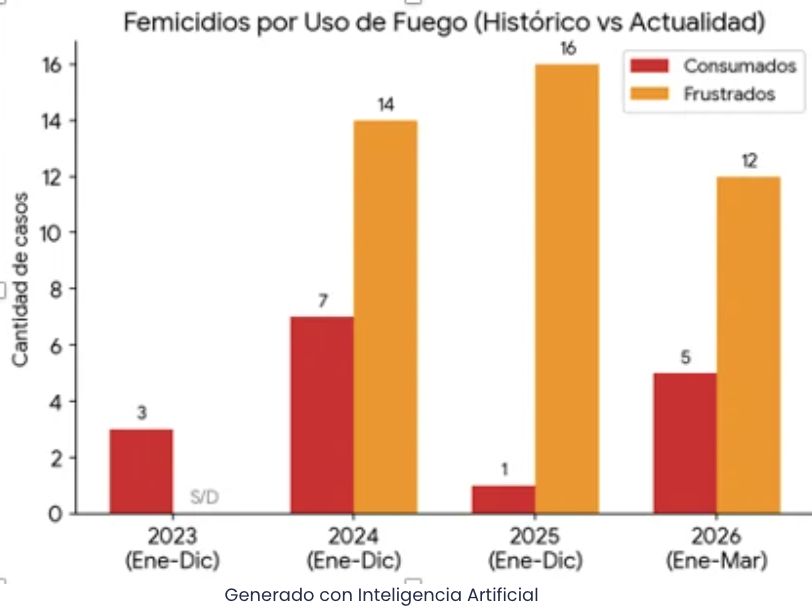
Between January and March 2026, the organization Utopix recorded five completed femicides and 12 attempted femicides in which fire was used as the murder weapon. The flames reveal a desire to inflict extreme pain and cause disfigurement, says anthropologist Aimee Zambrano.
Vanessa Davies
The flames of jealousy, which seem to consume any capacity for reason, often precede the flames that destroy real women in one of the cruelest expressions of gender-based violence. One such case occurred last May in Guayaquil, Ecuador. Vanessa Andreína, a 42-year-old Venezuelan woman, died two days after her partner doused her with gasoline and set her on fire. Vanessa was unable to survive the third-degree burns that covered 70 percent of her body. (Third-degree burns cause severe damage to all layers of the skin.) The alleged attacker, Ecuadorian national Jim Plúas, also died after being caught in the flames he himself started, according to Ecuador’s Extra newspaper. Another woman, according to press reports, was fighting for her life after likewise becoming the target of Plúas’ rage.
Vanessa Andreína’s tragedy is not an isolated incident. Utopix has dedicated itself to documenting and publicizing statistics on sexist violence against Venezuelan women both in Venezuela and abroad. Aimee Zambrano, the organization’s founder and director, explains that during the first three months of 2026, “there has been an increase in the use of fire that we had not seen in previous years.” In her view, this should serve as a wake-up call for both authorities and society as a whole.
Fire as a murder weapon
Before 2026, Zambrano notes, fire was used primarily in attempted femicides. Evidence of this can be seen in 2024, which ended—with figures compiled by Utopix—with 14 attempted femicides in which the aggressor resorted to flames. Between January and March 2026, however, five completed femicides and 12 attempted femicides involved fire as the murder weapon.
“In a single quarter of 2026, we are seeing the same number of femicides involving fire that occurred during all of 2024, which was considered the year in which we recorded the highest number of these cases,” she warns.
In addition to being the driving force and inspiration behind Utopix, Zambrano is an anthropologist, which allows her to offer a deeper interpretation of what lies behind the flames in the hands of these men:
“There is a need to inflict tremendous pain. It reflects an extreme level of cruelty toward the bodies of these women. We might even think that some do not necessarily want to kill them but rather to leave marks on their skin, to disfigure them.”
She also links this phenomenon to the historical use of fire against women accused of witchcraft, the hostility of the Inquisition, and the persecution of women who failed to conform to the roles society expected of them.
“Those ‘witches’ ended up burned at the stake,” she recalls.
It was a punishment imposed on women who stepped outside the boundaries set for them.
Fire has also been used to brand animals to reinforce ownership. Enslaved people were marked with fire as well—another sign meant to erase individuality. Flames have long been part of the repertoire of torture.
“The use of fire in femicide is connected to leaving a mark on women’s bodies. It reflects objectification: the victim is viewed as an object that belongs to the aggressor. He is marking her to assert that she is his property.”
Other countries have also debated this issue.
“There was a discussion about this in Argentina as well because a rock band drummer murdered his wife in that way. When the case went viral, these attacks supposedly increased. Then, after Milei became president, three cases of lesbicide were recorded: three lesbian women were killed in this manner when someone set fire to the room where they lived.”
The crime was reported in May 2024 in Buenos Aires. According to press reports, a man who had previously criticized the women because of their sexual orientation threw a Molotov cocktail into the hotel room where four women were sleeping. Three of them—Andrea, Roxana, and Pamela—died.
Young men who once loved
Men from another world do not commit femicides in Venezuela.
“We are talking about men between 16 and 45 years old, for the most part. In other words, they are young men,” Zambrano explains.
Most cases involve intimate-partner femicide, carried out by current or former partners or by someone close to the victims.
Firearms rank as the most commonly used weapon, followed by knives, beatings, and mechanical asphyxiation.
“In most cases, firearms are used, even though the perpetrators are not members of state security forces. In a country that implemented a disarmament plan and passed a disarmament law, where carrying firearms remains prohibited, this is striking. These are men who still have access to weapons, even though they do not use them in their jobs and despite all these measures,” the researcher notes.
The analysis reveals some variations from year to year.
“We observed a change in 2024, when most femicides were committed with bladed weapons. We know that femicide is an intimate crime, usually committed by a current or former partner, and it often involves the use of hands—through beatings or mechanical asphyxiation—or the use of knives.”
Another characteristic of femicide in Venezuela, according to Utopix’s findings, is that between seven and ten out of every 100 femicide perpetrators take their own lives afterward.
That was not the case with Jim Plúas, Vanessa Andreína’s killer, who was reportedly caught in the flames during the attack.