Audio : https://clyp.it/4fqav54m
Julio A. López, Editor-in-Chief — The expansion of ExxonMobil and Occidental Petroleum (OXY) into the ultra-deepwater Ultra Deep 1 block, located offshore from Trinidad and Tobago and geologically connected to the prolific Guyana-Suriname Basin, is not merely another Caribbean oil project. For Venezuela, this move could become one of the most significant energy and geopolitical developments of the coming decades.
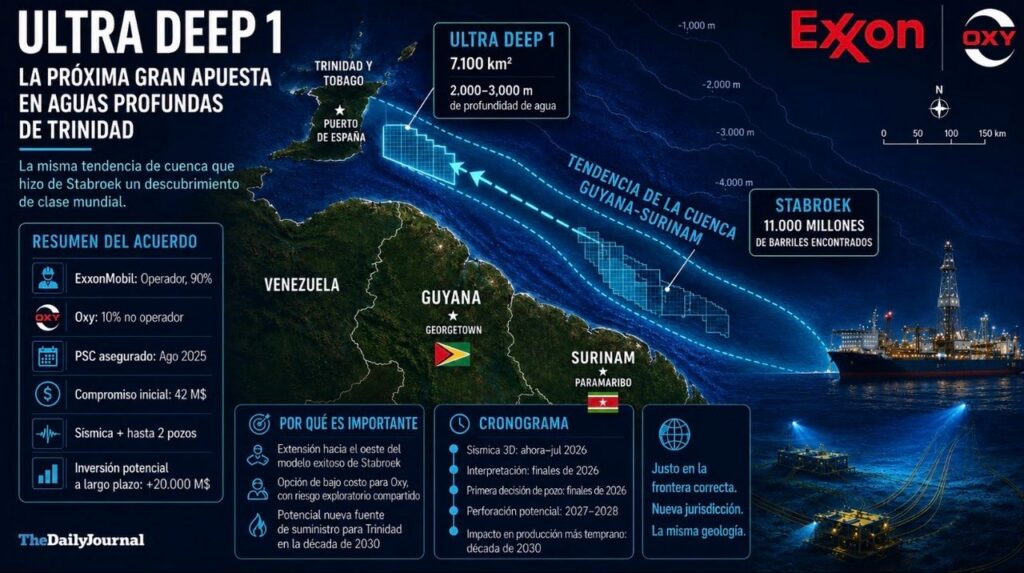
The area awarded to Exxon covers approximately 7,100 square kilometers in waters between 2,000 and 3,000 meters deep, along an underwater corridor that geologists consider a natural extension of the same structure that enabled Exxon to discover more than 11 billion recoverable barrels in Guyana.
Now, the interest of the international energy industry is beginning to shift northward within that basin, moving increasingly close to the Gulf of Paria and Venezuela’s offshore areas, historically regarded among the most promising in the Western Hemisphere.
The strategic importance for Venezuela is enormous. The Gulf of Paria and marine areas near the Orinoco Delta contain massive natural gas and heavy oil reserves that, for years, major oil companies viewed as one of the Caribbean’s last major energy frontiers. However, sanctions, political conflicts, legal uncertainty, and regulatory delays slowed or halted many of these projects. Meanwhile, Trinidad and Guyana have advanced at an accelerated pace.
The paradox is clear: ExxonMobil is using offshore Trinidad the exact same geological and operational model that transformed Guyana. Seismic studies and technical analyses conducted by international firms such as TGS indicate that the ultra-deep structures offshore Trinidad may contain petroleum systems comparable to those found in the Stabroek block.
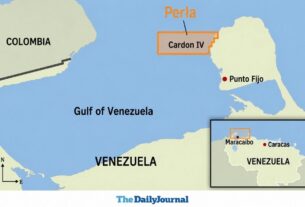
And once again, Venezuela enters the picture. Much of the explored area lies relatively close to Venezuelan maritime zones historically associated with gas development in the Gulf of Paria. In fact, Reuters revealed that Caracas has already formally requested technical information from Trinidad regarding Exxon’s seismic testing and activities, due to concerns that potential reservoirs may extend into Venezuelan territory.
Venezuela’s concern is not coincidental. For decades, the Gulf of Paria was considered by Petróleos de Venezuela (PDVSA) and international companies as one of the continent’s most promising gas-producing regions. Projects such as Dragon, Cocuina-Manakin, and other offshore developments aimed to transform eastern Venezuela into a massive liquefied natural gas (LNG) export hub supplying the Caribbean, Europe, and North America.
However, political delays and international sanctions allowed Trinidad to capitalize on much of the existing regional infrastructure and consolidate itself as the Caribbean’s energy hub.
Now Exxon could take that dynamic to another level. The Ultra Deep 1 project initially includes 3D seismic studies, the drilling of up to two exploratory wells, and an initial investment of approximately $42 million. But if a petroleum province similar to Guyana’s is confirmed, the total investment could exceed $20 billion.
The project timeline reflects the pace of development. Seismic acquisition is expected to conclude in July 2026; geological interpretation will finish by the end of the year, and the first deepwater drilling operations could begin between 2027 and 2028.
For Venezuela, the scenario opens two completely opposing possibilities. The first: becoming isolated while Guyana and Trinidad capture investment, infrastructure, and operational control of the new Atlantic-Caribbean energy axis.
The second: leveraging renewed international interest to finally integrate the Gulf of Paria into a regional energy export system alongside Trinidad, Guyana, and Suriname, using Venezuela’s vast reserves as a natural complement to regional growth.
From geological, commercial, and logistical perspectives, such integration would make sense. Eastern Venezuela possesses giant reserves, geographic proximity, historical experience, and skilled human capital. But in today’s energy world, international capital demands political stability, clear rules, and legal certainty.
Exxon is already betting billions of dollars that the energy future of the southeastern Caribbean will look more like Guyana than Venezuela’s old oil model. And that may be the most important signal emerging from the Ultra Deep 1 project.