The Daily Journal.- The territorial dispute over the Essequibo region saw a new exchange of official positions on May 26, coinciding with the 60th anniversary of Guyana’s independence from the United Kingdom.
While Guyanese President Irfaan Ali reaffirmed his country’s sovereignty over the disputed area from a highly symbolic location, Venezuela’s Foreign Ministry issued an official message of congratulations, calling for dialogue and invoking the 1966 Geneva Agreement as the only valid mechanism to resolve the controversy.
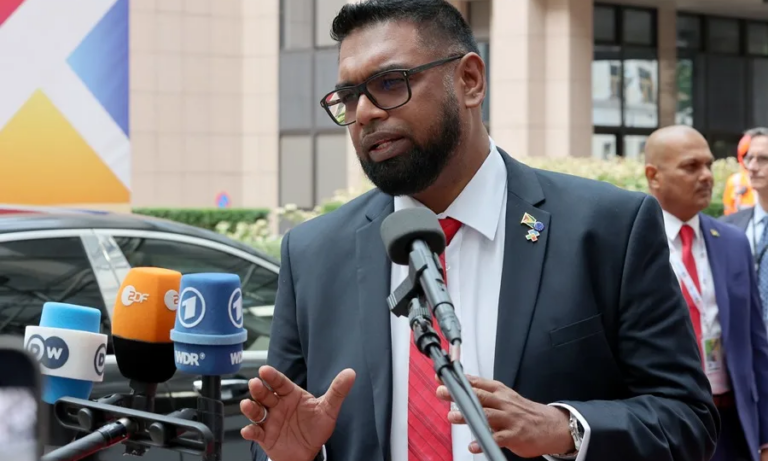
According to a report by the EFE news agency, President Irfaan Ali delivered his official speech during the flag-raising ceremony at Fort Island, a location situated precisely in the Essequibo region—territory that makes up two-thirds of the land administered by Georgetown and which Caracas claims as its own based on historical rights.
Georgetown defends the 1899 Arbitral Award and criticizes Caracas
During his address, the president and commander-in-chief of the Guyanese Armed Forces rejected arguments recently made by the Venezuelan government before international courts, stating that the defense of its current borders will continue strictly through legal channels.
“The Essequibo belongs to Guyana. It has never been Venezuelan. Nor Spanish,” Ali declared firmly, referring to the 1899 Paris Arbitral Award as the undisputed legal and historical basis of his country’s position.
The Guyanese leader also used the occasion to sharply criticize recent statements by
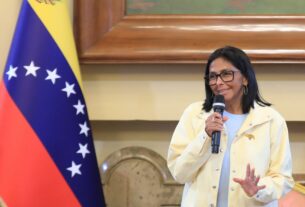
Venezuela’s acting president Delcy Rodríguez, who described the case brought by
Georgetown before the International Court of Justice (ICJ) as an “anti-legal absurdity.”
“This is not the language of a neighbor. This is not the language of international law. This is not the language of peace,” Ali stated.
However, he clarified that the defense of territorial integrity will be pursued through courts and diplomacy, “never through war.”
Venezuela invokes the anti-colonial spirit of the Geneva Agreement
Meanwhile, Venezuela’s Foreign Minister Yván Gil released an official statement via digital channels extending the Bolivarian government’s congratulations to the neighboring country on the end of British rule, linking the historical event to the origin of the territorial claim.
“The Bolivarian Government expresses its sincere congratulations to the people of Guyana on the anniversary of their independence, achieved on May 26, 1966. This significant event marked the end of more than 150 years of British colonialism and its impositions, which affected the life of the Guyanese people as well as relations between Guyana and its neighbors,” the statement reads.
Venezuelan diplomacy recalled that one of the first acts of independent Guyana in 1966 was to sign the Geneva Agreement together with Venezuelan authorities, a document which, according to Venezuela, invalidates the 1899 Arbitral Award invoked by Georgetown.
“More than a commitment between nations, the Geneva Agreement became one of the most important instruments to reaffirm the anti-colonial position of our peoples. Today, Venezuela continues seeking a fair and direct solution to the Essequibo dispute, a consequence of British colonialism, from which Guyana today celebrates its independence,” Gil concluded.
The dispute remains under international scrutiny after oral hearings were held this month at the International Court of Justice in The Hague. Guyana seeks a ruling validating the
19th-century arbitral award—declared null by Caracas in 1962—while Venezuela reaffirms its rejection of the Court’s jurisdiction to resolve the conflict over this region rich in natural resources and oil deposits.
With information from EFE.