By Jimmy Seba, Founder and CEO, Global Key Inc.
Audio: https://clyp.it/5yici2ca
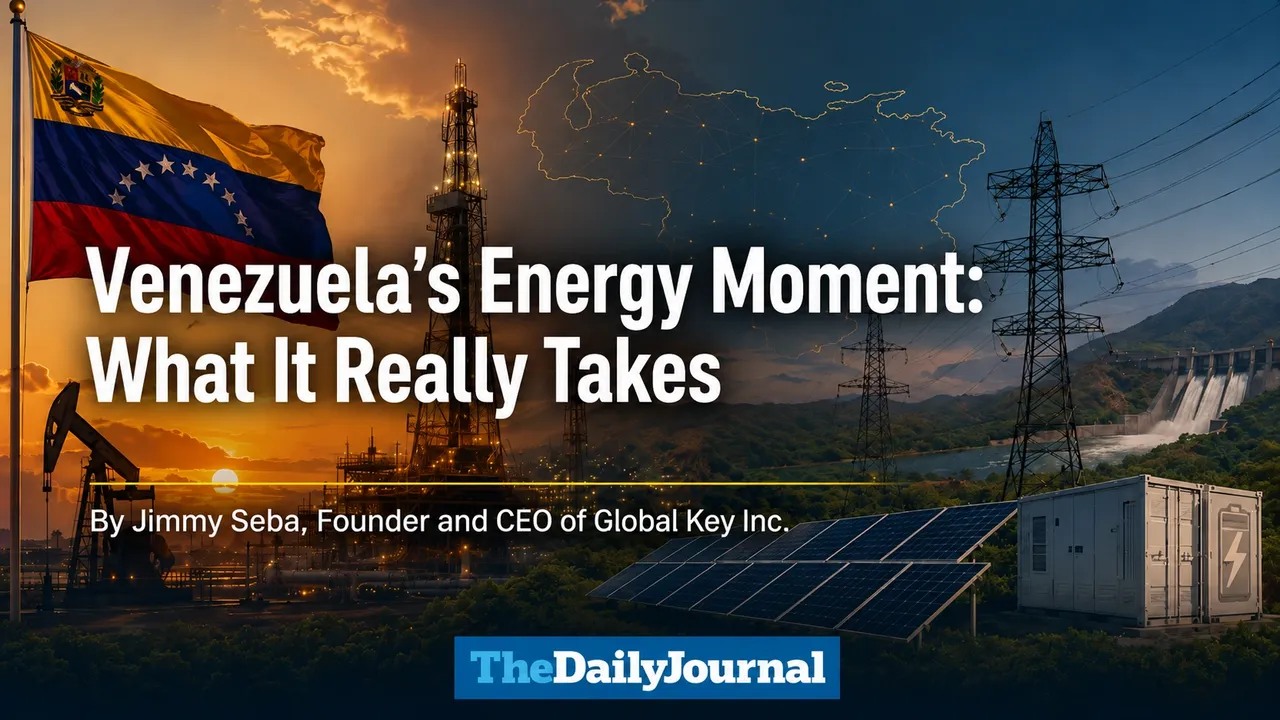
The Daily Journal – I have maintained direct relationships in Venezuela and across the US-LATAM corridor throughout the period when most of the world looked away. What I see today is not a new story. It is the result of twenty years of conditions converging at once.
Venezuela holds 303 billion barrels of proven oil reserves — the largest of any country on earth, 17 percent of the global total. It currently produces approximately 1 million barrels per day, ranking 21st globally. At its peak in 1970, it produced over 3.7 million barrels per day. Beyond oil: strategic minerals, natural gas, a geographic position that makes Venezuela a natural energy anchor for the Caribbean and Latin America, and 9.2 million Venezuelans in the diaspora — engineers and professionals who represent one of the most underestimated assets in any serious recovery strategy.
The real opportunity is not only in the wells. It is in the ecosystem around them — services, equipment, logistics, supply chain, and energy infrastructure.
Venezuela’s grid is in crisis. On May 7, 2026, the country hit a record electricity demand of 15,579 megawatts — and the grid could not meet it. Hydroelectric output has dropped 40 percent since 2020. Thermoelectric plants run at 15 percent of capacity. Zulia state, the heart of Venezuela’s oil production, suffers the worst outages. The energy infrastructure problem is not separate from the oil recovery. It is a prerequisite for it.
The path forward is not to wait for centralized infrastructure. The procurement reality makes that impossible. Large-frame gas turbines have confirmed lead times of five to seven years — some manufacturers are already booking 2030 delivery slots.
Aeroderivative and refurbished units move faster when available, but not at the scale Venezuela requires. Large power transformers average 128 weeks per Wood Mackenzie’s 2025 survey — generator step-up units run 144 weeks, some extending to four years. Large industrial generators exceed two years. Venezuela cannot build its energy recovery around a procurement timeline that stretches a decade. Industries cannot wait. Communities cannot wait. Oil production in Zulia cannot wait.
Decentralized energy is not an alternative. It is the only answer that matches Venezuela’s actual timeline. Solar PV can be deployed in weeks to months. Battery storage provides reliability without grid dependence. Micro-hydro where Venezuela’s river resources allow. Hybrid systems combining solar, storage, and backup generation for continuous industrial-grade power. Each solution is selected on a case-by-case basis — based on geography, resources, load requirements, and timeline. Not ideology. Engineering.
I know what procurement realities look like from the inside. Four decades of building supply chains across this corridor — going direct to source, eliminating layers, understanding real lead times — make the deployment advantage of decentralized solutions concrete, not theoretical. Available now, at scale, timelines in months, not years.
The regulatory framework has moved further in recent months than it did in the previous ten years. The Hydrocarbons Law reform of January 2026 and the OFAC General Licenses issued through February represent the most significant opening in Venezuela’s energy sector in decades. These are real signals. They are not sufficient on their own.
Twenty years of survival under extraordinary pressure created workarounds that became the operating standard. That does not disappear because the legal framework changed. This is not a judgment — it is what happens to every institution under sustained stress. The engineers who kept this industry alive through two decades of collapse are not the problem. The environment in which they operated is. Recognizing that honesty is the first step to navigating it successfully.
I have walked into broken operations across multiple industries and markets for four decades. The pattern is consistent — capital that arrives without understanding the operational reality rarely survives contact with it. Venezuela is not different. The deals that define this recovery are being shaped now by who is present, building relationships before the market becomes obvious.
Venezuela’s potential is not to return to being an oil exporter. It is to become an energy power — for its own people first, then for the region. Communities and industries with reliable electricity. Venezuelan engineers and diaspora are leading a recovery they never stopped understanding.
That future is achievable. Not inevitable. Its potential and reality have always been separated not by geology but by execution.
The resource has always been there. In the ground and in the people. The conditions are being built. The question is who will be positioned when they are.