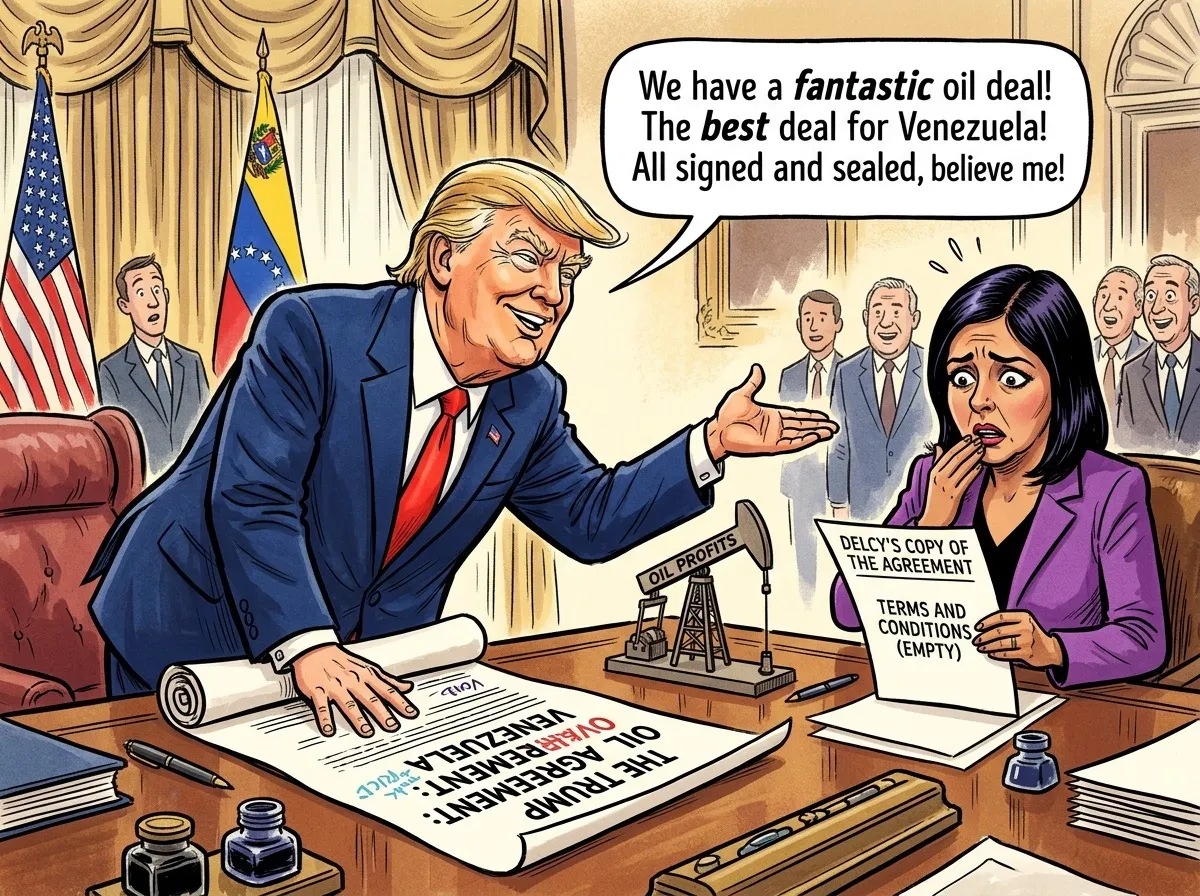
The Daily Journal – A recent investigation by U.S. news outlet ProPublica has revealed critical details about a new energy agreement in the region. The oil deal promoted by U.S. President Donald Trump with Venezuela protects the interests of private businesspeople. Still, it does not explicitly require the payment of $209 billion in taxes and royalties that the White House has announced as benefits for the South American country.
This finding raises serious questions about the agreement’s actual economic impact on the Caribbean nation.
Details of the agreement and government participation
In this regard, the news outlet examined a copy of the 18-page agreement signed by Secretary of State Marco Rubio and Secretary of Defense Pete Hegseth. According to the document, the U.S. government receives a 35% stake in the parent company of North American Blue Energy Partners (NABEP), an entity controlled by Venezuelan businessman Alejandro Betancourt.
The agreement also allows the United States to purchase 20% of NABEP’s production at $30 per barrel and grants Washington priority rights to acquire the remaining crude oil for 50 years.
However, this price does not include the cost of lighter materials that operators must blend with some of Venezuela’s heavy crude oil to facilitate transportation. This operational detail could conceal additional costs that would affect the venture’s actual profitability.
Long-term legal protections
The agreement’s structure aims to withstand political changes. According to ProPublica, its provisions make it difficult for future governments to modify or terminate the deal, revealing highly unfavorable terms.
The agreement also specifies that Betancourt will retain his position as chief executive officer and that removing him will require the votes of five of the seven board members.
Furthermore, the parent company maintains its registration in Barbados, where local legislation makes it difficult to identify certain owners and investors, raising concerns about transparency gaps that could harm Venezuela’s interests in exploiting its natural resources.
Additionally, the agreement does not require Venezuelan government representatives to sit on the board of directors. It also stipulates that a federal court in Texas will settle disputes between the company and the United States under U.S. law.
This foreign jurisdiction clause also appears to significantly restrict Caracas’s ability to intervene in commercial or legal disputes.
The $209 billion promise lacks contractual guarantees
Despite the official narrative promoting economic recovery, the document contains no binding provision guaranteeing the $209 billion in taxes and royalties that the White House announced and the Miraflores government endorsed.
Previous reports indicated that Venezuela’s interim authorities granted NABEP 100-year concessions covering 17 oil fields containing approximately 65 billion barrels of crude oil.
However, the agreement lacks oversight mechanisms and payment guarantees, reducing those figures to projections without legal enforceability and leaving the Venezuelan state without contractual tools to demand those revenues.
Reactions and concerns over energy sovereignty
Within Venezuela, political groups and labor organizations have rejected what they consider a disproportionate transfer of strategic assets. The Communist Party of Venezuela, for example, has already opposed agreements that prioritize foreign investment without clear benefits for the population.
Meanwhile, Washington seeks to attract capital and secure its dominance in the energy sector. However, the contractual terms reveal a scenario in which Venezuela bears the risks and faces a lack of transparency. Meanwhile, private partners and the U.S. government enjoy legal protections and operational control.
In conclusion, although officials portray the agreement as a driver of economic recovery, documentary evidence suggests that Venezuela may never receive the billions of dollars in promised revenues. The arrangement could establish a legal framework that prioritizes U.S. energy supply security over the South American nation’s sovereignty and economic well-being.
With information from ProPublica and EFE