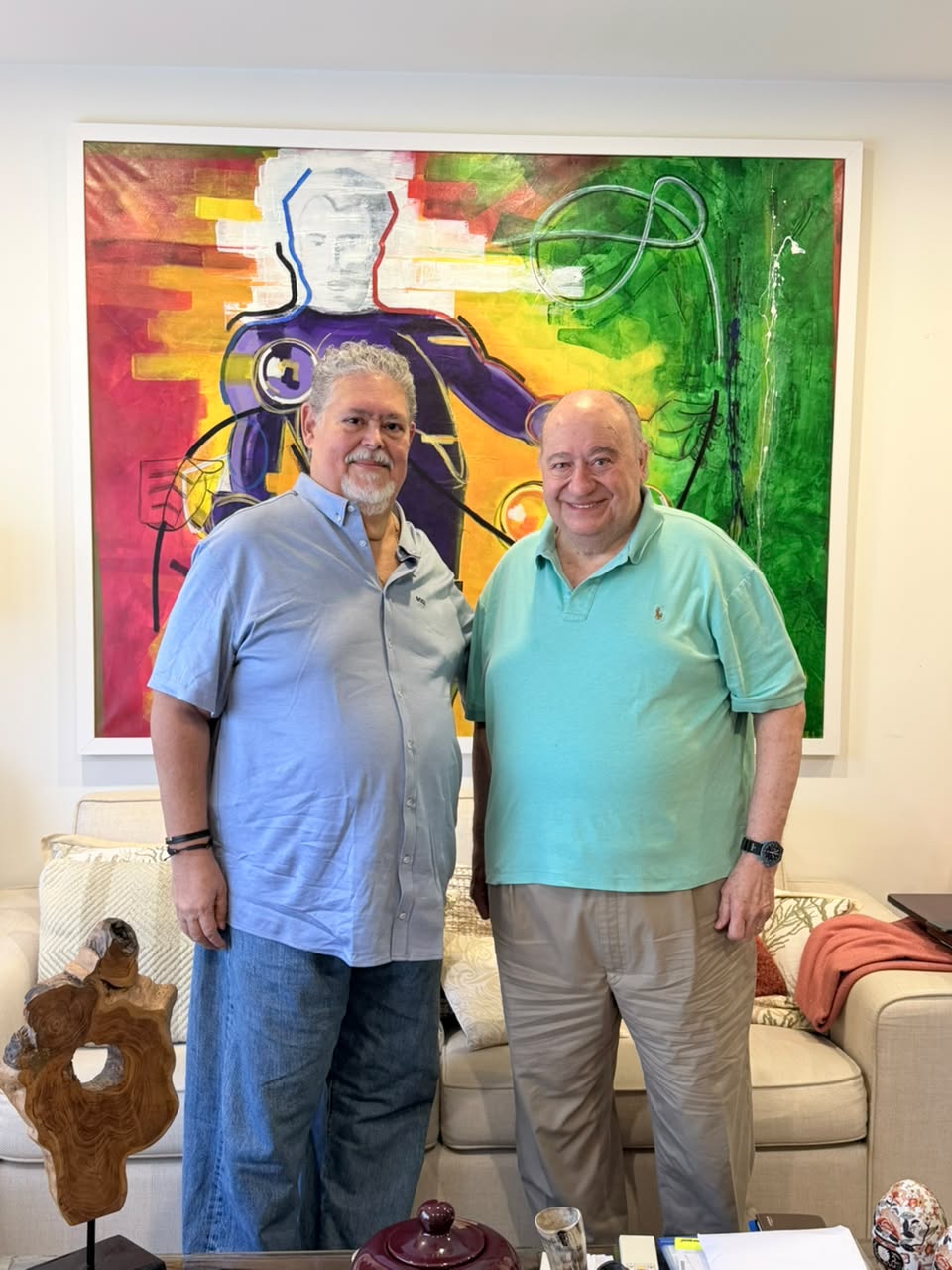
Dr. Juan Barreto.— I must warn the dear reader that I am not given to dispensing easy praise. Rather, I always seek to put myself in an uncomfortable position, but this time I want to share a pleasant impression from a kind surprise life has just given me. Around midday, I arrived at a modest neighborhood in Madrid, where a man with a kind gaze, an honest voice, and great warmth was waiting for me. The black coffee served in a handcrafted cup was not missing. He lives in a modest apartment that is carefully maintained and tastefully arranged.
I am not going to speak about what he thinks; all of that is already known through the media and social networks, nor am I going to speak about our differences. I intend to convey another dimension of judgment. I refer to depth, refinement, consistency, calibration, and fine-tuning. But, after all this, what—or who—am I talking about?
I had the opportunity to converse with Humberto Calderón Berti. I did not go to see the oil expert, nor the politician. I went in search of the human being, and I found a blend of serene wisdom that experience provides when it transforms itself into the humility that “understanding” brings.
Listening to him is like building a second layer of perspective. It is like achieving the precise “focus.” When he speaks, experience distills itself like the aroma of the Trujillo coffee he offers me, and it does so with the bluntness that frankness affords and with the true humility of one who knows what he is saying, with no other intention than to settle accounts with truth and with the times.
He is a journey through contemporary history. He has always been there. He is both witness and protagonist of this era. He tells the story, and we understand. His clear eyes shine, and youth remains there; and youth is nothing more than a state of mind that ages with time. “To know how to grow old is the greatest of virtues, and to achieve it with dignity is the art of living,” as Arthur Schopenhauer put it when he spoke of lives that are history in themselves and deserve commentary. “Life as a work of art,” for Theodor Adorno, which is only possible from the free gaze of one who has climbed the slope and stands at the summit looking at time. The difficult thing is to achieve that simultaneous gaze, that of someone who looks forward and backward at the same time.
I was afraid of growing a little older—because I am already old—but meeting Humberto gives me the certainty that I can and want to grow old while becoming a better person and, perhaps, with effort, a little wiser as well. To make knowledge and reflection a welcoming home from which to resist. Humberto combines sharp humor and reflection without disqualifying anyone, constructing the event and describing the characters without detaching himself from reality. From his stoic exile in Madrid, he has made “an honorable pact with solitude” (G. Márquez). He meets with his friends through various chat groups, advises others, and writes. It is a solitude that remains accompanied, lucid, and active.
Suddenly, he comments:
“I saw them arrive there, at Monómeros, presumptuous, ignorant, giving orders, demanding contracts, wearing brand-name clothes as armor, thousands of dollars walking around in search of a deal.”
Well-dressed chicken thieves who never understood that politics is the exercise of ethics as a way of life.
Each of Humberto’s phrases is an archaeology of the present. He does not complain, nor does he boast of anything. Yet his voice is a journey through layers and sequences, through events, reflections, characters, anecdotes, and figures. Lucidity is his hallmark. Fortunately, there are many others like him.
Unfortunately, politics today is practiced through idolatry. Listening to someone who has already lived through everything and has no ambition other than serving others is a balm.
I was surprised by his love for life, family, homeland, and sovereignty. He remains committed to the simple people of his native Trujillo, with whom he never loses contact. He is concerned, but calm. His principal concern is the way sovereignty is negotiated. At that point, I felt that we were among friends and that life had given me a new friend.
The homeland unites. I, who every day make a point of being a skeptic, confess that I concluded: there are still righteous people who can accompany Lot in building hope.
Humberto remains in Madrid; I return. But between us there remains an invisible thread. I do not know whether it is an unwritten pact, but in any case, I feel less alone. I can continue embracing our homeland, betting on integrity and dignity.