Américo Briceño Dos Santos, Political Scientist and University Professor — Most people conveniently understand peace as the absence of war or a period without conflict. However, Costa Rican politician Oscar Arias defines it differently: “Peace is a process, an attitude, a behavior, a way of life. It is not the absence of conflict, but the ability to resolve conflict through peaceful means.”
For the last twenty-five years, Venezuela has faced a series of political, economic, and social conflicts that have kept it far from any classification as a nation at peace. Although multiple initiatives have attempted to resolve these conflicts, the interests of different groups have prevailed, even to the point of denying the other’s existence.
We cannot move forward without revisiting the useful distinction proposed by political scientist Johan Galtung (1996), who differentiates between negative peace—“the kind imposed through the force of bayonets and the silence of cemeteries”—and positive peace, “which can only take root where social justice, institutional legitimacy, and unrestricted respect for popular sovereignty exist.”
When a nation’s political and socioeconomic conflicts abandon institutional mechanisms for settling disputes and escalate into violence and repression, society moves from uncertainty to fear. The use of such methods places us outside the realm of peace and prepares citizens for a prolonged conflict against authority and against one another.
July 28 marked a turning point in our country’s institutional history. An electoral outcome failed to reflect the aspirations of broad political sectors, while vote totals could not withstand basic mathematical scrutiny. Those who sought to uphold the legitimacy of those results ultimately resembled a Françoise Paviot napkin: a sophisticated and expensive object, yet ridiculously fragile and useless for wiping away the remnants of misery still visible on the lips of political actors.
And what led anyone to believe they could disregard the popular will without endangering the country and disrupting the Republic?
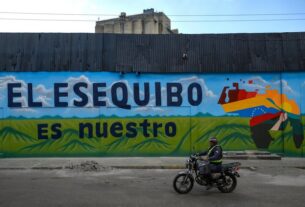
For more than twenty years, the government built a narrative around the threat of imperialism and its lackeys—the petit yankees—and constructed an identity-based discourse supposedly rooted in the principal contradiction between imperialism and the nation.
After all this time, and in light of current events, we may come to view this notion of the “principal contradiction” as a kind of incantation: a rhetorical device that invokes the threat of an external enemy to justify the usurpation of popular sovereignty.
Yes, on July 28, 2024, authorities chose to usurp that sovereignty under the banner of anti-imperialism. To accomplish that goal, they had to repress systematically the very people who once defended sovereignty against earlier historical aggressions.
What purpose did it serve to harass, imprison, and pressure Venezuelans into abandoning the defense of their electoral decision, only for the country to end up humiliated, shelled, burdened with deaths, and surrendering both sovereignty and resources?
The events of March 3 emerged from a Chavista leadership confident in its ability to negotiate and manage conflict with the United States. Government officials made an exceedingly narrow calculation and dismissed the possibility of a military operation targeting both the nation’s territory and the head of state.
The truth is that, while some argue that the strategy of this “new political moment” reflects a form of “Chavista pragmatism” aimed at preserving peace, democratic coexistence, and national reconciliation—and that it manifests itself as strategic resistance or resilience—these concepts ultimately function as euphemisms. Through such formulations, political leaders seek to present an accepted relationship of subordination to their supporters as though it were heroic resistance, tactical audacity, or an uncompromising defense of constitutional peace.
Today, the entity that, until recently, represented a threat to the nation’s survival has become a “strategic partner”—another euphemism that conceals a state of obedience and tutelage over every aspect of the country’s political and economic life. In this context, sovereignty appears to have become a legal inconvenience that the nation can no longer afford.
Popular sovereignty constitutes the final shield against external aggression. A government that enjoys the support of its people stands on solid ground and becomes far more difficult to attack. Once that shield disappears; once public support for those in power declines; once rejection of the head of state grows; and once the moment arrives for his capture—or extraction—the social fabric, in its collective imagination, replaces the idea of sovereignty with the darker notion of an “absolute resolution.”
In conclusion, the problem never lay with the nation or with imperialism. The real objective was always to remain in power for power’s own sake, dissolving political identity, blurring fundamental concepts, and distorting political institutions. The ruling movement could have managed its electoral defeat more responsibly and perhaps avoided the fateful events of March 3. Ultimately, the price of sustaining a false idea of peace has been the loss of the Republic itself and the surrender of the homeland.