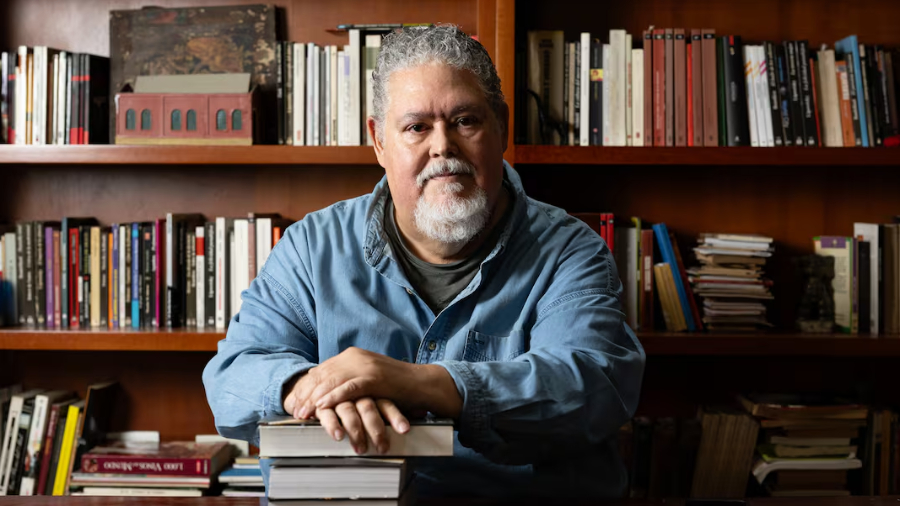
The Daily Journal — Former Caracas mayor Juan Barreto argued that Venezuela is experiencing a loss of political sovereignty due to what he described as a “catastrophic stalemate” between competing political forces. He drew on a concept developed by the Italian Marxist theorist Antonio Gramsci, in which no bloc prevails, and the confrontation ultimately triggers a broader crisis of the state.
Speaking during an interview with writer and geopolitical analyst Daniel Estulin, Barreto said the prolonged Venezuelan political conflict created a scenario in which “all legitimacy is lost, and the struggle for hegemony ends up pulverizing both sides.”
“What Gramsci calls a catastrophic stalemate emerged in Venezuela—a clash between forces where neither side can prevail, yet together they create a general crisis of the state,” he said.
According to the university professor, when this kind of stalemate cannot be resolved through consensus, one side eventually imposes itself through force.
“One force eventually prevails over the other not through consensus or legitimacy, but through crushing it. That is what he called the peace of the graveyards,” he said.
The political analyst linked this scenario to the crisis that followed the July 28, 2024 presidential election and the inauguration of Nicolás Maduro in January 2025. In his view, that process fractured institutional legitimacy.
“One side claims legitimacy through electoral records and an election it has never been allowed to fully demonstrate, while the other claims legitimacy by imposing itself through facts on the ground,” he said.
“Venezuela lost popular sovereignty”
Barreto argued that the main consequence of this confrontation was the loss of the principle of popular sovereignty, which he considers the foundation of the state’s legitimacy.
“Popular sovereignty—the source of all power, the constituent power from which the entire chain of legitimacy flows—has been dismantled,” he said.
He went on to argue that the country entered a stage in which “sovereignty no longer resides in the people but has been transferred through usurpation to a different sphere,” adding that political power now rests “not on consensus, but on the use of force and terror.”
The former mayor also contended that the intervention of a foreign actor altered Venezuela’s internal political balance.
“The foreign sentinel intervened to break the catastrophic stalemate, but not in favor of either side, because both forces had already been defeated,” he said.
In his view, that dynamic left Venezuela’s principal political actors subordinate to external forces.
“At this moment, the two main forces of Venezuela’s political polarization have become subordinate to the foreign sentinel. Neither side can act independently anymore because both now operate under external tutelage,” he said.
Barreto argued that Venezuela no longer functions as a traditionally sovereign state.
“It is an administered territory, and that is how it is treated. The foreign sentinel deals with those who administer Venezuela as one would deal with a faction that controls a territory,” he said.
From chavismo to “decaffeinated madurismo”
During the interview, Barreto also reflected on the evolution of Chavismo following Hugo Chávez’s death, describing Madurismo as a bureaucratic and authoritarian transformation of Chávez’s original political project.
“Chávez ended up creating around himself an amalgam of interests, forces, and centers of power—some visible, others hidden. Once he disappeared as a political figure, those groups emerged, took control of the state apparatus and the model Chávez had built, and used it for different purposes,” he said.
The former mayor described Madurismo as “the bureaucratic, authoritarian, deeply corrupt, and inefficient stage,” while arguing that it preserved elements of Chavismo’s original rhetoric.
“Madurismo brought about Chavismo without Chávez, amplifying the worst tendencies that already existed within Chavismo,” he said.
Barreto also argued that the current model combines what he sees as contradictory elements.
“Madurismo has managed to condense the worst aspects of capitalism and the worst aspects of the authoritarian left: a police state, institutions, and power concentrated around a single party,” he said.
Discussing the government’s current political orientation, Barreto described what he called a new phase—“decaffeinated Madurismo”—as more technical and less ideological in its public discourse.
“It presents itself as non-ideological, yet nothing is more ideological than technical discourse. Technical discourse has always served as a cover, a mask for the neoliberal right,” he said.
According to Barreto, this new phase has developed a more direct relationship with international economic interests.
“They speak about power through business and through relationships with international capital,” he said.
Barreto concluded by arguing that external factors, rather than domestic legitimacy, now sustain the current political order.
“If you lack the legitimacy to remain in power and you lack the narrative needed to achieve hegemony, then the only thing that sustains you is the support of the foreign sentinel,” he concluded.