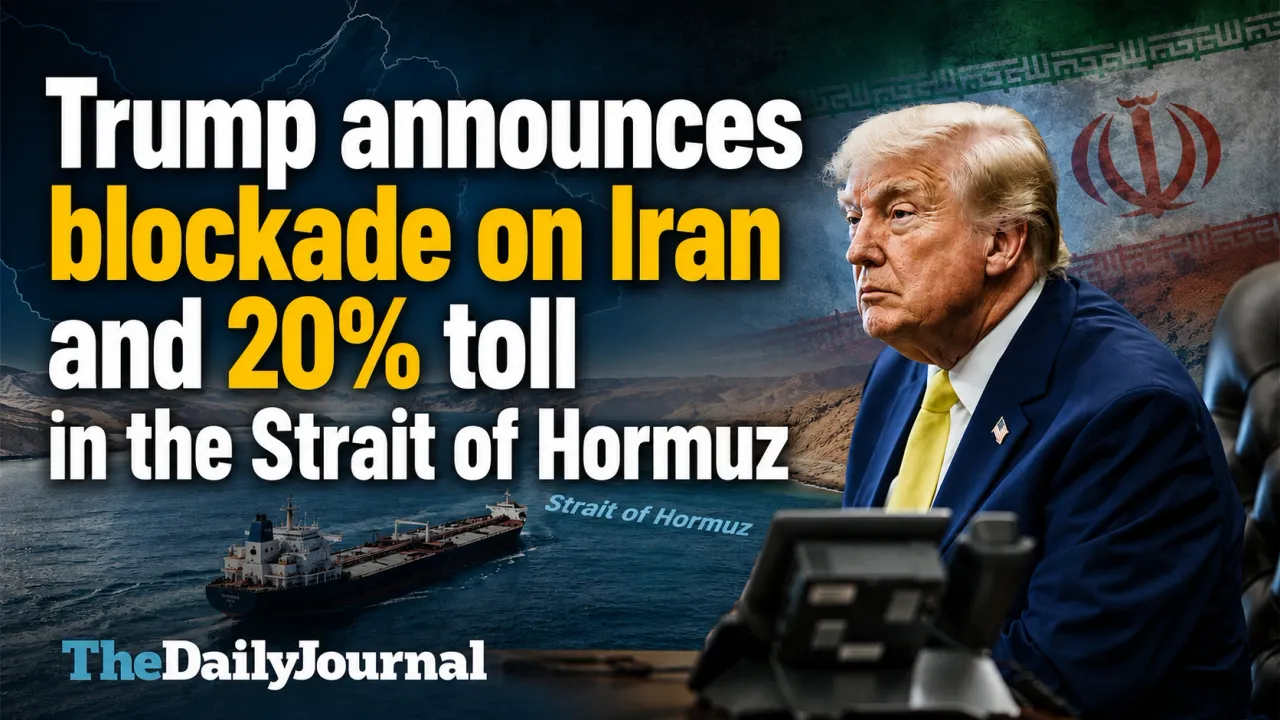
Julio A. López, Editor-in-Chief. — President Donald Trump announced Monday that the United States is “reinstating” a blockade on Iranian vessels transiting the Strait of Hormuz and will impose a 20% transit fee based on the value of all cargo passing through the waterway, as the conflict with Iran intensifies following the collapse of peace talks.
The Announcement, in His Own Words
Trump posted the following message on social media:
“The Strait of Hormuz is OPEN, and it will remain OPEN, with or without Iran. We are reinstating THE IRANIAN BLOCKADE, so called because it only stops the entry or exit of Iranian ships or customers. All other countries will enjoy fair and open access to the Strait.”
The president added that, from now on, the United States would be known as “THE GUARDIAN OF THE STRAIT OF HORMUZ” and that, “as a matter of FAIRNESS,” it would be reimbursed at a rate of 20% of all cargo transported, “for all costs necessary to ensure the security of this highly volatile part of the world.” Trump said that “the process and the organization will begin immediately.”
Hours later, in an interview with Fox News, the president went even further.
“We’re going to charge for protecting it,” he said. “We’re going to keep the Strait, and we’ll probably administer it ourselves.”
A Figure That Surprised Markets
The announcement came after media reports said Iran was seeking to charge about $2 million per vessel to allow passage through the Strait. Trump’s proposal represents a far greater burden: analysts cited by InvestingLive estimate that a 20% levy on cargo value would amount to roughly $30 million per vessel, without eliminating the risk of drone attacks or the high cost of maritime insurance.
The measure triggered an immediate market reaction. Gold fell $95 to $4,024, while oil rose more than 5%, reaching the session’s highs, a gain of 1.6 percentage points following the announcement.
Analysts warned that the strategy is unusual because a toll of that magnitude—higher than what Gulf allies themselves would pay Iran—could end up alienating those countries from Washington rather than strengthening the alliance.
Trump’s statement that “the process and the organization will begin immediately” suggests, according to some market analysts, that the United States may attempt to organize escorted convoys through the Strait, a monumental undertaking considering that roughly 100 oil tankers transit the waterway each day, along with numerous other vessels.
The Context: An Escalation With No Sign of Easing
The announcement came just one day after the United States launched its largest wave of strikes against Iran in weeks—targeting about 140 military sites—following an Iranian attack on a container ship in the Strait. Iran responded by launching attacks against Bahrain, Kuwait, Qatar, Jordan, and Oman.
Trump himself had said days earlier that the interim truce with Iran, which had been in effect for one month, was “over.”
Shortly after proposing the transit fee, the U.S. military said its latest wave of strikes against Iran had concluded, while insisting that Tehran does not control the Strait of Hormuz.
The measure also raises significant legal and diplomatic questions. The Strait lies within the territorial waters of Iran and Oman and has traditionally been regarded as an international waterway under the law of the sea. Washington’s decision to designate itself as the Strait’s “guardian” and impose a transit fee on non-belligerent third countries represents a break with that long-standing status at a time when nearly one-fifth of the world’s traded oil and natural gas passes through that route.
Mediators from Pakistan, Qatar, Egypt, and Oman continue trying to revive diplomatic efforts. Still, Trump’s announcement further complicates any prospect of Iran accepting a negotiated settlement over control of the Strait.