Trained and properly identified volunteers will conduct door-to-door inspections in the areas hardest hit by the earthquakes.
By Vanessa Davies
The Daily Journal — Like fractured giants. That is how hundreds of buildings in Caracas and La Guaira now stand after the June 24 earthquakes. The Presidential Commission for the Evaluation of Infrastructure Habitability has already inspected about 6,000 buildings, and not all of them passed the assessment. Since July 7, volunteers from the Venezuelan Engineering Association (CIV) have joined the effort to accelerate the evaluation process.
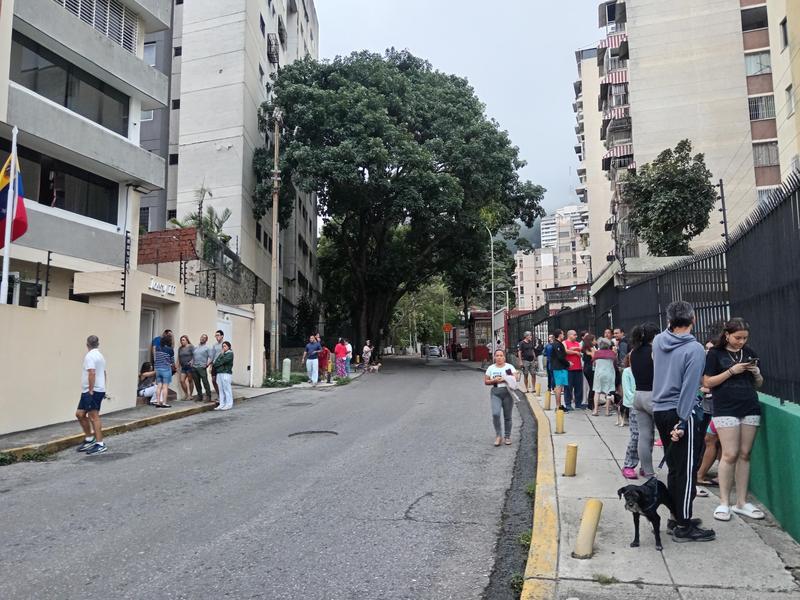
Many families remain outside their buildings, uncertain whether they can safely return home. The situation has become a common sight across Caracas. According to Francisco Garcés, president of the presidential commission, these rapid inspections aim to provide peace of mind to people who continue to live with uncertainty.
Enzo Betancourt, president of the Engineering Association, stressed that the inspections are completely free of charge. Authorities will report anyone who attempts to charge for the service to the appropriate security agencies.
“Charging for this service is prohibited,” he said.
Engineer Carlos González explained that properly identified volunteers will carry out the inspections. Each inspector will wear an official credential displaying a QR code and will carry a quick-reference guide for evaluating structural cracks.
Not a matter of guesswork
Every engineer and architect participating in the inspections must display an official identification badge. Residents should verify both the inspector’s national identity card and the QR code on the credential to confirm that the individual is a member of the CIV inspection teams.
“The most important thing is to prevent anyone from charging for this service,” González emphasized. “Residents should ask to see the inspector’s national ID and use the QR code on the credential to verify that the person belongs to the Engineering Association’s brigades.”
The back of each credential includes a quick-reference guide illustrating different levels of structural damage. Inspectors focus primarily on cracks affecting columns, beams, reinforced concrete walls, and other structural elements.
“The standards transform what might appear to be a subjective assessment of cracked or collapsed walls into an objective evaluation through arithmetic calculations, which ultimately determine a color classification. We adapted an international standard to local conditions,” González explained.
Those criteria determine whether a building receives a green, yellow, or red designation.
“This is not a case of someone simply saying, ‘This building looks fine.’ It doesn’t work that way.”
Garcés also clarified that a red tag does not automatically mean a building requires demolition.
“A red designation means the structure requires a more thorough evaluation. At this moment, however, occupying the building poses a risk,” he said.
Red means danger
Engineer Alfredo Urich expressed concern about residents who continue to occupy buildings that inspectors have already declared unsafe.
He urged families to respect the meaning of a red safety label and warned that ignoring official instructions places lives at risk.
Urich also praised the volunteers who initially provided free assessments to help reassure families about the condition of their buildings.
“That effort was valuable because it brought peace of mind to many people,” he said.
However, he stressed that, under the Engineering Association’s current coordination, volunteers must now work within an organized structure and operate only in the areas officially assigned to them, given the large number of damaged buildings.