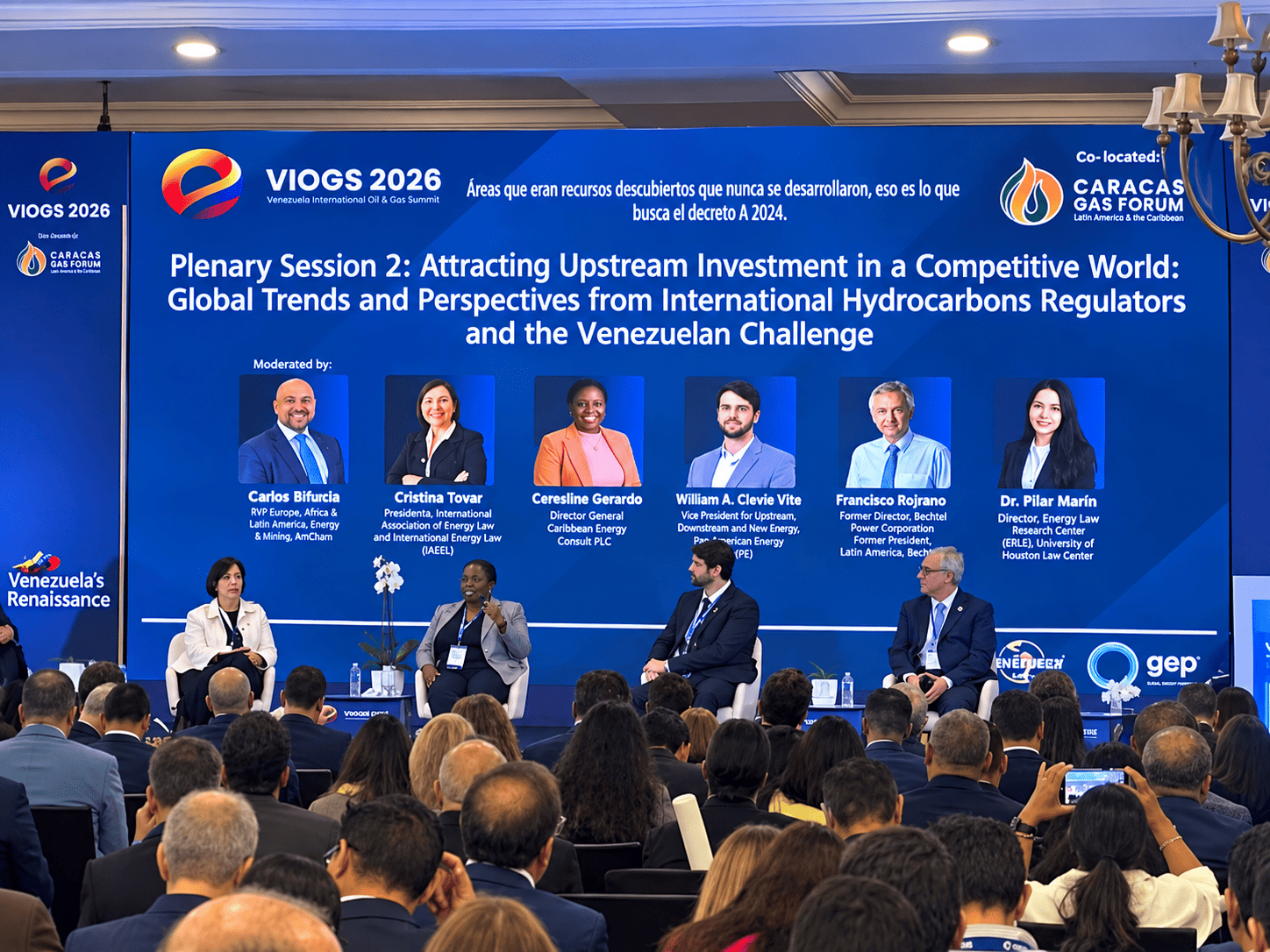
The Daily Journal. — Venezuela needs to review the tax burden on its hydrocarbon industry to compete for international investment, according to Cristina Tovar, executive president of the Venezuelan Hydrocarbons Association (AVHI), who noted that the sector once operated under a government take of as much as 93%.
“We came from a flat 93% government take across the board, regardless of whether it was a greenfield, brownfield, extra-heavy or heavy crude project,” Tovar said during the panel “Attracting Upstream Investment in a Competitive World,” held as part of the Venezuela International Oil and Gas Summit (VIOGS 2026) in Caracas.
According to Tovar, any discussion about oil industry competitiveness must begin by defining the business model Venezuela wants to develop and then establishing the legal and fiscal framework needed to make that model viable.
“We first have to envision the business model and then put in place a law or fiscal framework that fits it,” she said.
Tovar argued that the country should not apply the same fiscal conditions uniformly to projects with different characteristics and called for a review of the current framework to facilitate capital investment in exploration and production activities (upstream).
The executive cited Argentina’s Large Investment Incentive Regime (RIGI) as a reference and said one of the sector’s next tasks will be to assess whether Venezuela could develop a similar incentive framework.
“What business model do we need for the hydrocarbon sector to work and allow us to develop the entire value chain?” she asked.
A model for the entire value chain
Tovar said the investment debate should not focus solely on crude oil production. In her view, Venezuela needs to develop a model that encompasses the entire hydrocarbon value chain, including natural gas.
The AVHI president highlighted the association’s role in bringing together companies and other industry stakeholders to promote changes in both operating conditions and the country’s fiscal competitiveness framework.
In addition to reviewing the tax structure, she identified other priorities for the industry’s recovery, including natural gas development and professional training.
“One of the issues that concerns us most is talent development,” she said.
Financial restrictions
Tovar also said investment decisions must account for the financial and legal restrictions that continue to affect Venezuela’s oil industry because of international sanctions.
“We are a country where the sector is still subject to sanctions and operates under general licenses,” she said.
In this context, she explained that companies must simultaneously assess Venezuelan regulations and international restrictions that affect operations and access to financing.
“We need to understand the complexity of the different layers — the local framework and the framework that applies to us — and determine how we are going to operate under a system in which we still face some, or many, financial and legal restrictions,” she said.
The debate over the fiscal regime, contracts and conditions needed to attract capital is one of the main issues on the agenda at VIOGS 2026, a summit bringing together representatives of energy companies, investors and service providers from different countries in Caracas.