Héctor Sánchez
On October 12, 1492, Christopher Columbus landed on a Caribbean island, convinced—as official school history textbooks taught us—that he had reached the Indies. He brought glass necklaces and little mirrors, along with, of course, weapons and devastating diseases. In exchange for these trinkets, he seized the gold, the land, and the destiny of an entire continent.
Five hundred and thirty-four years later, the underlying logic has not changed; only the instruments and the actors have evolved. Today, the little mirrors are digital, and the conquistadors no longer sail in caravels but travel in aircraft accompanied by drones and sophisticated algorithms. Welcome to the new conquest of the Americas.
The empire has not altered its historical ambitions. It still covets gold, silver, and oil, now adding lithium, coltan, rare earth elements, and freshwater reserves to its list. Everything that glitters and everything essential to sustaining its war machine and technological industry. And, just as in 1492, what does it offer in return? Practically nothing but bombings, bullets, brute force, violent rhetoric, broken promises, selfies at international summits, and a few social media likes for the new Malinches willing to play along.
This continuity of dispossession is not a contemporary anomaly but rather the structural reproduction of the primitive accumulation of capital. As Karl Marx warned, the discovery of gold and silver deposits in the Americas, together with the enslavement and entombment of Indigenous populations in the mines, marked the dawn of the capitalist era of production.
October 12, 1492, inaugurated the relationship between modernity, capitalism, and the coloniality of power, establishing an international and racial division of labor. Under this colonial framework, the global peripheries become sources of raw materials and targets of extractivist plunder through state or paramilitary violence, demonstrating that structural dependency and the renewed reliance on primary commodities remain central to the dynamics of global capital accumulation.
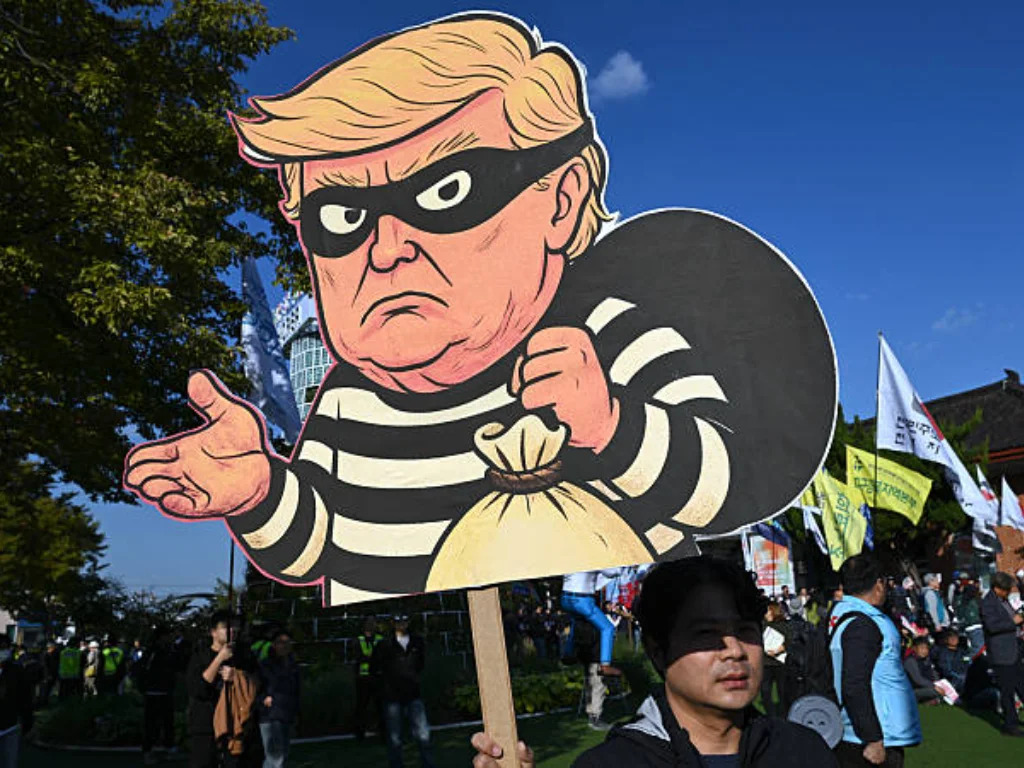
Donald Trump’s foreign policy toward Latin America has a precise name: the Donroe Doctrine. It is the classic Monroe Doctrine on steroids, which, under the rhetorical veil of “America for Americans,” seeks to replace the old Spanish Empire in the 21st century.
The January 3, 2026, military operation in Venezuela, dubbed “Absolute Resolve,” marked this doctrine’s baptism by fire. A lightning military strike decapitated the Venezuelan government. Barely seven months later, in August, an oil agreement transferred control of 17 oil fields to the United States, with estimated reserves of 65 billion barrels, equivalent to more than one-fifth of Venezuela’s proven reserves.
Although the Venezuelan government—headed by the vice president following the kidnapping of Nicolás Maduro—attempts to downplay the agreement’s scope, official U.S. documents confirm the reality: North American Blue Energy Partners (NABEP), a company in which the Pentagon holds a majority stake, secured 100-year concessions granting it the right to purchase 20% of production at cost for the U.S. strategic reserve, along with the right of first refusal on the remaining 80%. Venezuela’s National Assembly approved the agreement by a show of hands without even releasing its text to the public, evidence of the complete erosion of institutional norms. But oil is only the beginning. As Trump himself openly proclaimed: “We won, and we took the spoils.”
The U.S. strategy invokes sovereign decisionism and the primacy of material geoeconomic power to impose external control over strategic resources. This process not only dismantles the foundations of oil and hydrocarbon nationalism that emerged during the 20th century but also establishes a regime of forced custodianship in which sovereignty becomes little more than official Newspeak. Thus, political elites under foreign tutelage astonishingly describe resources that Washington administers under colonial control as “sovereign funds.”
Venezuela is not an isolated exception but rather the model that the empire has deployed across the rest of the continent through various methods. In Honduras, for example, ahead of the November 30, 2025, elections, Trump issued public statements threatening and coercing voters. The Honduran National Congress formally denounced this “absolute interference” as a violation of voters’ freedom. On election day, the Preliminary Electoral Results Transmission System (TREP) collapsed, authorities eliminated biometric verification mechanisms, and electoral fraud ultimately handed victory to the candidate aligned with Washington.
Argentina illustrates the opposite yet complementary case: voluntary surrender. Javier Milei’s government has turned the transfer of natural resources into a pillar of state policy. In September 2026, Washington and Buenos Aires launched the “Andes-Atlantic Corridor,” an infrastructure project whose explicit objective is to place lithium and copper deposits in northwestern Argentina, along with the resources of Vaca Muerta, under U.S. control and displace Chinese capital.
Brazil is next in line. The country holds the world’s second-largest rare earth reserves, as well as lithium, nickel, copper, and niobium. There, Washington’s political proxy takes the form of Bolsonaro’s son. The new conquest does not require soldiers on every corner. It needs only governments willing to sign, opposition figures willing to applaud, and populations that have abandoned collective mobilization.
Faced with the imposition of imperial power and the collaboration of the region’s dependent bourgeoisies, Latin American states have seen their strategic autonomy drastically diminished. Nevertheless, amid the erosion of international law’s normative foundations and the acquiescence of political elites, history shows that sovereignty is defended not by paternalistic rhetoric but by the moral and ethical reserves of the working class and popular sectors. Independent, decolonial resistance constitutes the only force capable of halting the advance of neocolonial ambitions across the continent.
Five hundred and thirty-four years have passed since that October 12, 1492—more than five centuries of plunder, dispossession, and relentless resistance. The conquest never truly ended. However, the struggles for independence bequeathed formal political freedom; economic warfare, subordination, and neocolonial plunder have persisted.
Yet the people’s capacity for resistance remains alive. The peoples of Latin America have survived empires, dictatorships, blockades, and invasions because, throughout history, they have known how to organize and build collective alternatives. The logic of plunder is powerful, but it is not invincible. As long as a people refuses to become the spoils of conquest, history will remain open. There will always be traitors, but popular mobilization ultimately defeats them.
May this October 12 serve, more than ever, as a day of active remembrance. A remembrance of historical injustice, but also of the dignity and transformative power of our peoples. A reminder that, 534 years later, we remain standing and will still be here when today’s empires collapse, just as the Spanish, British, and French empires did before them.