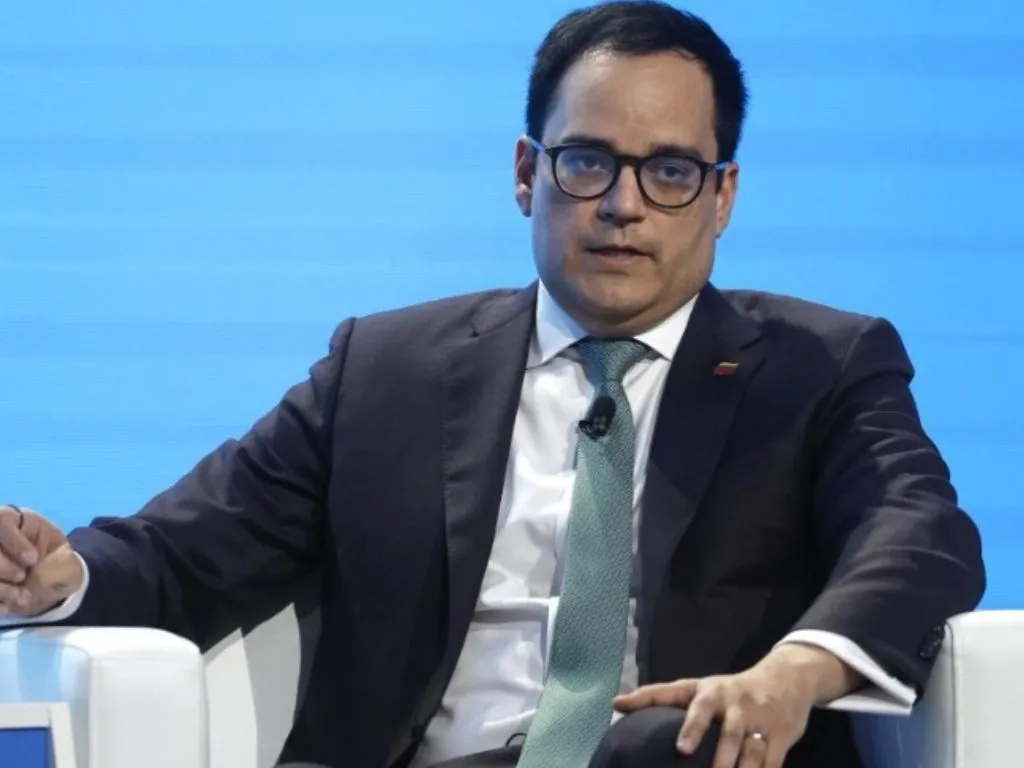
The Daily Journal.- Venezuela’s Vice President for Economic Affairs, Calixto Ortega, presented the country’s economic roadmap on Wednesday during a discussion in Bangkok on the sidelines of the International Monetary Fund (IMF) and World Bank annual meetings. The plan focuses on the oil and mining extractive industries.
Ortega, a former president of the Central Bank of Venezuela, outlined an economic roadmap built around four pillars. Venezuela restored relations with the IMF in April after withdrawing from the organization in 2019. The plan emphasizes growth through increased output from the extractive sector, particularly oil and minerals.
“These are the main drivers of foreign revenue and allow us to finance the rest of the economy,” the Venezuelan representative stressed.
Venezuela’s acting president, Delcy Rodríguez, recently stated that the South American country has recorded 22 consecutive quarters of economic growth. On Tuesday, the IMF released its World Economic Outlook report, projecting gross domestic product (GDP) growth of 5% this year and 7% in 2027.
“If Venezuela has grown for so many quarters despite the restrictions we have faced, we now have a great opportunity for growth to reach its true potential,” said Ortega, who also serves as Venezuela’s representative to the IMF.
Ortega also emphasized the need to use higher tax revenues from extractive industries to finance sectors “neglected over the past decade, such as water and electricity supply.” He further highlighted plans to reconnect Venezuela to the international financial system to address its public debt problem, an issue that authorities have been working on “since the beginning of the year,” he said.
In the same report, the IMF projected annual inflation of 467.9% in Venezuela by the end of 2026. Experts point to the rising U.S. dollar exchange rate as a main driver of inflation. The dollar serves as the primary benchmark for pricing goods and services in the oil-producing country following the hyperinflation crisis it experienced between 2017 and 2021.
On the dollarization of Venezuela’s economy and the bolívar’s depreciation, Ortega acknowledged that authorities are working to address the situation.
“Dollarization is not the right answer for the country. Instead, we must strengthen our national currency (…) Growth and stability will translate into a stronger bolívar. In the medium term, our currency will account for 100% of our domestic economy,” he said.
Despite economic growth, labor union representatives and workers across several sectors continue to denounce the country’s persistent wage crisis.
Ortega asserted that Venezuela “has learned from its mistakes,” explaining that during periods of high oil prices, the country relied heavily on imports of essential products “because it was easy and we had dollars to spend.”
“We will invest the potential revenues from the recovery of oil and mining production to expand the rest of the economy and develop industrial capacity,” he said.
Ortega’s remarks came during the annual meetings of the International Monetary Fund (IMF) and the World Bank, which began Monday in Bangkok, Thailand, and will continue through Sunday. At the forum, Venezuela’s Vice President for Economic Affairs is leading a discussion titled From Crisis Management to the Recovery of Hope, focusing on the country’s transition from crisis to economic recovery and Caracas’ cooperation with the IMF.
The gathering brings together delegates from 191 countries and territories, including economy ministers, central bank governors, business leaders, and representatives of multilateral organizations. The agenda focuses on the opportunities and risks of artificial intelligence (AI), energy price trends, public debt levels, and prospects for global economic growth.
Throughout the week, the IMF plans to release its country-by-country economic growth projections, along with reports on global financial stability and fiscal monitoring.
IMF Managing Director Kristalina Georgieva has warned that artificial intelligence could boost global growth while also deepening economic inequalities due to its potential impact on employment and the concentration of profits among technology companies. Meanwhile, the agenda also includes discussions on the financial consequences of armed conflicts, energy markets, and global supply chains.
With information from EFE.