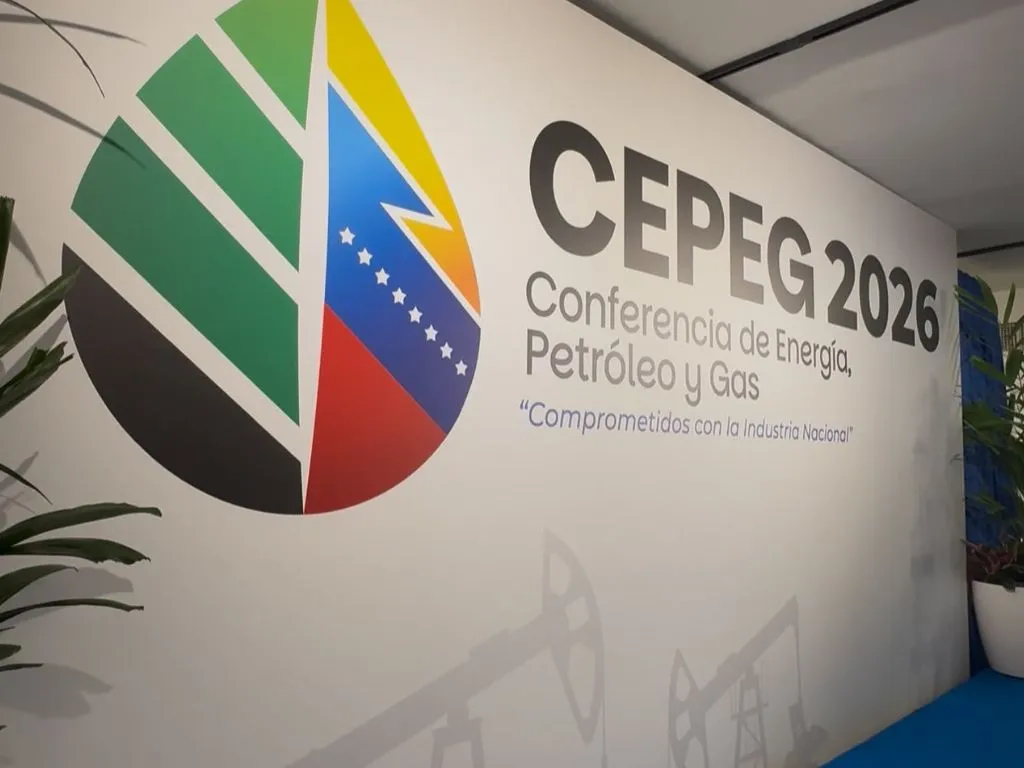
The Daily Journal – Petróleos de Venezuela (PDVSA) has set a target of ending 2026 with national oil production of 1.3 million barrels per day (bpd), up from its currently reported 1.24 million bpd, according to an announcement by the state-owned company’s president, Héctor Obregón Pérez, during the Energy, Oil and Gas Conference (CEPEG 2026) in Maracaibo.
The state oil company’s announcement came during the 40th anniversary celebration of the Venezuelan Petroleum Chamber’s Zulia chapter, an event bringing together operators, suppliers, and domestic and international companies to discuss operational challenges and investment opportunities in the sector.
During his presentation, Obregón outlined regional production targets and linked growth to regulatory changes that the government has introduced to expand private-sector participation. In the western Lake Maracaibo basin, one of the main areas targeted for recovery, PDVSA aims to increase production from the current 370,000 bpd to 400,000 bpd by year-end. The official attributed this recovery to collaboration among local companies, private operators, and investors, noting that the region has increased output from approximately 70,000 bpd four years ago to its current level.
The PDVSA president emphasized that the strategy to boost production relies on reforms to the Organic Hydrocarbons Law, publishing its implementing regulations, and adopting new contractual models. He reported that the state oil company has signed 61 hydrocarbon production participation contracts and continues negotiating another 44. He said the goal is to end the year with 105 agreements nationwide.
However, figures from the Organization of the Petroleum Exporting Countries (OPEC) provide an important point of comparison. In its September report, OPEC placed Venezuelan oil production at 1.15 million bpd, according to secondary sources, compared with 1.133 million bpd in August. Venezuela directly reported production of 1.206 million bpd in September, highlighting the additional increase in activity that PDVSA will need to achieve its target.
Electricity and gas: Investment bottlenecks
The announcement of production targets comes as companies operating in Venezuela seek to overcome a major constraint: access to electricity and gas. Roy Biagioni, president of the Venezuelan Petroleum Chamber’s Zulia chapter, stressed that companies need these resources to operate, along with better navigation conditions on Lake Maracaibo.
Against this backdrop, companies are increasingly turning to self-generated electricity. Biagioni noted that Chevron already operates its own power generation facilities and plans to add another unit, while Repsol is developing a project to generate its own electricity. The industry representative estimated that by 2027, oil companies pursuing these projects could operate independently of the National Electric System (SEN). This strategy aims to ensure operational continuity and reduce reliance on the public power grid.
In addition to crude oil production targets, PDVSA’s president announced that the company expects a significant increase in methane gas supply for industrial and residential use in Zulia during the first quarter of 2027.
Well potential and industry warnings
Although the government and PDVSA have outlined optimistic targets, private-sector representatives warn that achieving them will depend on operational conditions that still require solutions. Biagioni said he has yet to see significant progress from the new energy agreement between Venezuela and the United States in Zulia’s oil-producing municipalities. He also cautioned that investments and equipment deliveries take time.
“Don’t think this will happen overnight. Investment levels are very high. The equipment has to arrive. This is a gradual process,” the Petroleum Chamber president said.
Biagioni estimated that Zulia has between 5,200 and 5,500 Category 2 wells that operators could reactivate more quickly than others. Recovering these wells could generate an additional 400,000 bpd, according to the industry’s estimate of potential production recovery, rather than a guaranteed output level.
The feasibility of this recovery will depend on each well’s condition, the required repairs, and the investment needed to restart operations. Biagioni acknowledged the deterioration of the region’s oil infrastructure but maintained that operators could repair much of it. He also warned that developing new fields could be more complicated without road access and electricity supplies.
Supplier expectations and the broader context of international agreements
Growth expectations also extend to equipment and service suppliers. José Menegaldo, a representative of SM Baralt, noted that new projects could generate substantial demand for technological solutions and specialized services. He added that operators require more than 400 vessels for marine operations.
Discussions at CEPEG 2026 come amid a new phase of energy cooperation between Caracas and Washington. On August 28, officials announced an agreement to develop 17 Venezuelan oil fields through North American Blue Energy Partners (NABEP), with estimated proven reserves exceeding 65 billion barrels and an investment plan that could reach $100 billion.
Meanwhile, on September 2, Venezuela formalized agreements with Chevron, Eni, and other companies. Chevron announced investment plans exceeding $7 billion to increase its production in Venezuela, while Eni plans to invest in developing the Junín 5 field.
The participation of international companies in the conference reflects efforts to attract capital, technology, and services to revive the oil industry. Nevertheless, warnings from petroleum industry representatives about investment requirements, electricity availability, and the condition of oil fields underscore that these projects will also depend on resolving persistent operational challenges.