By Natalia Jaua
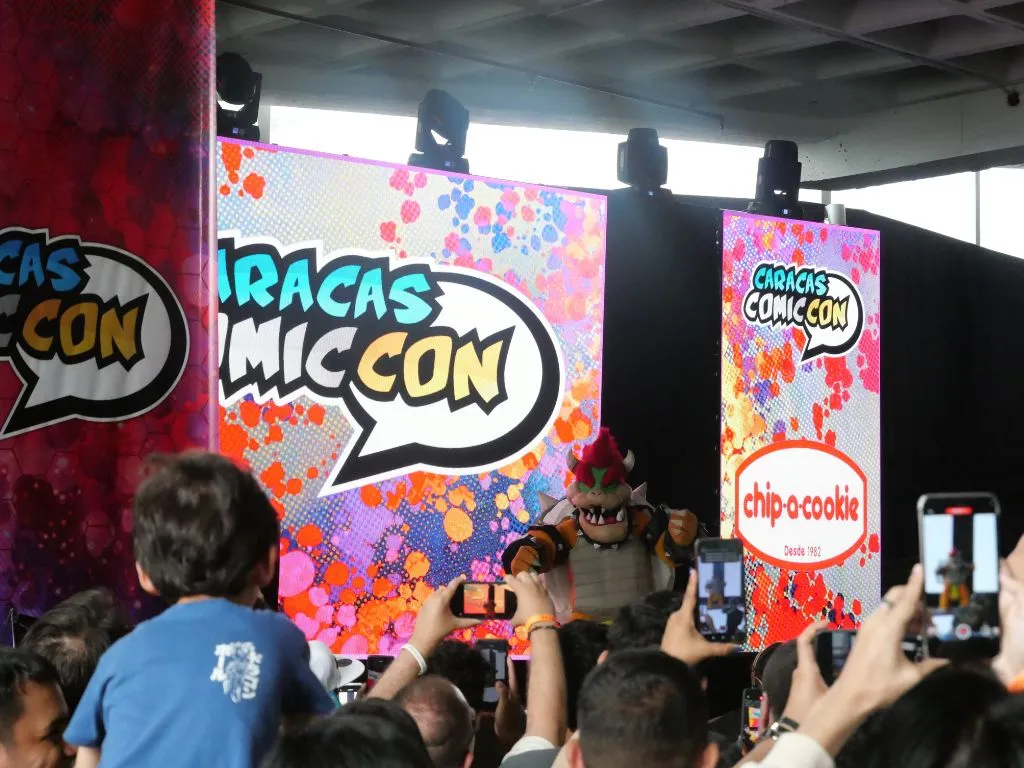
The Daily Journal – Some reunions feel like coming home. That must have been what Mario Castañeda was thinking when, microphone in hand, he recalled that Caracas was the first city to welcome him to a convention back in 2005. Twenty-one years later, the man who gave Goku his voice returned to the Venezuelan capital for the 27th edition of Caracas Comic Con, held on October 17 and 18 at the Líder Shopping Center’s event venue, and the audience greeted him with the same devotion as always.
Starting at 11 a.m., the Espacio hall transformed into a miniature multiverse. Attendees streamed in steadily throughout both days, with activities running until 8 p.m. General admission cost around $20, with discounted rates for children ages 5 to 12, senior citizens, and people with disabilities. Children under four entered free.
The exhibitors’ area was a main attraction. Organizers divided the booths into several categories: Stores (merchandise featuring anime and related themes), Artists (illustrators and artisans selling their own creations, a category that quickly sold out), and Food.
Among the convention’s regular exhibitors, Calabozo Criollo stands out as a Venezuelan community dedicated to board games, role-playing games, and wargames that has participated in Caracas Comic Con since its earliest editions. Founded in 2004, Calabozo Criollo is more than just a booth: it is a gathering place for players of Warhammer, Dungeons & Dragons, Catan, Infinity, and other gaming systems. The community offers free demonstrations to attendees to help expand gaming culture throughout the country.
The convention went beyond its international guests. Venezuelan talent took center stage, with Rocío Mallo and Angie Mallo, the voices of Garnet and Aquamarine in Steven Universe, hosting a special activity featuring a mini voice-acting competition.
Music also had its moment, with Unit K Studio bringing energy to the stage through dance performances. Throughout both days, contests, trivia games, video games, shops, fan clubs, and cosplay activities kept attendees entertained.
Nevertheless, the icing on the cake was Mario Castañeda, the beloved and widely recognized Latin American voice actor. When he stepped onto the stage on Saturday, before launching into any monologue or answering questions, he shared a personal memory: Caracas was the first city to welcome him to a convention in 2005.
Organizers had announced two appearances: a question-and-answer session on Saturday and his traditional voice-acting show on Sunday. The moment of pure exhilaration came when he performed a live Dragon Ball Z monologue. The audience erupted in cheers, applause, and the kind of enthusiasm that only a character like Goku can inspire among his fans.
The other major international surprise was Steven John Ward, the South African actor who portrayed Dracule Mihawk in Netflix’s live-action adaptation of One Piece. Organizers had confirmed his participation in fan meetings throughout both days. After the Yamato Cosplay Cup was canceled, he agreed to give an additional stage presentation on Sunday to fill the gap.
On Saturday, The Daily Journal attended his panel and had the opportunity to ask him two questions about his character and his relationship with one of the series’ protagonists, swordsman Roronoa Zoro (portrayed by Japanese actor Mackenyu Arata).
They say you should never meet your heroes, and Mihawk and Zoro embody that saying quite well. Do you think Zoro sees Mihawk as a source of insecurity or as motivation?
Motivation. That’s what I think. Because he has to get somewhere. Maybe right now it’s insecurity, but I definitely think it’s more motivation to become that. Because that’s what he wants to be: the greatest swordsman, but he’ll have to get past me.
What emotion do you think will define their connection when they meet again?
I think Zoro will be arrogant. He thinks he can take on Mihawk. But I think he’ll want to learn more because he’ll realize he’s nowhere near Mihawk’s level.
Not everything went according to plan. Organizers had announced that the Venezuelan qualifying round of the Yamato Cosplay Cup would take place on Sunday, October 18, promising the winner a place in the international finals in Japan. However, days before the event, organizers issued an official statement announcing the competition’s cancellation.
The reason: registrations fell short of the minimum required under the competition’s official rules. Director Daniela Paolillo explained that the “complex circumstances the country has faced throughout the year played a decisive role in the low number of registrations.” She also announced plans to develop a new strategy to ensure Venezuelan representation at Yamato 2027.
To fill the gap in Sunday’s schedule, Steven John Ward agreed to make an additional appearance, taking the stage on both days. Even so, cosplay remained one of the event’s main attractions through other activities, including stage performances, photo opportunities, and appearances by figures such as Nitacosplay, known for her work with latex prosthetics, and the Ecuadorian group Young Friki Cosplay, which performed on Sunday.
In 2016, researcher Edsandra Zamora presented a study at the Andrés Bello Catholic University (UCAB) describing Caracas otakus as an “urban tribe” whose members built their identities around anime and manga. Her assessment was clear: the community’s presence had grown in Venezuela, yet it remained a relatively unfamiliar phenomenon to Venezuelan society. Caracas Comic Con, which already existed at the time, emerged in her research as the natural culmination of that process: the only place where these young people “feel safe showing who they are without any embarrassment.”
Zamora also documented a revealing fact about the scale of the scene during those years: in 2014, Venezuela hosted more than ten otaku conventions, six of them in Caracas. By 2015, the number in the capital had dropped to three. These were niche events, sustained by a community that was beginning to organize itself but had not yet achieved the widespread visibility it enjoys today.
Caracas Comic Con’s own figures tell the story of that transformation. Its first edition, in March 2010, took place at the CIEC of the Metropolitan University. According to reports from the time, the first day drew “rather poor attendance” before experiencing a modest increase. Three years later, in 2013, organizers reported that the previous edition had attracted more than 8,000 fans. By 2018, the convention had grown enough to hold three editions annually and had welcomed more than 130,000 attendees since its inception.
In August 2025, the 15th-anniversary edition brought together 7,000 people over one weekend. That same year, the Venezuela Game Show—which incorporates cosplay and anime culture into its programming—attracted more than 30,000 people over three days. By 2026, attendance had climbed to 35,000 visitors.
The cosplayers who pose for cameras today at the Líder Shopping Center are the heirs of those who gathered in internet forums and university conventions a decade ago. Comic Con did not create that community; it made it visible and, in doing so, helped it multiply.
Although organizers have not released official attendance figures, turnout was likely strong, since they have already confirmed that Caracas Comic Con will continue its journey across Venezuela in 2027, with upcoming stops in Táchira and Valencia. This shows the community extends beyond the capital and continues to expand across the country.