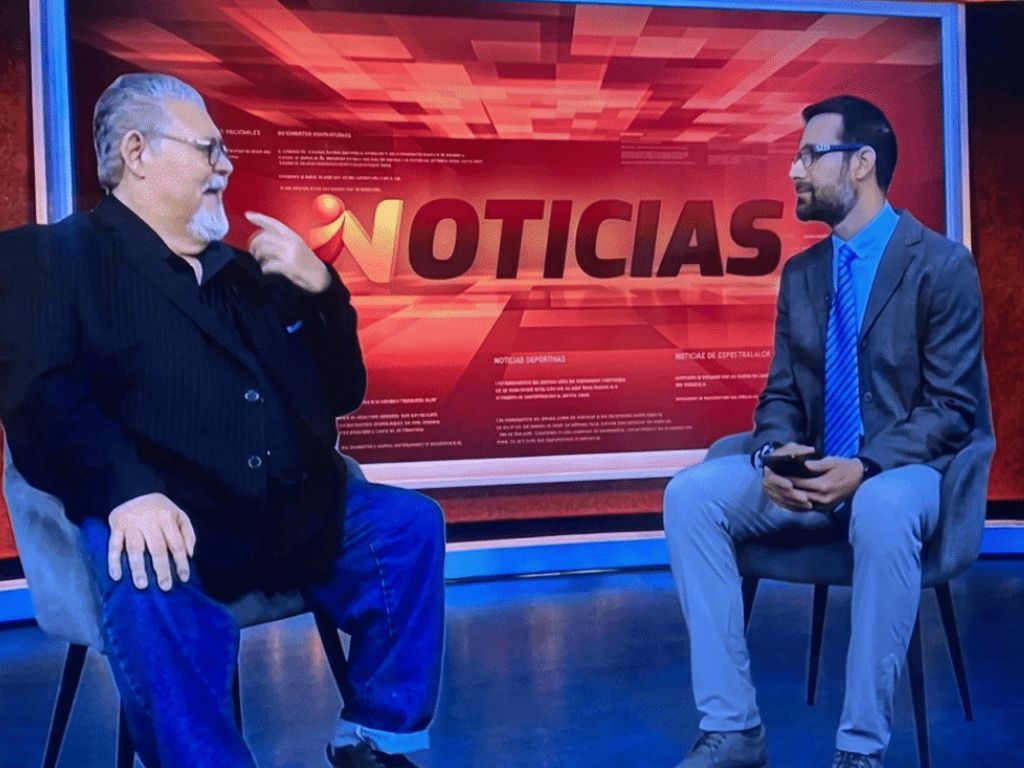
The Daily Journal.– During a television interview , former Caracas mayor Juan Barreto argued that Venezuela’s political future will depend to a large extent on the decisions adopted by acting president Delcy Rodríguez, whom he credited with the ability either to preserve the current power structure or to promote a democratic transition based on national reconciliation.
In an extensive analysis of the national reality, the university professor maintained that the political landscape that emerged following the July 24, 2024 presidential process has left citizens in a state of profound defenselessness, though still with a firm desire for transformation.
“The Venezuelan people’s desire for change and transformation remains intact. That desire for change that was expressed on July 28, 2024, is still there. It is in the streets, and one feels it when visiting the neighborhoods; I spend my time doing that, immersed in communities, and people want this to change,” Barreto stated.
The Executive’s Historical Crossroads
For the analyst, the acting president’s administration stands at a crossroads where institutional rhetoric about national pacification must urgently be validated through verifiable structural reforms rather than simple political readjustments.
“I believe President Delcy Rodríguez has a great opportunity, and she herself will decide how she enters history, how she wishes to enter history; it is in her hands. She faces enormous difficulties, but it depends on her whether she goes down in history as continuity with Maduro—as a stage of mere adjustment for the continuation of madurismo —or whether she becomes the breaking point, the dividing line from which society democratizes and reconciles,” the political analyst challenged.
The former mayor referred directly to recent official speeches by the Executive:
“She has been speaking about peace. I give her the benefit of the doubt, but I also say this: people want concrete actions; this is not about speeches or proclamations.”
“Things fell apart; the state apparatus was pulverized and crushed the citizenry,” he added.
In this regard, Barreto plainly warned that the social context makes it impossible simply to turn the page without accepting responsibility:
“So this is not about saying, ‘I throw some dirt over it and I’m done playing,’ or ‘if I don’t remember it, it didn’t happen.’ This is not reggaeton. This is real life and the pain people have carried for a long time.”
No Immediate Conditions for Elections
When assessing the electoral landscape and the demands of various sectors of the media opposition, Barreto ruled out the existence of the minimum technical and institutional conditions necessary to call immediate elections.
He pointed out that spokespersons from the organized opposition estimate a technical timeframe of up to 40 weeks due to delays in appointments to the Judicial Branch and the Electoral Authority.
“Everything seems to indicate that, unfortunately, despite the fact that we all want a change in the situation, there are no conditions for elections to be held immediately (…). The Supreme Court of Justice has not yet been fully constituted; the committee that will evaluate nominations to the National Electoral Council has not even been created. And with this National Electoral Council, which was discredited after the July 28 electoral process, it is impossible to go to elections because there is no credibility,” he argued.
In Barreto’s view, resolving the issue of legitimacy of origin in the country requires reactivating international negotiation tables accompanied by rigorous audits.
“We must return to negotiations and bring back international organizations such as the Carter Center, the United Nations Commission of Experts, and friendly countries that can send observers and monitors. It has to be an absolutely transparent process that leaves no room for doubt, so that what happened in the last elections does not happen again, where a shadow of doubt remained over the results and where, to this day, it has not been possible to establish to whom legitimacy of origin belongs,” he concluded.
As a possible path forward, he urged Delcy Rodríguez to broaden the institutional framework beyond political elites:
“Call upon the country—not only the elites or interested groups—call upon the real country. Solve people’s problems, and at the same time let us advance simultaneously, without postponing matters, toward creating a new Electoral Council that would allow us, for example, within a year from now, to move toward a process at the end of 2027.”
Social Disappointment, Protests, and Failures in the Current Dialogue
The political leader warned that political and economic paralysis is fueling street protests across the country.
“Among the people there are high levels of disappointment, frustration, skepticism, and desperation—those four things. And sometimes those four emotions are channeled in different ways, and one of those channels is protest, which itself has different forms of expression,” he analyzed.
Finally, Barreto criticized the format of the dialogue and peace talks promoted by Miraflores Palace, describing them as exclusionary because they fail to incorporate the country’s active social forces.
“What has happened with this dialogue and peace table? It gradually wore itself out because what it convened was not the country; it was a group of important citizens—good people—but one cannot say they are representative forces of the people. For example, I have not seen real meetings with labor union leaders,” he criticized.
Barreto insisted on the need for a genuine negotiating table with viable and actionable proposals:
“Like that famous roundtable in Poland, where discussions took place and the decisions reached were broadcast within 24 hours,” he recalled.