Julio A. López.- While Guyana continues to attract the attention of the global energy industry through giant discoveries led by ExxonMobil, Suriname is moving quickly to establish itself as the next major player in the Guyana-Suriname Basin, one of the most promising petroleum regions on the planet.
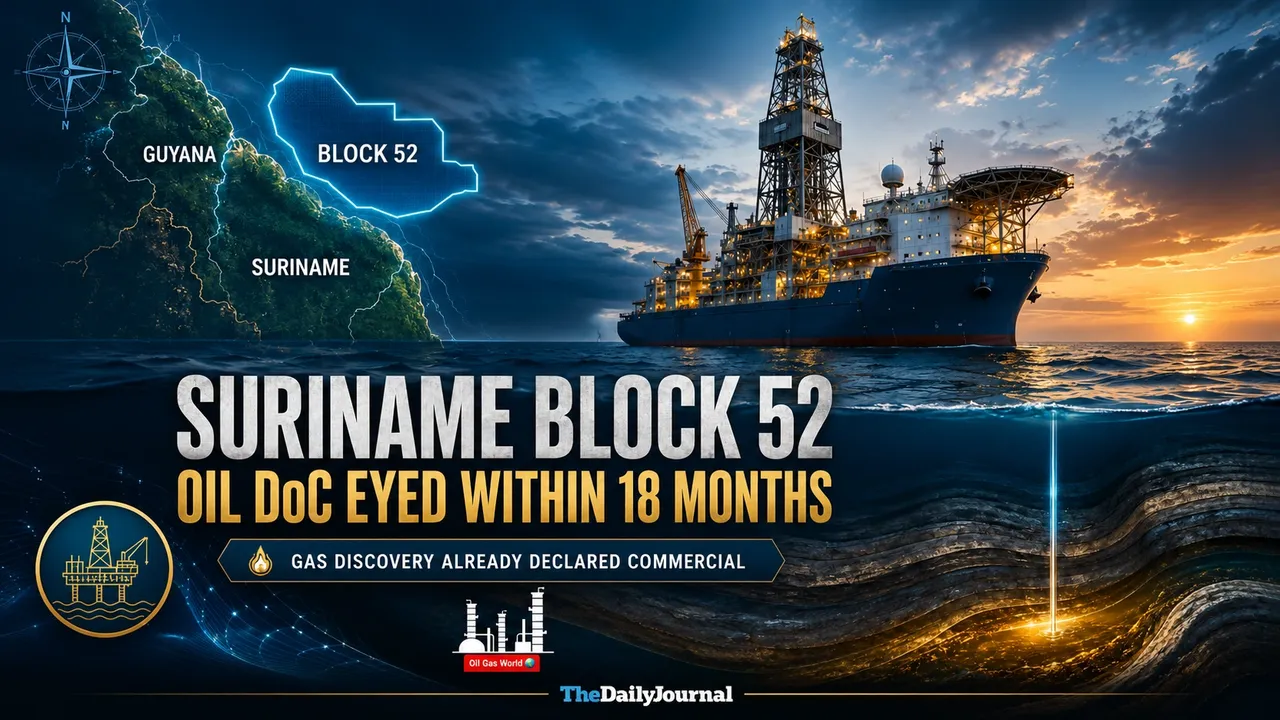
Industry attention now focuses on Block 52, a deepwater offshore area operated by Malaysia’s Petronas. Surinamese authorities expect a Declaration of Commerciality for oil within the next 18 months, a crucial step toward the commercial development of the resources discovered in the area.
The announcement provides new momentum for a country that barely appeared on the global energy map a few years ago and now attracts growing interest from major international oil companies.
Block 52 already reached an important milestone in November 2025 when operators declared the Sloanea natural gas discovery commercially viable. The field represents Suriname’s first major offshore gas project and could lead to the construction of floating liquefied natural gas (FLNG) facilities. Project partners expect a final investment decision before the end of this year and target first production around 2030.
However, the block may hold even greater potential.
In addition to gas discoveries, Petronas identified significant oil shows in several exploratory wells, including Roystonea-1, Fusaea-1, and Caiman-1. These drilling campaigns confirmed the presence of petroleum and natural gas systems in a region that shares key geological characteristics with Guyana’s prolific Stabroek Block, where ExxonMobil has discovered more than 11 billion recoverable barrels of oil equivalent and currently produces close to 900,000 barrels per day.
Industry analysts believe that simultaneous oil and gas development in Block 52 could dramatically transform Suriname’s economy over the next decade.
Models developed by Rystad Energy estimate that recoverable resources in the block could exceed 500 million barrels of oil equivalent. Analysts also estimate that Suriname’s natural gas potential could reach 20 trillion cubic feet, placing the country among the continent’s most important emerging energy producers.
Suriname’s energy expansion extends far beyond Block 52. The country is also advancing the GranMorgu megaproject, led by TotalEnergies, which carries an investment exceeding $10.5 billion and targets first oil production in 2028. At the same time, state-owned Staatsolie continues to offer new offshore licensing rounds covering more than 70,000 square kilometers of exploration acreage.
Regional analysts view this trend as much more than a Suriname story. The combination of Guyana’s discoveries, Trinidad and Tobago’s advances in natural gas, and Suriname’s growing prospects is steadily shifting South America’s energy center of gravity toward the Atlantic.
In that context, the northern Atlantic coast of South America is emerging as one of the principal energy growth corridors of the twenty-first century, attracting billions of dollars in investment, deepwater technology, and new infrastructure for oil and gas exports.
What looked like a high-risk exploration frontier just a decade ago is rapidly evolving into a new global energy province. And Suriname, quietly but decisively, intends to become part of that story.