Audio: https://clyp.it/yfbjizdt
María Alejandra Díaz Marín.- The most dangerous lie is not the one people force others to believe. The most dangerous lie is the one that makes truth stop mattering. Hannah Arendt warned about that danger when she studied how modern societies accepted extreme forms of domination. Leaders did not need to convince everyone to believe the same lie; they only needed to destroy society’s collective ability to distinguish truth from propaganda. That logic still survives today.
For years, Washington portrayed Venezuela as a “narco-terrorist dictatorship” controlled by criminals, torturers, and mafias. From Donald Trump to Marco Rubio, officials repeated the same narrative: a corrupt structure tied to drug trafficking had hijacked the country and driven its destruction.
But when the moment for action arrives, reality reveals something: they do not dismantle that structure. They negotiate with it, associate with it, praise it, manage it, and ultimately legitimize it politically. At that moment, the entire moral narrative collapses.
If they truly believed that a criminal apparatus controls Venezuela, how can they justify promoting a “transition” supported by the same elites they spent years accusing of corruption, drug trafficking, and human rights abuses?
The answer is obvious: democracy and human rights never represented the real issue. Geopolitical and energy control always drove the real objective.
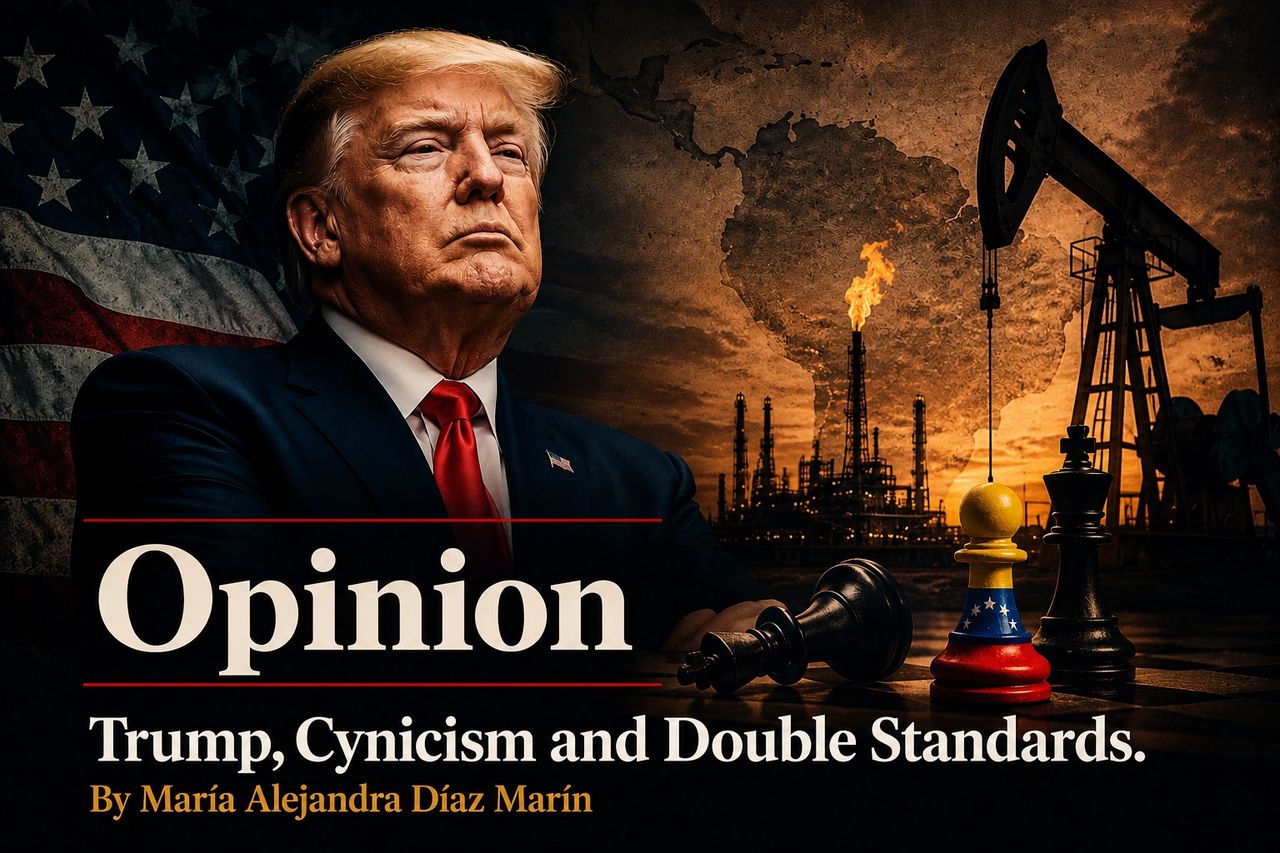
Trump never acted as a liberator. He served as an imperial administrator who decided which governments would serve Washington’s strategic interests and which must surrender.
The Monroe Doctrine never disappeared; it simply adapted to a new era. Today, officials no longer speak openly about colonies. Instead, they speak about “transition,” “stabilization,” or “hemispheric security.” But the principle remains unchanged: Latin America must remain subordinate to U.S. interests.
Rubio’s statements confirm that reality with brutal clarity. When he says that “for the first time in more than a decade Venezuela’s wealth benefits the people,” he does not defend Venezuelan sovereignty. He openly acknowledges a system of foreign supervision over the country’s oil revenue. That does not represent national recovery. That represents colonial management of strategic resources.
The United States controls how much oil Venezuela sells, how Venezuela sells it, and under what conditions authorities manage the country’s main national resource. Modern piracy now speaks in technocratic language. The new pirates of the Caribbean no longer use galleons; they use sanctions, financial blockades, Wall Street-supervised accounts, and wars to hide their own moral decline: a political class linked to Epstein Island’s pedophile network and manipulated like puppets by Netanyahu’s genocidal agenda.
Cynicism reaches grotesque levels when Rubio presents miserable salaries as social progress. While he speaks about “benefiting the people,” millions of teachers, doctors, and public workers survive on incomes that cannot cover food, transportation, or medicine. Starvation wages do not represent social justice. They manage poverty.
Officials deliberately confuse minimal assistance with national recovery. Real benefits for the Venezuelan people would include dignified salaries, industrial recovery, functional public services, productive autonomy, institutional reconstruction, free elections, and sovereign control over national resources. But Washington’s project for Venezuela does not pursue those goals.
Rubio’s narrative seeks to impose a deeply colonial idea: Venezuela can only manage its oil “correctly” under Washington’s supervision. According to that narrative, Venezuelans need foreign guardians to manage their own resources, as if U.S. leaders were better administrators. Fifty million poor people inside the United States expose the failure of that argument.
The political double standard represents the most serious problem of all: Trump wants to present himself as an enemy of the “narco-regime”. At the same time, he simultaneously promotes agreements with the same actors he once claimed to fight. Without winning a single election or receiving a single popular vote, those structures now receive international legitimacy through Washington’s approval.
That reality turns Trump not into an adversary of the system, but into a political partner of a structure accused for years of corruption, drug trafficking, and human rights abuses. Venezuela’s tragedy cannot be solved by replacing one corrupt elite with a dependency structure managed from abroad.
No people achieve freedom by surrendering sovereignty. No nation rebuilds itself by transforming into the energy colony of a foreign power.
What officials now attempt to sell as “benefits for the people” does not represent economic emancipation or democratic recovery. It represents managed subordination. And that reality does not turn Trump into a liberator. It turns him into an accomplice of a new system of criminal domination.