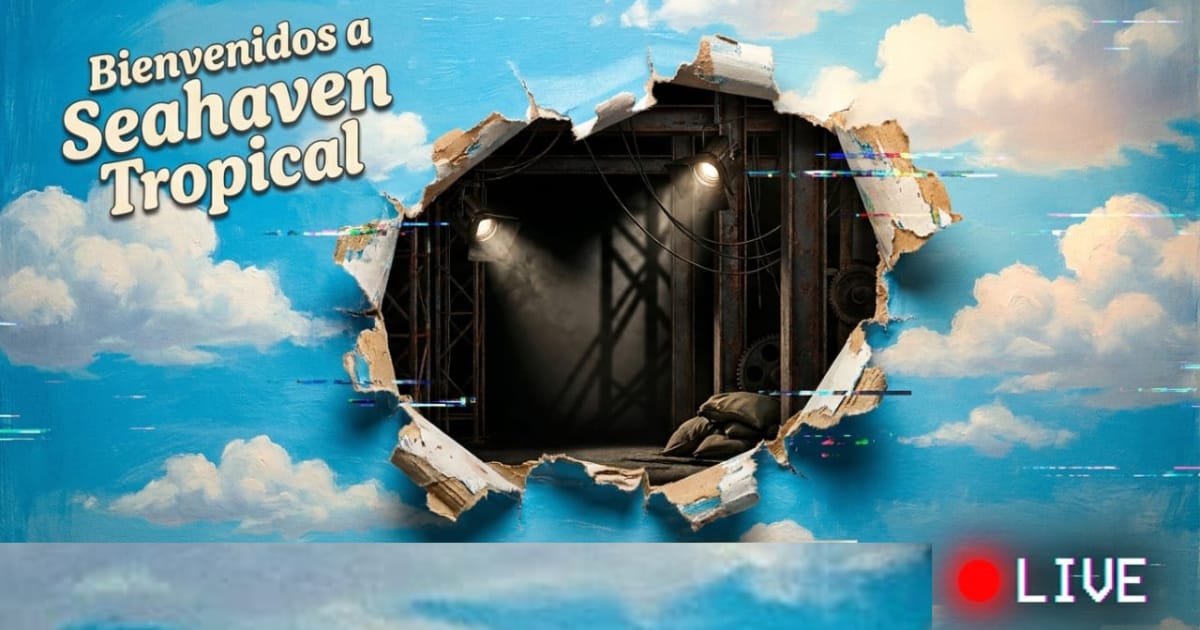
Héctor Sánchez. Sociologist. — Venezuela today resembles an enormous recording studio more than a sovereign republic. Much like fictional Seahaven, we live beneath a glass dome where reality has given way to a meticulously orchestrated simulacrum: a hyperreality in which the political script comes first and shapes the facts.
A 1998 film, viewed in retrospect, looks almost like a documentary about our country: The Truman Show, directed by Peter Weir. The film tells the story of Truman Burbank, a man who leads an apparently normal life on an island called Seahaven, unaware that television producers manufactured his entire environment.
Inside this nationally scaled set, power does more than lie; it builds a world that performs truth. Meanwhile, Venezuelan citizens, turned into the “Trumans” of this story, struggle to decipher whether what we see belongs to the sky or merely to a cardboard wall painted blue.
The cast of this show follows a predictable script. On one side stand supporting actors such as interim president Delcy Rodríguez, who performs a defense of sovereignty while her brother, Jorge Rodríguez—president of the National Assembly—rushes reformed laws through the system and hands them over neatly packaged.
On the opposite side of the set stands an opposition that shows no discomfort with the erosion of that same sovereignty. Its members criticize the “producer” not for the deception itself, but for failing to hand over the country with greater enthusiasm and speed.
Between them thrives a fauna of opinion manufacturers—panel experts and hired social media voices—who fill the role of secondary characters. They know the entire spectacle rests on falsehoods, yet they smile for the camera because their contracts guarantee a monthly paycheck. These figures forecast and manipulate the country’s future according to the wishes of whoever pays their bills, leaving behind an unbearable debt for the nation. In essence, they work as mercenaries.
Yet true control lies not in discourse but in the mechanics of the panopticon. The show’s director—that invisible Christof operating from a lunar control room—understands that Truman remains inside the set only when fear paralyzes him. In the film, aquaphobia served that purpose; in Venezuela, extreme precarity plays that role. A worker who survives on a salary of twenty-seven cents and a handful of fleeting monthly bonuses does not live as a citizen; that worker survives as a subject trapped in bare existence, a homo economicus immobilized by permanent insecurity. The system uses hunger and strategic disinformation not merely to deceive, but to produce lethargy and apathy.
The show’s greatest triumph lies precisely in our transformation into passive spectators. Seated on the sofa of crisis, many simply watch reality drift across the screen and adopt the interests of the ruling class as their own out of fear of chaos.
Truman’s final tragedy did not stem from captivity but from the audience’s reaction when the show ended: a casual “what’s on next?” while viewers searched the television guide. That same danger shadows our “silent majority”: people legitimize abuse through inaction and through the consumption of banal anti-information that destroys critical thinking. In this setting, poverty wages condition speech and public engagement, while background performers play along with perversity itself.
Yet every simulacrum develops cracks. The show begins to wobble when “production errors” grow impossible to conceal. Reality carries an intrinsic stubbornness; no matter how loudly the script speaks of sovereignty, foreign aircraft flying over Caracas as though it were an amusement park tear through the scenery.
That moment—when the ship of truth crashes against the edge of the studio—marks the beginning of reality’s resistance. Escape from this “tropical cave” demands not physical strength but mental strength, the kind that allows us to step beyond the frame of fantasy.
Truman’s show will end not when the director calls cut, but when Venezuelans stop performing according to someone else’s script and choose to walk out through the set’s door to create lives of their own making. Only then will people expose, confront, and dismantle the perverse “deep state” for the good of the country and the wider world.
As Truman would say: “In case I don’t see you again: good morning, good afternoon, and good night!”