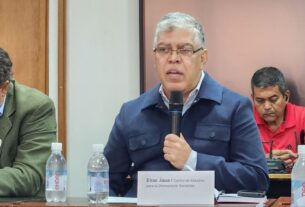
Professor Dilio Hernández, director of the UCV Center for Research and Prospective Analysis, proposes incorporating both public and private universities. The project is advancing under the framework of the Organic Law on Special Economic Zones.
By Vanessa Davies
The “house that conquers the shadows” seeks to overcome not only the specters of every kind looming over Venezuela, but also the shadow of stagnation. The tsunami the nation has endured — bearing different names and interpretations depending on one’s view of the conflict — devastated institutions of higher education: their workers, infrastructure, and connection with the world.
One pathway toward a different reality could be the creation of a university special economic zone . At least, that is how Professor Dilio Hernández, director of the Center for Research and Prospective Analysis (CIAP) at the Central University of Venezuela (UCV), envisions it.
“We built the project around the Organic Law on Special Economic Zones because that is where it must be situated in order to obtain the benefits these special economic zones provide,” Hernández explained during the National Meeting of Chairs and Centers for Innovation and Entrepreneurship recently organized by the UCV Emprende Chair.
Many Hands Working Together
Official figures indicate that Venezuela has more than 70 universities, including traditional, experimental, and private institutions, and the system reaches 175 institutions when colleges and university institutes are included. Venezuela’s University Law defines them as a community of spiritual interests seeking truth and strengthening human values.
A Special Economic Zone (SEZ) , according to the Ministry of Planning, is defined as a space designed to strengthen regional potential and benefiting from various incentives to export goods and services. The Organic Law on Special Economic Zones, enacted in 2022, includes industrial, technological, financial, and agricultural activities, as well as benefits such as a one-stop administrative system and tax incentives.
As Professor Hernández recalled, SEZs offer tax exemptions.
“Negotiations can be held with municipalities, negotiations can be held with SAPI,” he noted.
For the university zone, he indicated, they would request a 100% exemption from income tax , followed by a preferential fixed rate subject to mandatory reinvestment in the university.
According to Professor Yudi Chaudary, director of the UCV Emprende Chair and another promoter of the initiative, this structure would provide universities with tools for acquiring equipment, upgrading technology, and forming partnerships to reduce costs.
The framework currently being developed by UCV includes a western node centered on the University of Zulia and Rafael Urdaneta University; a central node at the University of Carabobo; an Andean node at the University of the Andes; and a central-western node involving Yacambú University and Lisandro Alvarado Central-Western University.
“We can build a very large university package,” Hernández emphasized.
The model being outlined is a hub-and-spoke system — in other words, one principal node with several secondary nodes.
Problems Waiting to Be Solved
Universities participating in the innovation and entrepreneurship meeting agree that urgent needs exist.
“There are many companies with needs. A small replacement part for machinery that is out of service can be produced by a university,” explained Professor Ulises Rojas, Academic Vice Rector of the University of Carabobo.
“We have a country full of problems waiting to be solved, and if the knowledge you possess is not connected to problem-solving, it simply becomes another book in a library,” reiterated Professor Hirwing González, training director at the Innovation and Entrepreneurship Center of Andrés Bello Catholic University (UCAB).
That knowledge, she argued, can serve as the solution not only to a problem but also “to a market need of any kind — economic, social, or technological.”
The pharmaceutical sector could become the spearhead of this vision.
“I imagine a pharmaceutical company located in Los Ruices that could have a technology node at UCV with the capacity to develop research and generate products, while benefiting from tax exemptions,” Hernández illustrated.
Other sectors that could benefit from a university SEZ include banking, through payment gateways and related services; retail, through tools for large-scale logistics; and the public sector, through digitalization initiatives, among many others.
But the university special economic zone “will not be anchored on Jupiter.”
In a Venezuela where electricity demand exceeds supply — as acknowledged by government authorities themselves — the project requires energy security .
Likewise, Hernández stressed that robust fiber-optic infrastructure and curricular flexibility are critical.
Dialogue with authorities to move this initiative forward is only just beginning.