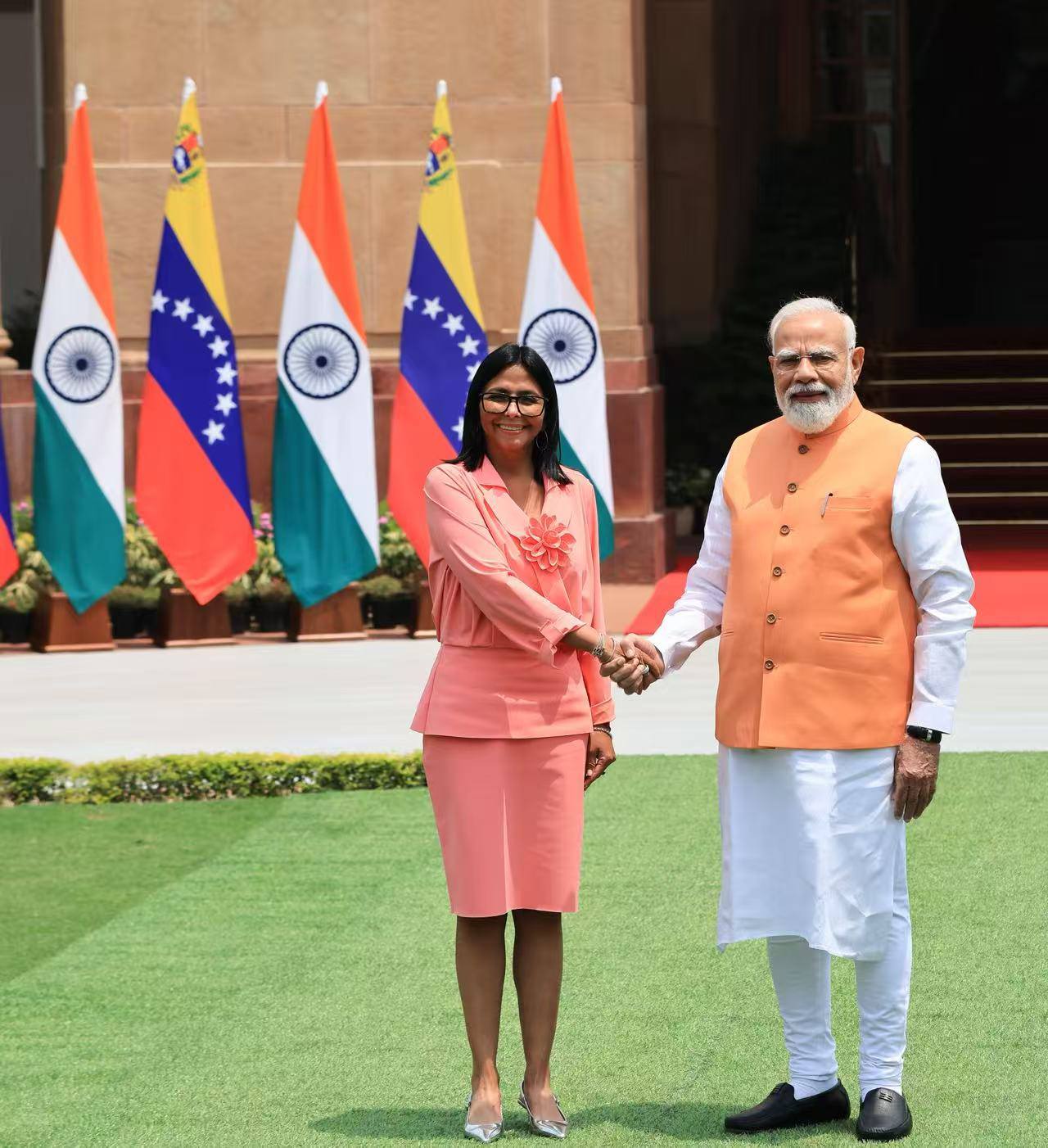
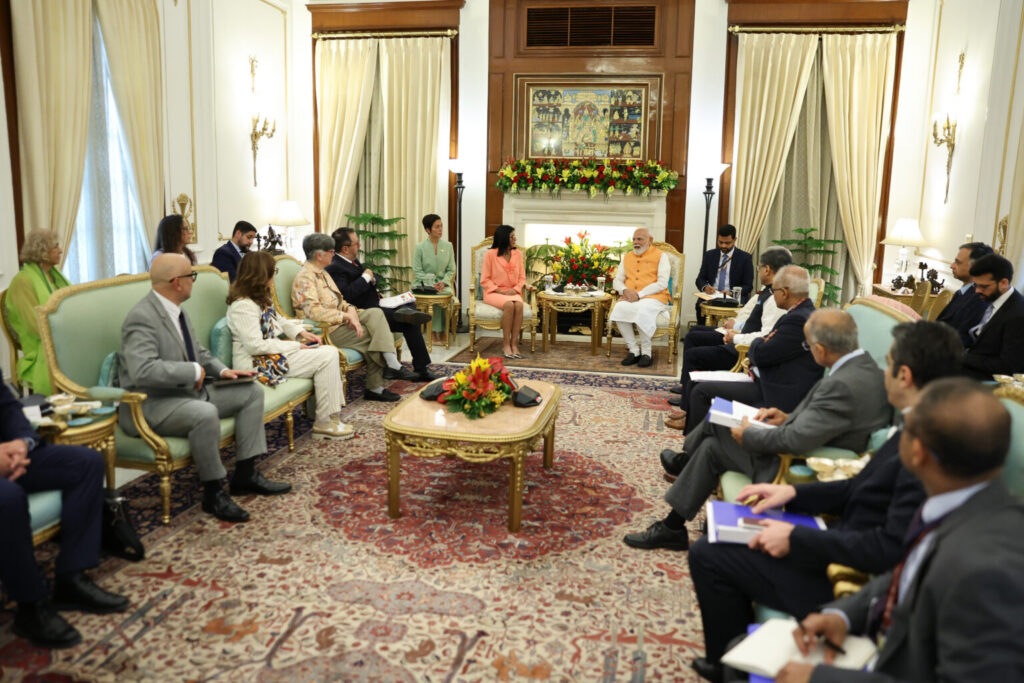
The Daily Journal — Indian Prime Minister Narendra Modi welcomed Venezuelan Acting President Delcy Rodríguez with a red-carpet reception on Thursday at the iconic Hyderabad House. The high-level meeting aims to deepen bilateral trade and secure crude oil supplies for the Asian nation amid severe disruptions in global energy markets.
Indian Foreign Minister Subrahmanyam Jaishankar stated after the official greeting that the meeting “will further strengthen” strategic cooperation between the two countries.
According to an official report from Venezuela’s presidential press office, both leaders focused their discussions on “strengthening the role of both nations within the geopolitical framework of the Global South and advancing mutually beneficial macroeconomic agreements.”
New Delhi’s Energy Urgency
India, the world’s third-largest oil importer, faces a complex situation following the outbreak of war in the Middle East. The country imports nearly 90% of the crude oil it consumes and, before the conflict, relied on shipments moving through the Strait of Hormuz for almost half of its supply. The current blockade has driven up fuel prices, put pressure on the Indian rupee, and pushed New Delhi to aggressively seek alternative suppliers in less-traditional markets such as Ecuador, Algeria, Iran, and Venezuela.
Rudrendra Tandon, a senior official at India’s Ministry of External Affairs, said that India “is aggressively pursuing new sources of crude oil and energy to strengthen its energy security.” He added that the Caribbean nation represents “an opportunity and a very important part of our plans.”
Reports from energy consultancy Kpler confirm the rapid rise of Venezuelan crude in the Asian market. Between April and May, Venezuela became India’s fourth-largest oil supplier, ranking behind only Russia, United Arab Emirates, and Saudi Arabia. In May, Indian imports of Venezuelan crude reached 319,200 barrels per day, a 13.9% increase from the previous month. Before this recovery, which followed sanctions relief measures, India had not purchased Venezuelan cargoes since May 2025.
Review of the Bilateral Cooperation Framework
Venezuela’s presidential press office reported that both delegations prioritized export-related issues during their talks. The discussions “focused on a comprehensive review of the bilateral cooperation framework, with special emphasis on the hydrocarbons sector, since India has become one of the leading destinations for the nation’s energy exports.”
Rodríguez had previously visited New Delhi in February 2025 in her former role as Minister of Petroleum. This time, she entered the negotiations under different political circumstances as acting head of state and with the support of a delegation representing the ministries of Economy, Foreign Affairs, Science and Technology, Transportation, and Communication.
Beyond the oil sector, Tandon reported that Modi and Rodríguez explored investment opportunities for Indian corporations in key sectors of the Venezuelan economy, including mining, critical minerals development, pharmaceuticals, and automobile assembly.
Washington’s Geopolitical Factor
The growing commercial relationship between Caracas and New Delhi has received strategic support from the United States. Following the capture of President Nicolás Maduro in January of this year and the installation of a new interim government in Venezuela, the administration of Donald Trump has promoted Venezuelan crude as a direct substitute for Russian oil.
Although Washington extended a temporary exemption for transactions involving Moscow’s crude oil until mid-June, the White House continues to pressure Modi’s government to reduce its dependence on Russia sharply. In line with that policy, U.S. Secretary of State Marco Rubio recently stated that the United States wants to sell India “as much energy as they are willing to buy,” while explicitly highlighting significant “opportunities with Venezuelan oil.”