The Daily Journal — A preliminary rapid damage assessment released Thursday by the World Bank estimates that the June 24, 2026 earthquakes caused $19.579 billion in direct damage to physical assets across Venezuela.
The report, Global Rapid Post-Disaster Damage Estimation (GRADE) Report: Venezuela Earthquakes – June 24, 2026, states that the disaster destroyed approximately 1.39% of the country’s total exposed capital stock.
Residential buildings account for the largest losses
The economic assessment divides direct losses into three major categories of physical assets.
Residential buildings account for the largest share of the damage, with losses totaling $9.312 billion, representing 47.5% of the nationwide total.
Infrastructure follows with $5.235 billion in losses, or 26.7% of the total physical damage. Non-residential buildings account for the remaining $5.031 billion, representing 25.7% of total losses.
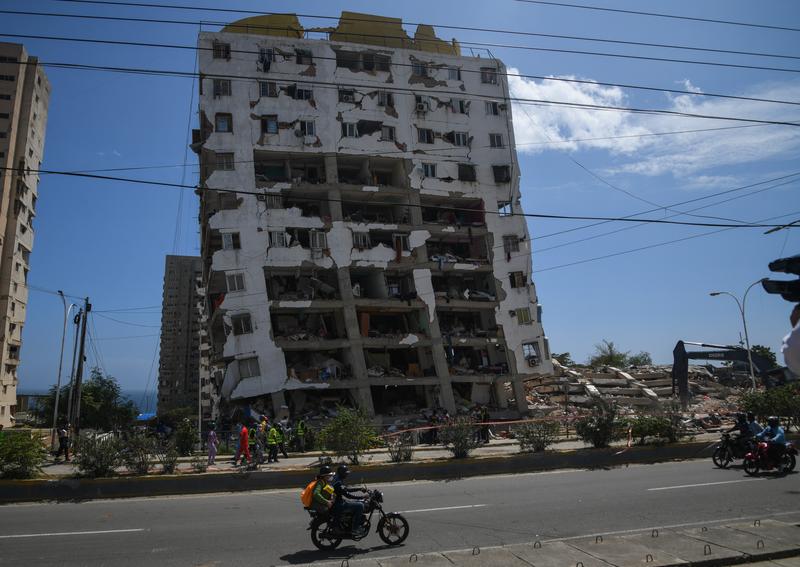
The report also notes that homes, large apartment buildings, and non-residential structures were highly vulnerable to seismic waves, particularly due to failures in masonry structures and in reinforced concrete buildings lacking adequate seismic detailing.
Central-northern Venezuela suffers the greatest impact
The earthquakes caused the most severe destruction in four states across north-central Venezuela, which together account for more than 85% of the country’s total material losses.
La Guaira recorded the highest losses in both absolute and relative terms, with $4.982 billion in physical damage. That figure represents 25.4% of nationwide losses and equals 16.62% of the state’s total exposed capital value.
The Capital District accounts for 21.8% of the country’s structural damage, with losses estimated at $4.286 billion.
Nearby Miranda reported $3.785 billion in losses, representing 19.3% of the national total, while Carabobo recorded $3.710 billion in destroyed or damaged assets, equivalent to 18.9% of the country’s overall impact.
World Bank warns about reconstruction pace
The World Bank’s technical team stressed that “the pace of reconstruction will play a decisive role in shaping the economic and social impact” of the disaster.
The institution warned that if public and private investment remain at current levels, Venezuela would need to finance reconstruction by diverting resources from other productive investments. Under that scenario, reconstruction would take more than 10 years, while productive capacity, GDP, and household consumption would remain below pre-earthquake levels until at least 2036.
To reduce those effects, the World Bank recommended a recovery package that combines public financing with measures that encourage private investment.
“If the fiscal envelope expands, greater public investment could accelerate reconstruction, while transfers to affected households would help reduce consumption losses,” the report states.
The institution also emphasized the need to address existing social gaps, noting that “recovery measures can achieve greater effectiveness when they combine physical reconstruction with uninterrupted essential services and targeted support for households,” helping prevent the disaster from deepening inequality among the country’s most vulnerable populations.