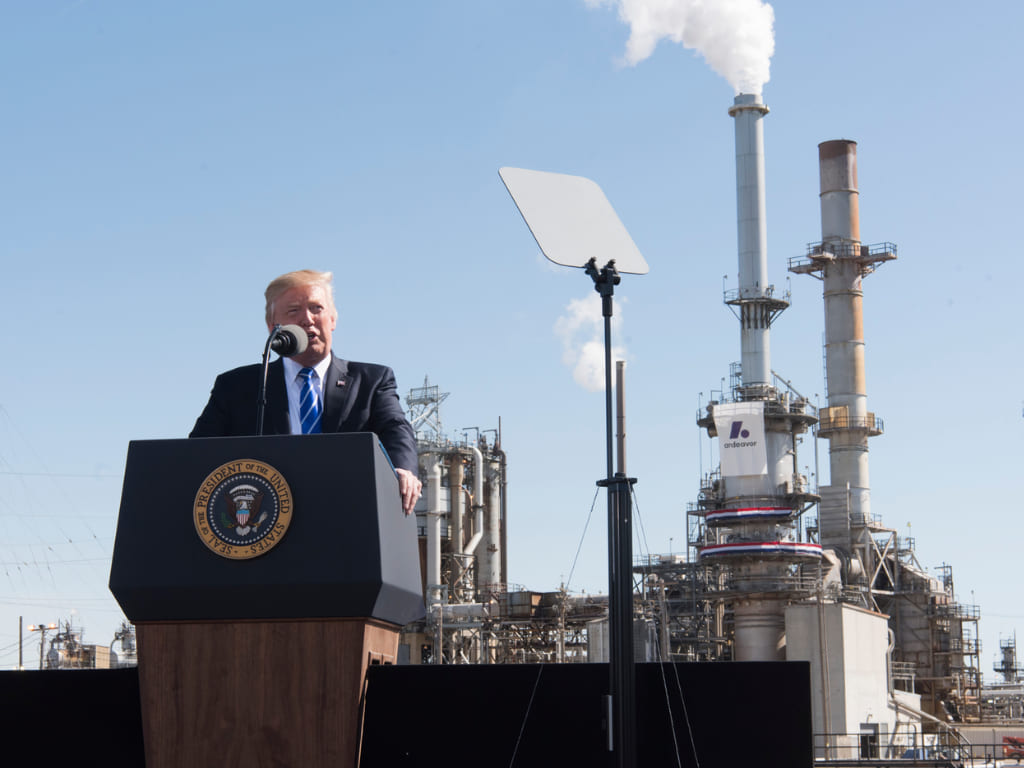
The Daily Journal. — U.S. President Donald Trump announced Friday that Washington had reached an energy agreement with the Venezuelan government that he described as “the largest oil deal in world history,” under which U.S. companies will assume majority control over more than 65 billion barrels of proven crude oil reserves.
In a message posted on his social media platform, Trump said Secretary of State Marco Rubio and Secretary of War Pete Hegseth conducted the negotiations under his direction and in direct coordination with Venezuela’s acting president, Delcy Rodríguez, whom he described as “highly respected.”
Energy and economic scope of the bilateral agreement
Trump emphasized that the agreement took shape “through a partnership with private enterprise” and said the transfer of operational control would come at “no cost to the American taxpayer.”
Regarding its impact on the domestic market and the country’s strategic hydrocarbon supply, he said the deal “more than doubles U.S. oil reserves.”
The Republican president said the increase in crude oil supplies “will substantially reduce gasoline prices for all Americans for a long time into the future.”
Bilateral relations and political impact
Trump presented the agreement as central to reshaping diplomatic and commercial relations between Washington and Caracas. According to his statement, the initiative aims to boost local economic growth while “helping to continue steering Venezuela toward tremendous success and great prosperity.”
“This transaction will greatly strengthen the already growing relationship between Venezuela and the United States,” Trump concluded, describing the agreement as an “unprecedented matter” in the two countries’ shared foreign and energy policy.
According to previous reports from Axios and Reuters, negotiations focused on more than a dozen producing oil fields containing some 90 billion barrels of proven reserves. Former allies of Chavismo — some of whom have already faced prosecution in the United States — and interests linked to Chinese companies previously controlled those fields. In exchange for granting Washington an ownership stake, Venezuela would receive investment from private companies, including U.S. firms, which would develop the fields and generate greater oil revenues for the country.
Sources cited by Bloomberg said one proposal under discussion involved a 100-year lease for several of the fields. The Washington Post reported Friday that the parties could finalize the agreement in early September and that it could prove “costly and controversial,” given that Venezuela’s Constitution defines hydrocarbon resources as assets of “inalienable public domain,” meaning that any formal transfer would require a constitutional amendment.
The war in Ukraine and tensions with Iran have intensified the White House’s interest as both factors have pushed international crude prices higher. At the same time, the U.S. Strategic Petroleum Reserve stands at its lowest level in 40 years. Trump has framed his energy push within what he calls the “Donroe Doctrine,” his strategy for U.S. energy dominance in the Western Hemisphere.
This does not mark Washington’s first move into Venezuela’s oil sector following Maduro’s fall. In January, Trump announced the transfer of between 30 million and 50 million barrels of “sanctioned” crude oil to U.S. territory and said he would control the proceeds. However, outlets including the Financial Times and Reason have questioned the scheme’s lack of transparency. Despite a commitment to provide quarterly audits, the administration has not submitted reports to Congress. At the same time, estimates indicate that Venezuela has already sold more than $13 billion worth of crude under U.S. control.
Venezuela’s interim government has not yet issued an official statement on the terms of the agreement Trump announced Friday.