Óscar Reyes Matute
Audio: https://clyp.it/hwjdmm2j
Following Sun Tzu, Napoleon warned that every soldier should carry ammunition, a well-sharpened dagger and, above all, a chicken in his backpack. Israel keeps its dagger sharp and has enough weaponry to devastate any rival; however, according to its own authorities, its supply of chicken and troops is beginning to run short.
The United States is running out of missiles, but it can simply reactivate its military-industrial empire and turn it into a profitable business for the private sector.
Iran is being strangled: despite its proclamations about the Strait of Hormuz, Tehran itself suffers from the blockade, which prevents it from exporting oil and imposes an economic stranglehold similar to the one Venezuela endured before 3E.
Israel, for its part, although it remains the regional economic and military power supported by colossal external aid, shows severe financial cracks after a prolonged war. Neither enemy propaganda nor Netanyahu’s opposition makes this claim; Israel’s own Central Bank does.
Institutional Discrepancy and War Spending
The Ministry of Finance estimates the accumulated direct cost of the conflict at $92 billion; however, the Bank of Israel puts the figure at $117 billion. This $25 billion gap — which results from accounting for debt interest, future commitments and direct investment — by itself exceeds the annual defense budget before October 2023.
Sustaining military operations costs more than $3 billion per week, plus another $11 billion spent after the conflict escalated in February following the closure of Hormuz.
Macroeconomic Impact
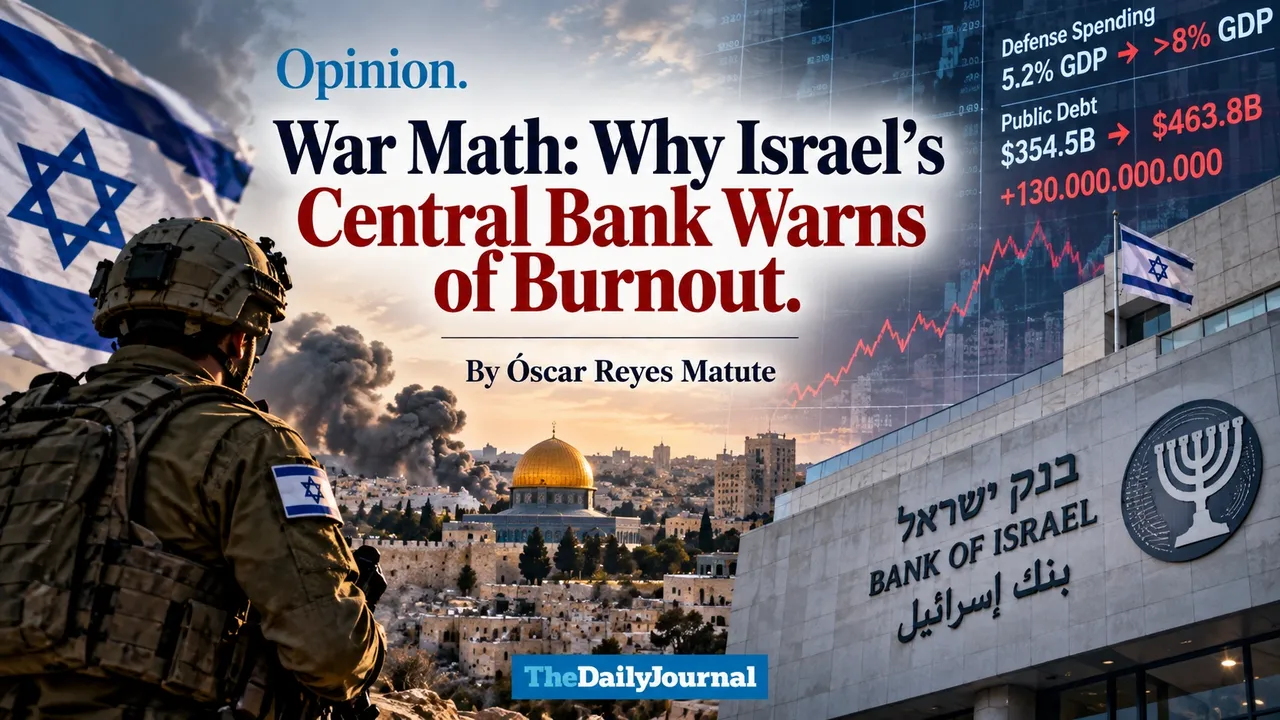
The defense budget jumped from 5.2% to more than 8% of GDP, and ten-year projections require an additional $116 billion, placing military spending at nearly 6% of GDP (compared with 3% in the United States, for example).
In less than three years, public debt climbed from $354.5 billion to $463.8 billion, adding $130 billion and pushing the debt-to-GDP ratio from 60% to 70%.
The possibility of reduced U.S. aid further increases Israel’s vulnerability. That aid has totaled $158 billion since World War II and currently amounts to $3.8 billion annually, but diplomatic erosion and possible ideological shifts in Washington threaten its continuity.
Talent Flight and Social Fracture
The technology sector — which accounts for 20% of GDP and 56% of exports — faces critical erosion. The industry relies on 300,000 highly skilled professionals; during the first year of the conflict alone, more than 8,000 emigrated. Likewise, emigration among the highest-income segment has increased by 80% since 2019. The mobilization of reservists compounds the problem, with reservists serving more than 400 cumulative days and bringing commercial productivity to a standstill.
The human impact is severe: cases of post-traumatic stress rose by 70% (60,000 people received treatment), authorities have registered more than 30,000 minors as trauma victims, and medicinal cannabis licenses increased tenfold, reaching 140,000 registrations.
The Haredi Dilemma
The demographic and fiscal divide further aggravates the situation. The ultra-Orthodox community (Haredim) represents 13% of the population, or more than one million people. Since the days of Ben-Gurion — when they numbered only 400 — the state has historically exempted them from military service so they could devote themselves to Torah study. Today, they sustain Netanyahu’s governing coalition.
Slightly more than half of ultra-Orthodox men participate in the formal labor market, and fewer than one-third pursue university studies. A Haredi household receives an average of $2,000 per month in government subsidies, while the average secular citizen pays $2,918 more in taxes than they receive in services. Projections indicate that by 2050, ultra-Orthodox Jews will represent one in four Israelis — and one in three by 2060 — shrinking the share of the population that pays taxes and serves in the military.
Despite a critical shortage of 15,000 soldiers that the General Staff has warned about, and despite the Supreme Court ruling that ended the military exemption, only about 3,000 of the 80,000 ultra-Orthodox young men of military age have enlisted.
Without productive dynamism or fairness in taxation and military service, bayonets will not suffice. Israel’s own social structure could force a dramatic turn in the conflict. Israel itself is confirming this, not through the voices of its adversaries, but through the figures from its own Central Bank.