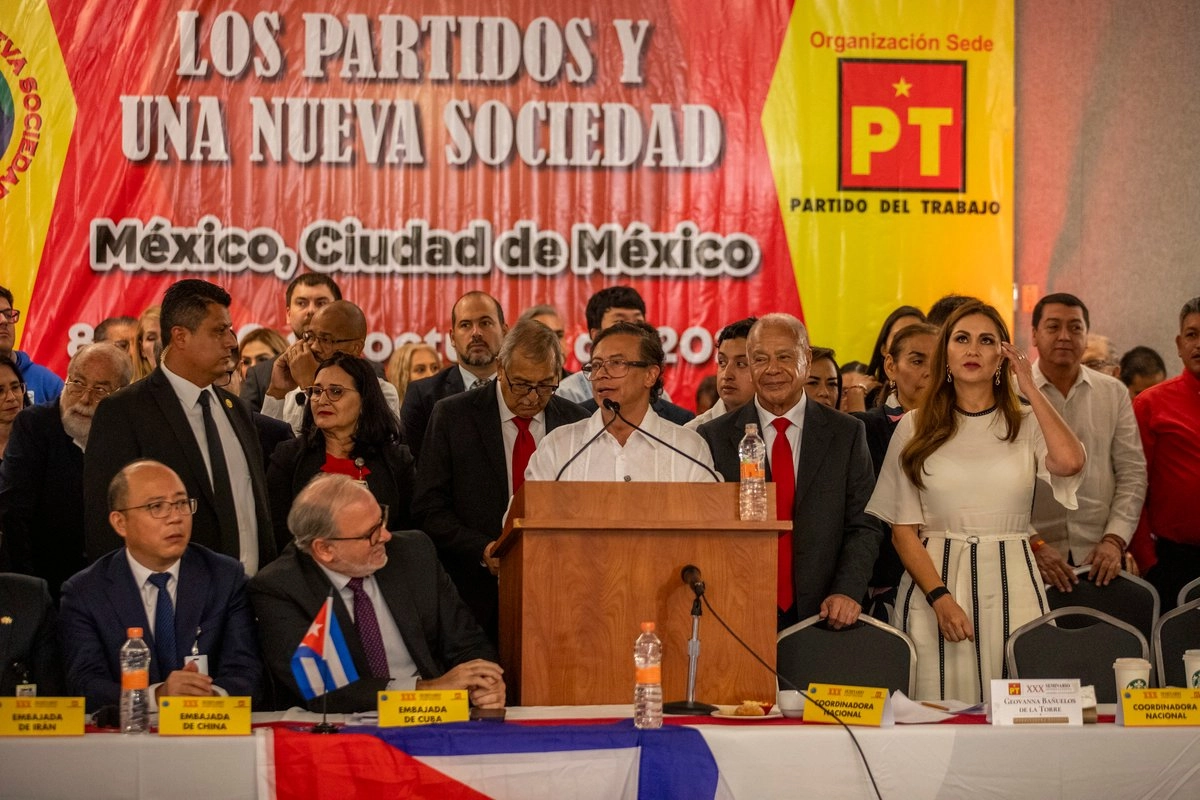
The Daily Journal.- Former Colombian President Gustavo Petro arrived at the 30th International Seminar “Political Parties and a New Society,” organized by Mexico’s Labor Party (PT) in Mexico City, to discuss the left, the climate crisis, and the future of energy resources. Instead, he found himself in a confrontation with two lawmakers from Venezuela’s United Socialist Party (PSUV) after criticizing Venezuela’s transfer of oil to the United States and asserting that Donald Trump was telling the truth when he described the resource as spoils of war.
“There can be no Chávez with oil given away to the United States,” Petro declared during his remarks. The statement evoked Hugo Chávez’s legacy and the anti-imperialist rhetoric that shaped Venezuelan foreign policy for years, prompting PSUV lawmaker Jesús Faría to interrupt him with shouts. The confrontation continued after the speech when fellow ruling-party lawmaker Tania Díaz approached the former Colombian president and accused him of remaining silent about the January 3 U.S. military operation.
Videos circulating on social media captured the incident, exposing a contradiction within Chavismo since Nicolás Maduro’s capture. While the leadership headed by the Rodríguez siblings and Diosdado Cabello negotiates oil agreements and a new relationship with Washington, sectors of the international left that supported the Bolivarian project for years now question its rapprochement with the Trump administration.
The dispute also reveals that the PSUV has not adopted a unified position toward criticism as it adjusts to the new political landscape. Faría’s and Díaz’s reactions contrast with acting President Delcy Rodríguez’s public conduct during the United Nations General Assembly, where she praised the oil agreement between the two countries.
“The man is telling the truth”
Petro devoted part of his speech to the consequences of the January 3 U.S. military operation, which resulted in the capture of Maduro and his wife, Cilia Flores. The former president questioned Venezuela’s response during the attack and highlighted the actions of Cuban military personnel who served on Maduro’s security detail.
“The survivors of Maduro’s kidnapping were left alone. Thirty-two dead. The survivors fought until their last round of ammunition,” he stated.
Petro also referred to the testimony of Yohandri Varona Torres, a Cuban soldier who served on Maduro’s personal security team.
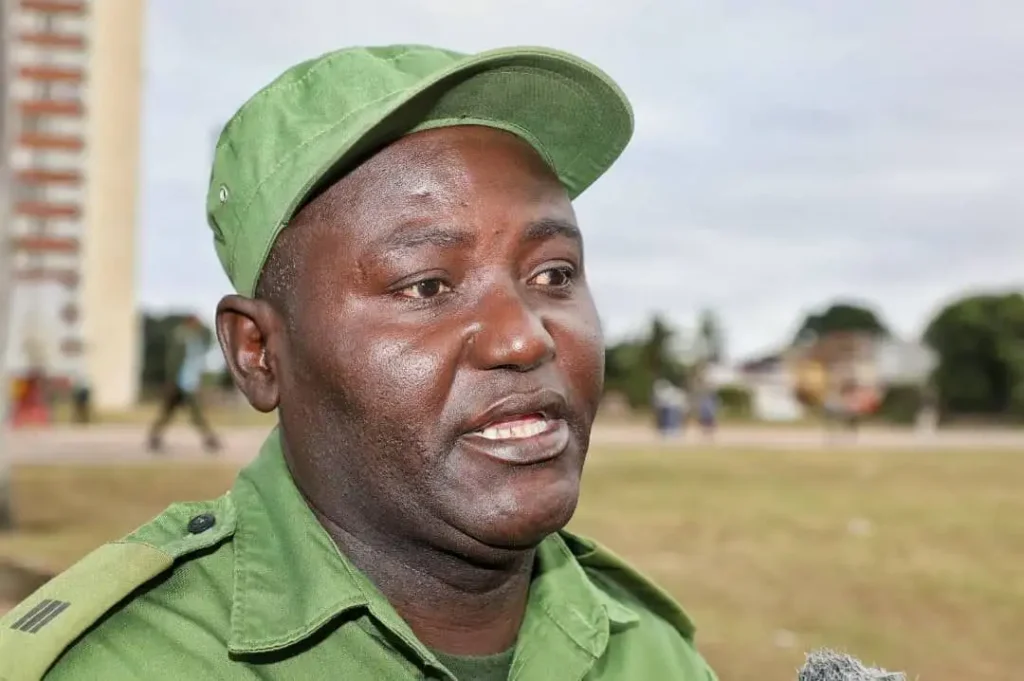
Yohandris Varona Torres at a tribute honoring the 32 Cuban military personnel who died during the U.S. military bombing of Caracas.
“It wasn’t Venezuelan soldiers who collected the bodies and prevented them from falling into U.S. hands. No. A Cuban survivor picked up each body and moved it to a storage facility outside U.S. control. That is why their families were able to bury them,” the former president recounted.
Indeed, Varona Torres told Cuban media in an interview in late January: “Nobody helped us with that, but we left no bodies on the battlefield. We kept them in one of our dormitories.”
The former Colombian president used the account to question Venezuela’s response during the attack before turning his criticism toward U.S. control over the country’s energy resources.
“When Trump goes to international events and says, ‘We won Venezuela’s oil as spoils of war,’ the man is telling the truth,” he said.
The statement immediately prompted a reaction from PSUV lawmaker Jesús Faría, who interrupted Petro from his seat.
“That’s a lie!” Faría shouted. “Tell the truth. What you’re saying is a lie. You need to have some dignity,” he insisted, according to videos circulating on social media.
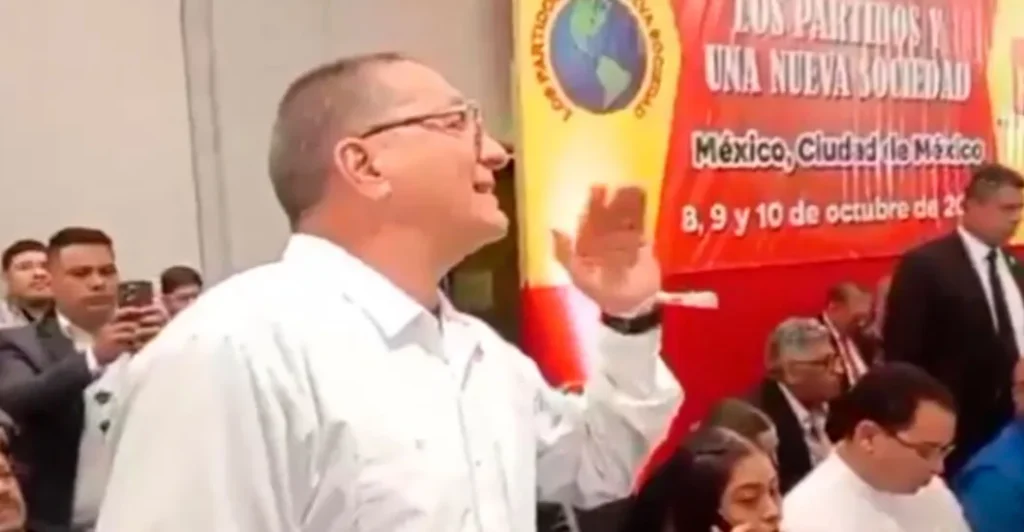
Lawmaker Jesús Faría confronts former Colombian President Gustavo Petro (Screenshot).
Petro responded that Trump had said exactly that and continued his speech.
The former president argued that Chávez’s legacy could not justify the current energy agreement with Washington.
“Chávez did not become the historic figure he is in Venezuela just to give away the oil,” he stated.
“Brothers and sisters, we are in another phase of history (…). Obviously, we must learn from history, but we cannot live on nostalgia,” he added.
The exchange took place at an international gathering of left-wing organizations and leaders. In this forum, Chavismo spent years defending its anti-imperialist identity and its alliances with governments and movements opposing U.S. influence in Latin America.
Tania Díaz accuses Petro of betraying Maduro
The confrontation did not end with Faría’s interruption. After Petro finished his speech, lawmaker Tania Díaz approached him and challenged his position regarding the U.S. military operation.
“You didn’t even ask Venezuela before saying the outrageous things you just said. I know you knew about the military operation against Venezuela, and you kept quiet. Tell the truth,” she snapped.
Díaz also called the former Colombian president “Santander,” referring to Francisco de Paula Santander, a historical figure associated with political disputes involving Simón Bolívar.
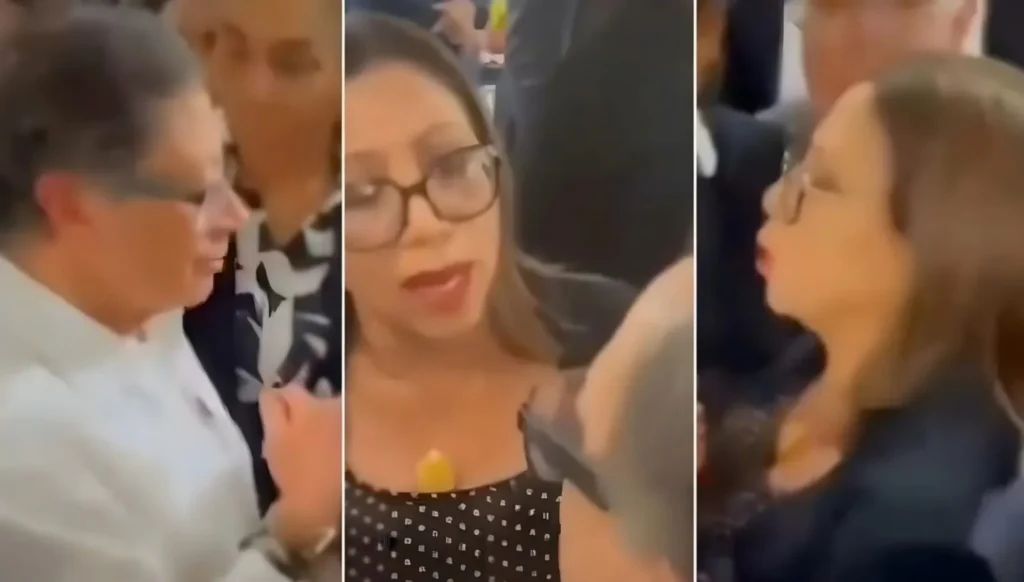
Tania Díaz confronts Gustavo Petro following his opening address at the 30th International Seminar of Mexico’s Labor Party (PT) (Screenshot).
She followed the historical reference with a direct accusation concerning Petro’s position toward Maduro.
“From the beginning, when you refused to recognize him, you betrayed him. Otherwise, he wouldn’t be in prison in New York,” the lawmaker argued, referring to disagreements between the former Colombian president and the Venezuelan government following the July 2024 presidential election.
The Colombian government’s response to that election centered on demands for electoral transparency. Then-Foreign Minister Luis Gilberto Murillo defended the principle of “no electoral records, no recognition” and called for the publication of voting records to verify the results that Venezuelan authorities announced. Petro also declined to attend Maduro’s inauguration in January 2025.
Those disagreements did not prevent the Colombian president from maintaining communication with the Venezuelan government or expressing his opposition to U.S. military intervention. However, Díaz views Petro’s stance on Venezuela’s electoral process as a political betrayal that contributed to Maduro’s isolation.
Delcy Rodríguez and the new relationship with Washington
The clash in Mexico contrasts with Delcy Rodríguez’s conduct during the 81st United Nations General Assembly in New York in September.
Rodríguez remained in the chamber during Trump’s address, in which the U.S. president defended the bombings of Caracas and Maduro’s capture. Rather than publicly confronting him then, the Venezuelan leader has advocated a bilateral “cooperation agenda.”
“To the victor belong the spoils,” Trump declared when referring to the oil agreement with Venezuela. He described it as one of the largest agreements in history and highlighted the United States’ privileged access to Venezuelan energy resources.
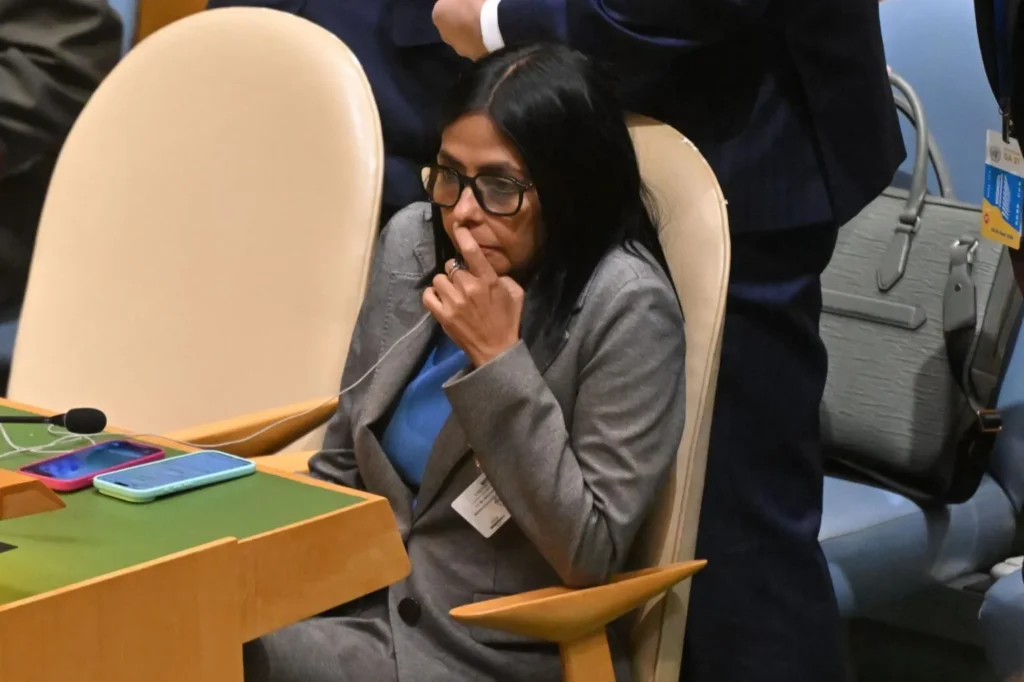
Venezuela’s interim President Delcy Rodríguez during the opening speeches of the General Debate of the 81st session of the United Nations General Assembly (UN) at UN Headquarters in New York City, United States, September 22, 2026. EFE.
In her own address to the UN, Rodríguez thanked Trump and his administration for “resuming the path of diplomatic relations and cooperation with Venezuela.” She also described the oil agreement announced on August 28 as one of the “largest ever signed.”
The contrast between the two situations is significant. While Petro denounced Venezuela’s transfer of oil to the United States and Faría and Díaz responded with personal accusations, Rodríguez emphasized the economic opportunities arising from the understanding with Washington.
Criticism emerges from chavismo’s own networks
Reactions to the confrontation in Mexico extended beyond political leaders. On social media, accounts belonging to commentators and influencers who traditionally support Chavismo and participate in campaigns backing Cuba endorsed Petro’s statements and criticized the Venezuelan lawmakers who confronted him.
One account, under the name Tere Felipe, thanked the former Colombian president for his “solidarity” with the Cuban people and for remembering the 32 Cuban soldiers who died during the January 3 operation.
“Thank you, @petrogustavo, for your solidarity and courage toward the Cuban people. For speaking the truth when others remain silent. Thank you for not forgetting the 32 Cuban heroes who fell in Venezuela. Thank you for standing with the Cuban people, who are suffering an unjust genocide…” the account posted on X on October 9, 2026.
“Thank you for speaking the truth when others remain silent,” she wrote. In the same message, she described those who confronted Petro as “unworthy” and accused them of failing to challenge Trump during his address to the United Nations.
“They are the same people who, at the UN, did not dare confront a criminal like Donald Trump, who kidnapped their president and stole their oil,” the account stated in a post on X.
The confrontation in Mexico exposes a tension that the PSUV has yet to resolve publicly: how to maintain its anti-imperialist identity. At the same time, its leadership negotiates with Washington under conditions shaped by Maduro’s capture and the United States’ influence over Venezuela’s political and economic affairs.