José Gregorio Yépez
Following the events of January 3, Venezuela’s political landscape has been redrawn, giving rise to unprecedented circumstances for the country. Interpretations abound, and new words and expressions have emerged from every corner.
Perceptions range from denunciations of a “trusteeship” to those who, with relief, say: “Thank goodness it happened.”
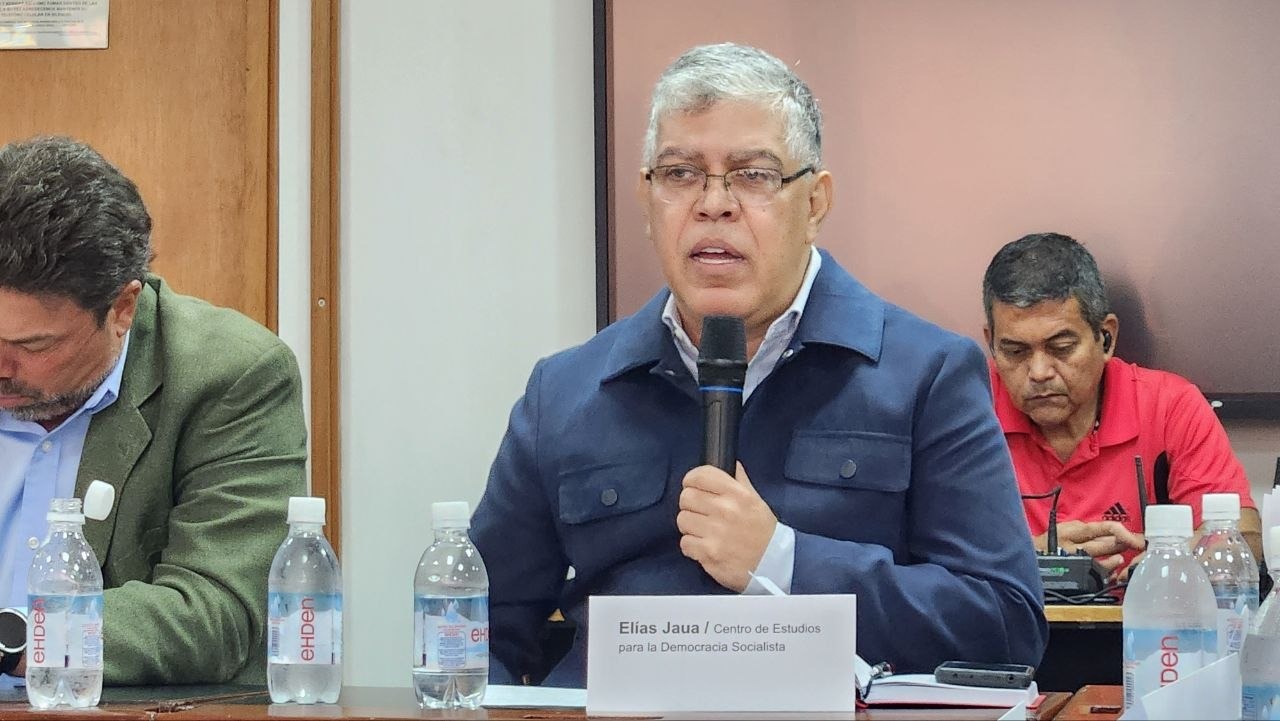
The political and multidimensional crisis facing the country is intrinsically linked to the polarization that has divided Venezuelan society. Nevertheless, Elías Jaua argues that the Government has a duty to defend sovereignty at all costs.
His concerns extend beyond territorial issues. He highlights what he views as the distortion created by the administration of revenues from oil sales through an account managed by the United States government.
The former Vice President of the Republic during the administration of Hugo Chávez maintains that it is necessary to “demand before the International Court of Justice the immediate restoration of the Venezuelan State’s control over the nation’s revenues.”
After the Civic Forum’s Convergence Tables event, we had the opportunity to speak with the political leader about the political and geopolitical context in which Venezuela finds itself.
The gendarme intervened
—You speak of a catastrophic stalemate that led us to lose the Republic. When did we lose it, and how do we recover it?
—We lost it on January 3 during the military aggression carried out by the United States government. From that point on, a trusteeship was imposed, leaving Venezuela without sovereign control over its resources and national revenues, which are deposited in a sub-account of the U.S. Treasury Department. The country has lost its capacity for political self-determination because none of the political actors dares to build a solution or regulate the conflict; instead, everyone waits for directives from the current U.S. administration. We have lost it because our foreign policy is conditioned, and we have lost it because a foreign government can send military vessels into our airspace and deploy its security agencies without any possibility of preventing it.
—How can this be reversed amid the current geopolitical situation? How can it be reversed internally in a country divided into three poles: the Government, the bloc grouped around María Corina Machado and Edmundo González, and a broad political sector that demands participation but cannot secure it?
—I would say that this broad sector is decisive in creating a political space capable of achieving national cohesion and demanding the restoration of the Republic. However, under the current Constitution, the Venezuelan State is obligated to preserve the Republic’s sovereignty. Therefore, it can turn to the appropriate international bodies and formally denounce this violation.
Jaua pauses to emphasize his point:
“Not merely a violation… a deprivation of its economic sovereignty! Of its political sovereignty. The State must demand before the International Court of Justice the immediate restoration of control over the nation’s revenues by the Venezuelan State, which constitutionally and sovereignly must administer them under the fiscal oversight mechanisms established by the Constitution itself.”
—Realpolitik suggests that this is unlikely to happen. So how should Venezuelan political forces reposition themselves under these circumstances? How can they regroup?
—International denunciation must not be underestimated. While it is true that the current U.S. government disregards international law, international law still exists. A sovereign state must establish legal precedents for future claims it may need to make.
—To leave a record of what is happening.
—To leave a record of the situation it is being subjected to. It must also denounce this situation before the international community.
After presenting this argument, he pauses and shifts his analysis toward domestic affairs.
He acknowledges that:
“The most difficult challenge is achieving a national agreement capable of creating a democratic, peaceful, and electoral solution to Venezuela’s situation. That is what would provide the strength—the cohesion of the nation—to demand the restoration of the republican model.”
—And how can such a political agreement be built? You have said that Venezuelan politicians of this generation do not know one another and have not established mechanisms for understanding. How can these mechanisms be built under current conditions?
—First, the dialogue spaces that have been opening must genuinely include all sectors. If even one sector feels excluded, we will be planting the seeds of a new fracture and future conflicts.
—How can Oscar Figuera’s Communist Party and Vente Venezuela coexist in the same spaces when even their own ideological allies reject them?
—The responsibility lies in the willingness of those who currently have the capacity to convene.
—The State.
—Yes, the State. But not only the government. Parliamentary forces as well. All parliamentary forces represented in the National Assembly should issue that call to all political and social forces. Too many people are being left out. A consensus among four parties and Fedecámaras—with some trade unions—may be imposed, but it will not persuade.
—That requires trust. What paths exist to build the trust needed to create the plural space required to solve the country’s multidimensional crisis?
—Trust cannot be decreed. It must be built. It begins when everyone is seated at the same table, talking, presenting ideas, and reaching agreements that, if not satisfying all conflicting interests, at least move toward an agenda in which everyone feels represented. But at this moment, more than trust, what is needed is a willingness to act in the country’s interest—a profound love for Venezuela.
We cannot pretend nothing is happening.
He pauses again. As if searching through an archive of memories, he speaks with concern:
“One cannot help but be astonished that in every forum people are discussing whether we should reform the judiciary, political conditions, or labor laws, as though Venezuela currently had the autonomy to determine such matters.”
“The Labor Law, for example, will be reformed more in accordance with the interests of multinational oil companies, just as the Hydrocarbons Law was reformed. So what are we talking about? We cannot continue pretending nothing is happening, as young people would say, given the grave situation Venezuela faces,” he remarks with a sarcastic smile.
The sociologist then turns to history.
“Venezuela has lost the Republic twice: in 1814 during the period known as La Bovera, and again on January 3, 2026. That comparison illustrates the gravity of the situation.”
“What enabled the restoration of the Republic after 1814? The unity of all patriots. Bolívar finally sat down with Mariño, Bermúdez, and the others. Piar liberated Guayana. Bolívar stated clearly: we cannot have a Republic while slavery exists. We cannot have a Republic while Indigenous peoples remain marginalized. We cannot have a Republic without education. Bolívar proposed a social consensus that made political unity possible and allowed us to advance all the way to Upper Peru to resolve that conflict,” says the former Vice President.
—You have described democracy as a means of regulating conflicts of interest, and you also speak of putting the country first. That has not happened, and it led us to this ‘catastrophic stalemate.’ What triggers do you see that could truly change this situation?
—Unfortunately, I believe those triggers will emerge as the occupation and trusteeship deepen. This process is only beginning. Pressure aimed at changing laws and institutions in favor of the occupying power’s interests, together with the occupying power’s increasingly visible military presence, will eventually awaken public consciousness.
—When people feel the boot on their neck.
—Unfortunately, yes.
Healing the wounds
—You have spoken about the wounds we carry as a society. Where do you see those wounds, and how can they be healed?
—First, through recognizing one another. We became trapped in competing narratives. Chavismo has its narrative. Chavismo won the 1998 election, initiated a broad constituent process, and submitted the Constitution to a popular referendum, which was rejected less than a year later. A coup d’état took place. Chavistas were persecuted, criminalized, and demonized. Later there was an attempt to regulate the conflict through the 2004 recall referendum, which brought a period of stability. The conflict did not disappear, but it ceased to be existential until Commander Chávez’s death. Afterward, the conflict once again became antagonistic and existential. The goal became the annihilation of the other side.
“To heal these wounds, we must first recognize one another. No one is going to annihilate the other side; that has already been proven. That is the catastrophic stalemate. Neither side succeeded in making the other disappear. Then, as Gramsci almost prophetically described, a ‘foreign sentinel’ arrived and essentially said: ‘If you cannot stop killing each other, I will destroy both of you.’”
Jaua describes recognition of the other as “the necessary condition.”
“We must overcome the political denial that has characterized us. The confrontation left wounds that must heal; there is pain. Just as there are people who became victims of unjustifiable and severe state repression, there are also Chavistas who, in their communities and apartment buildings, were beaten, publicly humiliated, stripped naked, and burned. That debt must also be settled.”
Individual responsibilities
Jaua warns that political identities should not be treated as collective culprits.
“Political identities cannot be labeled as responsible for wrongdoing. Responsibility must be individualized so that these events do not happen again in Venezuela. If we remain at the level of historical narratives saying ‘Chavismo did this’ or ‘the opposition did that,’ nothing will change.”
He adds that maintaining those labels will prevent reconciliation:
“There will be no reunion. On the contrary, there will be repetition, because individuals responsible for wrongdoing hide behind broad accusations directed at political identities.”
“In some ways this happened to us. It was one of our mistakes. Where are those responsible for the Caracazo? As a State, the Bolivarian Revolution had the opportunity to pursue accountability and did not do so. We denounced the massacre, the Caracazo, but not a single individual was held accountable for one of the worst massacres in contemporary Venezuelan history. That must never happen again.”
—If you had to make a public mea culpa regarding your political actions, what would it be?
—Having contributed, at certain moments, through my opinions, to extreme polarization. And later, not having accumulated enough political strength to reverse the polarization that engulfed us. In 2018, at the beginning of the PSUV party congress, we made an effort to prevent the situation from escalating to this point.
In a reflective tone, he concludes:
“Unfortunately, there was no space for the discussion needed to develop that effort fully. Then events such as Guaidó’s parallel government unfolded, and we entered a logic of war. I believe I could have done more to make the logic of politics prevail.”