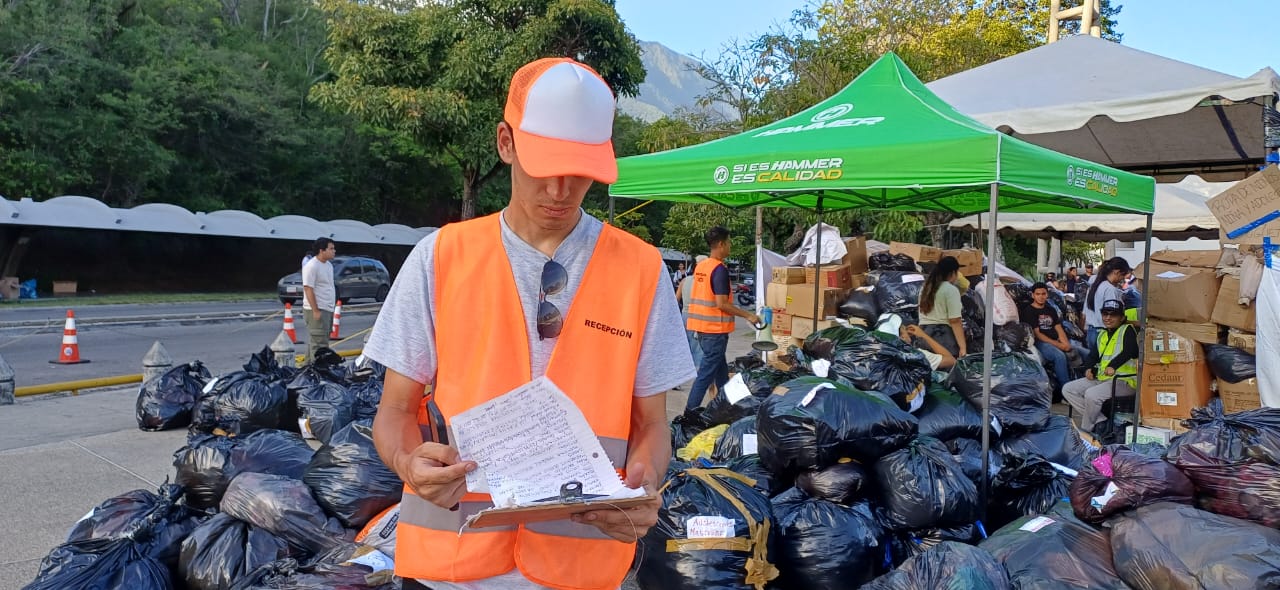
He studies dentistry at the Central University of Venezuela and chose to put his experience in event organization at the service of solidarity at the collection center located in Rectorate Square.
By Vanessa Davies
The Daily Journal.— Good intentions alone are not enough to respond to a catastrophe. It also takes logistics, work routes, and operational flows for distributing clothing, food, water, cat food, and dog food. That is exactly what Olayo Pereira provided. A dentistry student at the Central University of Venezuela (UCV), Pereira chose to place his knowledge at the service of solidarity. Without seeking attention, he focused on keeping the collection center at UCV’s Rectorate Square running smoothly.
“I’m not a politician or anything like that. But I was going crazy sitting at home. I work in events,” he explains.
His experience organizing events helps him understand workflows, how to receive donations, what to do with everything that arrives, and how to dispatch supplies efficiently. Wearing an orange vest and a cap, he is often seen putting up a tent with a broomstick or unloading boxes of humanitarian aid. What they will not see is him praising himself on social media. That is simply not who he is.
“Everything I do comes from the heart. Social media can drive you crazy because it gives you relevant information, but it also fills you with stress and anxiety. And there are too many people chasing publicity, and that’s not me.”
He started “from the bottom” immediately after the two earthquakes struck on the afternoon of June 24. He recalls spending the following day clearing rubble in San Bernardino. Then, on Friday, June 26, “at 5:30 in the morning, I was going to help in the kitchen because I enjoy cooking, but they already had their own structure. Everyone had completely forgotten about clothing. Without the organization put together by two people…”
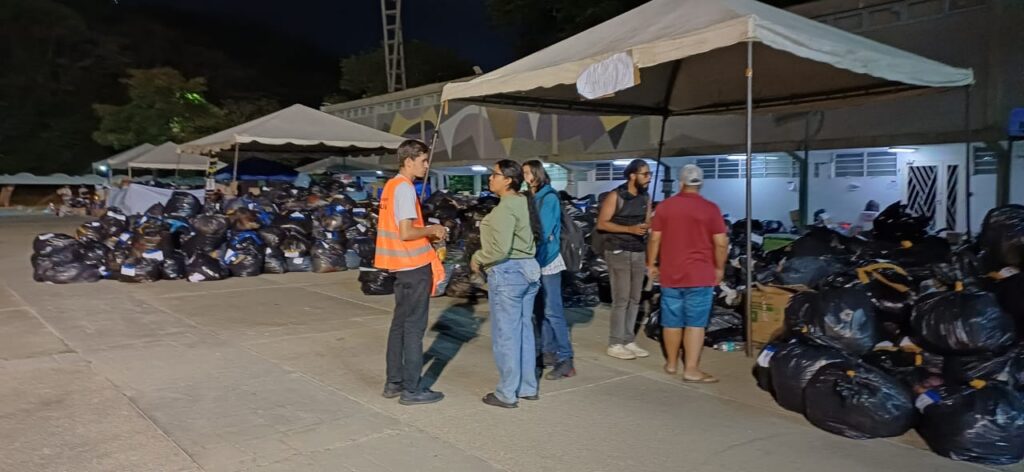
Hand-to-Hand Delivery
Pereira works with his cellphone, of course, but he never turns the camera toward himself for photos.
“I use my phone exclusively to stay organized.”
He has coordinated the departure of truckloads of donations.
“By Monday, more than 180 trucks loaded with clothes, sheets, and towels had already left. They first went to La Guaira, El Junquito, San Bernardino, Parque del Este, and Parque del Oeste.”
He regrets that after the tragedy, obstacles in the official sector began to appear.
“On Sunday, June 28, I arrived at a collection center without my vest. As soon as I got out of the vehicle, someone told me, ‘That’s going somewhere else.’ I asked who was receiving it, and they answered that it was going to this place and that place. I replied again, ‘This will go directly into the hands of the people affected.’ When I showed them my vest, their masks fell off. They wanted to stop everything. If I hadn’t stayed alert, they would have taken everything just to leave it sitting there.”
Despite those obstacles, he has kept the collection center operating.
“We send supplies once we have designated specific areas. We have tried to be as transparent as possible, keeping both paper and digital records.”
The center has also received donations from the University of Zulia, the University of the Andes, Táchira, and Ciudad Guayana.
“Young people, with enormous hearts, have done the work.”
Pereira is grateful that volunteers continue to arrive.
“The number of volunteers is beyond words, and I thank every one of them for lending their hands. My deepest condolences for what our country is going through, but now we all share one heart, and that heart is Venezuela.”