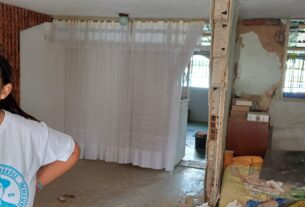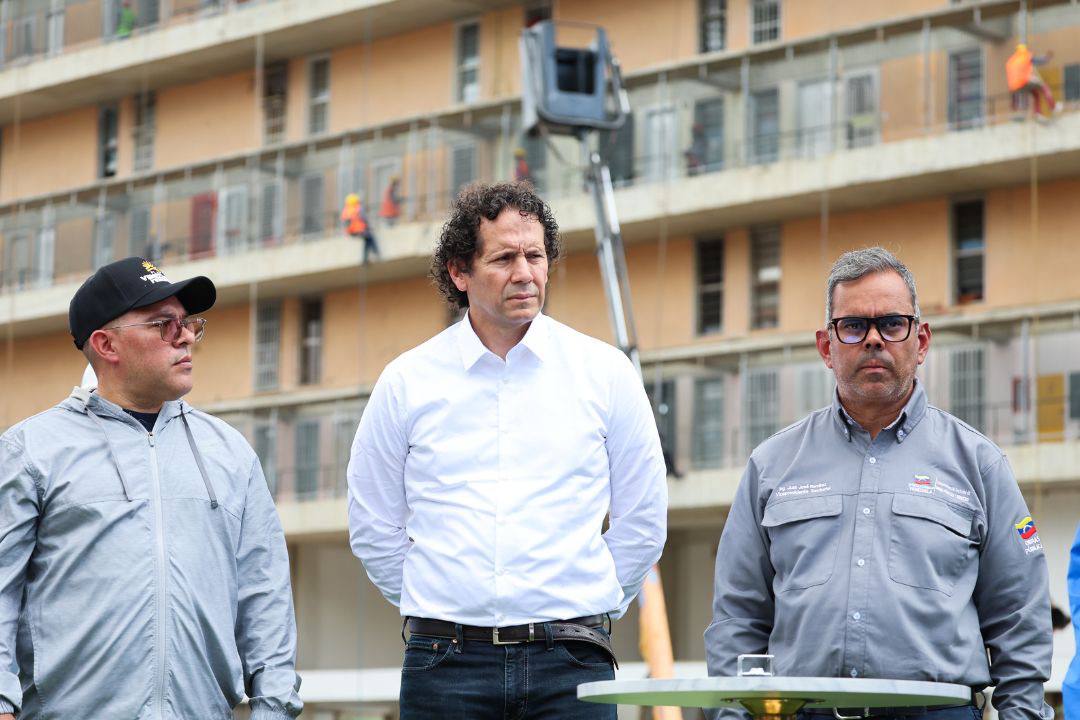
The presidential commission led by Francisco Garcés has already inspected approximately 6,000 residential buildings. Beginning July 7, volunteer engineers from the Venezuelan College of Engineers joined the assessment efforts.
By Vanessa Davies
Three colors have taken on a new meaning in Venezuela since the earthquakes of June 24: green, yellow, and red. The rapid assessments conducted by the Presidential Commission for the Evaluation of Housing and Infrastructure Habitability have classified more buildings as green—safe for occupancy—than as red —unsafe to inhabit for the time being. Even so, many families continue to wait outside their residential complexes, hoping for a definitive answer that will allow them to return home.
“We have evaluated nearly 6,000 buildings across seven states. Of course, there is still data to collect. Still, every one of these inspections has followed the guidelines established by the presidential commission, which are based on the national protocol we developed several years ago and which has been internationally validated,” explained Francisco Garcés, president of the presidential commission and Venezuela’s newly appointed Minister of Transportation.
According to Garcés, between 12,000 and 15,000 additional structures still require inspection. To accelerate the process, volunteer engineers from the Venezuelan College of Engineers (CIV) joined the inspection teams on Tuesday, July 7.
“There is an urgent need to assist people who no longer feel safe in their homes, especially those living in large residential developments and apartment complexes,” Garcés emphasized.
In those cases, the objective is to verify conditions and restore confidence. “If the structure shows no damage and the building receives a green classification, residents can return.”
A red rating is not a final verdict
The initial inspection, Garcés stressed, primarily aims to provide reassurance—or, when necessary, to advise families to seek temporary alternatives.
“The purpose is to determine whether a structure is safe or unsafe for occupancy. It does not determine whether the structure is earthquake-resistant. Likewise, a building that receives a red classification does not necessarily have to be demolished.”
The engineer explained that once the first round of inspections concludes, authorities will move into a second phase.
“At that stage, buildings classified as yellow or red will undergo a much more detailed evaluation to determine the appropriate course of action.”
Garcés also clarified that, regardless of residents’ wishes, “repairs can only be carried out on structures that received a green classification and have been deemed safe.”
Buildings requiring repairs “must comply with the transitional regulations that will be established, because repairing a structure with a yellow or red classification requires adherence to different technical standards.”
The cost of those second-phase repairs, he added, forms part of the planning process “and of the financial mechanisms that both the public and private sectors will ultimately develop to support the affected population.”
The engineer reiterated that earthquakes cannot be predicted. He also underscored that Venezuela has mandatory seismic-resistance standards, along with regulations governing masonry and reinforced concrete construction, which all professionals involved in designing, planning, or constructing buildings throughout the country must follow.
As Garcés emphasized, engineers and architects bear responsibility for ensuring that these standards are properly applied.