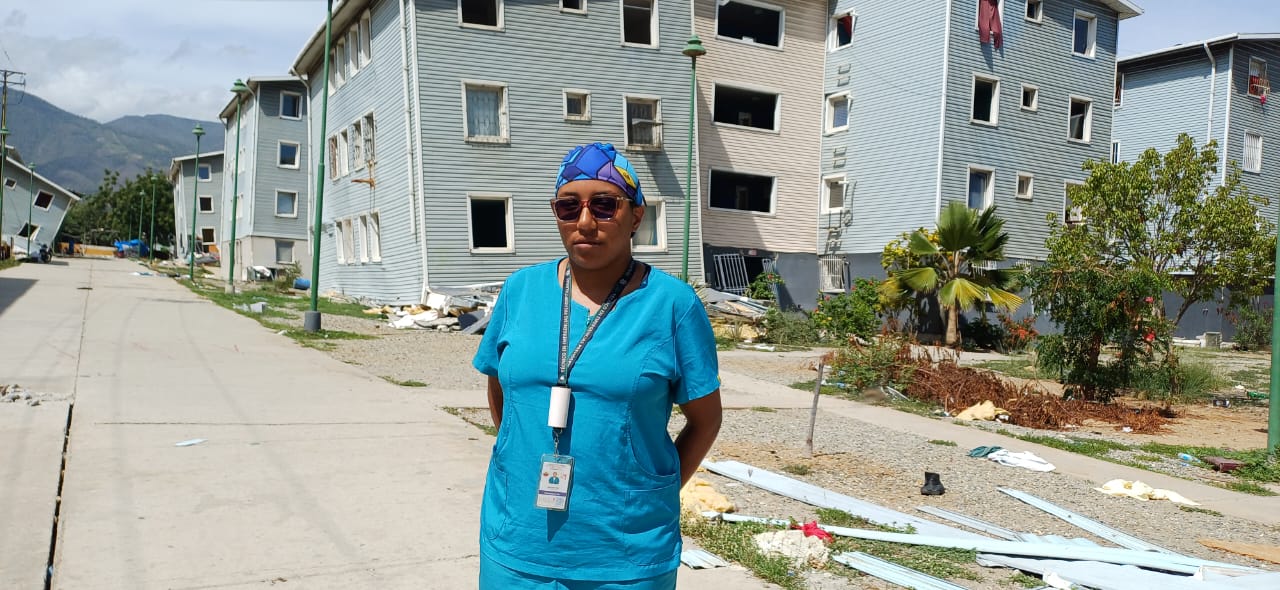
Why is finding a loved one’s body so important for grieving families? “Finding the body means you can bury it and have a place to visit,” emphasizes paramedic Emili Quintero, who is stationed in Playa Grande.
By Vanessa Davies
Some people choose to carry heavy crosses. Emili Quintero appears to be one of them.
A paramedic by profession and by calling, she embraced the joyful challenge of rescuing survivors trapped beneath the rubble left by the twin earthquakes that struck La Guaira on June 24. She also accepted another painful responsibility: recovering the bodies of those who did not survive.
Emili worries about the race against time between demolition and debris removal—tasks driven by machinery and costs—and the desperate search carried out by families hoping to find loved ones buried beneath the disaster zone.
She now supports operations at the emergency post located in the Gran Misión Vivienda Venezuela Hugo Chávez housing complex in Playa Grande. There, she has witnessed the bodies of children, mothers mourning irreparable losses, and families struggling to understand what happened.
She knows how heavy machinery behaves in the field.
“The Jumbo excavator opens access points, removes walls, and does the work we simply cannot do with our hands. The telescopic crane also lifts one concrete slab at a time. It works a little more slowly, but it is also efficient. The Jumbo tears everything apart, and then we have to dig carefully. You need an experienced eye if you want to find the bodies,” she explains.
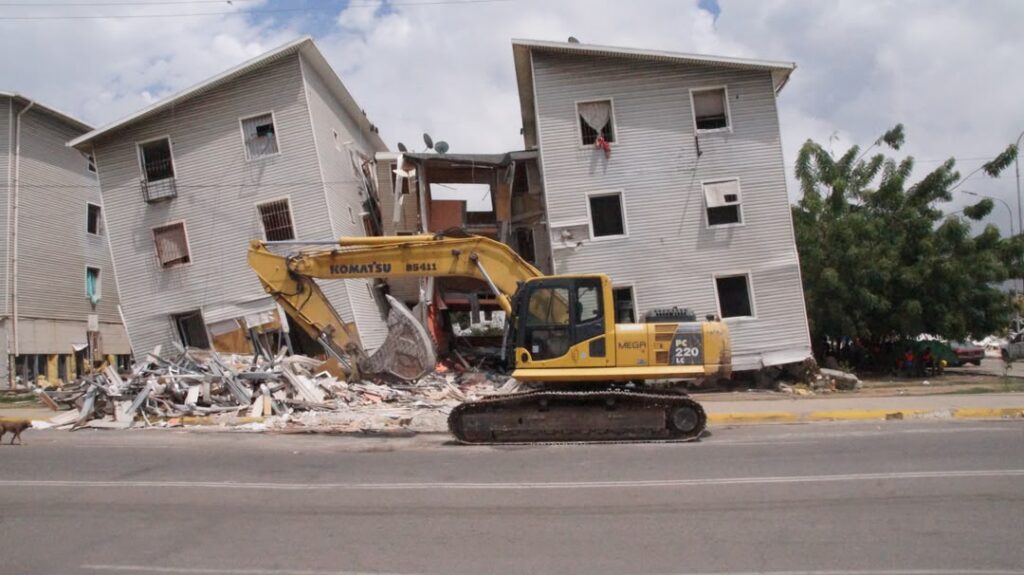
Hugo Chávez Housing Complex, Playa Grande, La Guaira. Photo: Oswaldo Rivero
—How should body recovery take place?
— “It is a very delicate process. For example, in this housing complex, the buildings are four stories tall, and every ground floor collapsed. We need heavy machinery, because it allows us to recover bodies intact. But everything depends on how the building or house collapsed. Many structures fell like dominoes, making recovery much more difficult. If we do not have machinery, then we sometimes have to perform amputations so families can at least receive part of their loved one’s remains and say a proper goodbye.”
—Why is the body so important in a situation like this?
— “Finding the body gives you certainty that your loved one has died. Other people still hope someone survived or ended up somewhere else. Many people were in shock. The place was horrifying. Dust filled the air, and no one could see anyone. Finding the body means you can bury your loved one and visit them. You can go to a place and say, ‘My brother, my mother, my son is buried here.’”
The body makes farewell possible, Quintero repeats.
This disaster has become the largest emergency she has faced in her 26 years. Although the subject still gives her goosebumps, her determination to help outweighs every other emotion.