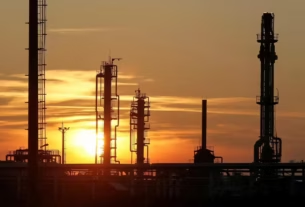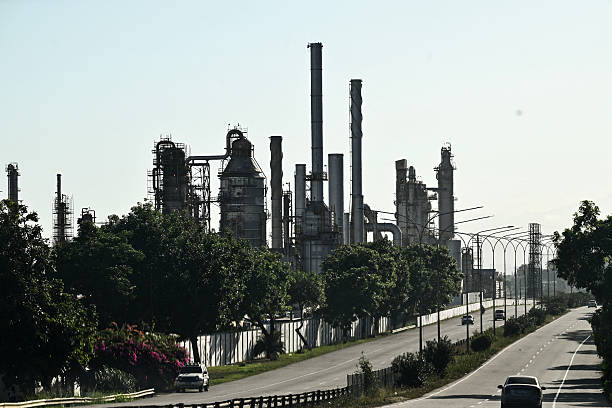
Reuters — Venezuela’s Paraguaná Refining Complex, in the country’s west, once symbolized the nation’s oil wealth and its ambition to transform vast crude reserves into fuels and export revenue. Today, however, the complex in Falcón state, with the capacity to process 955,000 barrels of crude per day (bpd), operates at only a fraction of its potential after decades of decline.
In the months before the powerful earthquakes that struck Venezuela last month, Reuters visited the areas surrounding the Amuay and Cardón refineries, which make up the Paraguaná complex, as well as one of the country’s other two active refineries. Reporters interviewed nearly 50 workers, contractors, residents, and industry experts.
An employee at Amuay, which has a processing capacity of 645,000 bpd, described the facility as “ugly and rusty,” citing nearly full open-air waste pits and leaks from pipelines and valve stations.
Workers said years of insufficient investment, equipment failures, and shortages have left Paraguaná struggling to produce the fuels Venezuelans need.
The investigation found severe deterioration and limited maintenance at the three facilities, highlighting the challenges Venezuela faces in restoring its oil infrastructure, even as U.S. President Donald Trump has pledged US$100 billion in foreign investment.
Although Venezuela’s refineries rank among the country’s most deteriorated assets, they also remain essential for domestic fuel supply. Even so, industry executives and analysts told Reuters that foreign investors are unlikely to commit funds to the refining sector in the near term.
According to energy analyst Oswaldo Felizzola, recovery efforts following the two earthquakes—which killed more than 5,000 people and caused widespread destruction, particularly in the coastal state of Vargas—have made the refineries’ future even more uncertain.
“Right now, the priority appears to be rebuilding Vargas state and addressing the tragedy caused by the earthquakes across the country,” he said.
Felizzola added that any major investment in refining will likely wait until 2027 or later, as the government focuses on increasing crude oil production. He estimated that restoring Venezuela’s refining capacity would require at least US$20 billion, an assessment shared by other industry experts interviewed by Reuters.
Renewed interest in Venezuela
Several foreign oil companies have expressed interest in Venezuela this year after U.S. forces captured President Nicolás Maduro on January 3.
However, those companies have little incentive to rehabilitate Venezuelan refineries because the United States already has facilities capable of processing Venezuela’s heavy, high-sulfur crude.
That reality leaves Acting President Delcy Rodríguez’s government with limited prospects for raising funds to restore the refineries, whether through foreign oil companies or the facilities themselves. The refineries supply fuel to the domestic market at prices far below operating costs because of decades-long subsidies.
Conditions at the refineries remain critical.
Workers and a recently retired engineer said the Amuay flexicoker, which once converted low-value heavy residues into cleaner, higher-value fuel, now sits idle and blackened.
The engineer said the plant has no realistic chance of recovery after years of dismantling to obtain spare parts.
“If we needed a pump, we took it from there. If we needed piping or an instrument, we got it there,” he said.
Major oil companies have remained cautious about investing in Venezuela, even in more attractive sectors such as crude oil and natural gas production. Exxon Mobil and ConocoPhillips left the country in 2007 after then-President Hugo Chávez expropriated their projects.
Many foreign energy companies have signed memorandums of understanding for exploration and production projects. Still, negotiations with the government to finalize contracts have progressed slowly since lawmakers reformed the country’s energy legislation.
Asked about Venezuela’s refineries, a White House spokesperson said the United States is not participating in their reconstruction while noting that Venezuelan oil exports recently reached their highest level in seven years.
Regulations approved in July, which complement the recently amended Hydrocarbons Law, created a licensing system that allows private companies to operate refineries—previously controlled exclusively by PDVSA—and market the fuels they produce.
However, analysts said the new framework remains unattractive to many investors, partly because it introduces a new tax of up to 5% on refiners’ gross revenue.
Despite holding some of the world’s largest crude oil reserves, Venezuela has struggled over the past decade to produce enough fuel to satisfy domestic demand, which currently stands at about 250,000 bpd.
Workers and contractors said the Paraguaná complex has not undergone any major repairs this year after the Chinese company Jiazhan Shaelion reduced its operations there.
A Jiazhan employee said the company, one of PDVSA’s main refining contractors, is completing an outstanding project but has not reached a new agreement with the state oil company.
When Washington granted licenses this year to foreign companies seeking to expand operations or return to Venezuela, it excluded firms from countries it considers adversaries, including Russia, China, Iran, North Korea, and Cuba.
Representatives from PDVSA, the Venezuelan government, and Jiazhan Shaelion did not respond to requests for comment.
At PDVSA’s smaller refineries—Puerto La Cruz, with a capacity of 187,000 bpd, and El Palito, with 146,000 bpd—local contractors have carried out recurring repairs since last year on a catalytic cracking unit that has experienced repeated problems, as well as on the facilities’ electrical systems, according to five plant employees.
Iranian state-owned companies completed the last major overhaul at El Palito in early 2024.
Subsequent efforts to secure sufficient electricity and allow the refinery to operate independently from the national grid proved inadequate during the emergency created by the June earthquakes. A key transmission line failed, forcing the refinery to halt operations for about two weeks.
The refinery resumed operations in mid-July and plans to carry out a major maintenance shutdown in the coming weeks.
In April, Jovanny Martínez, PDVSA’s Vice President of Refining, said smaller repair projects had enabled El Palito and Amuay to recover processing capacity of approximately 20,000 bpd each.
Crude exports rise
The refining sector’s problems contrast sharply with rising crude oil production.
Since January, under strict U.S. oversight of Venezuela’s oil revenue, production has increased, and exports have climbed from fewer than 800,000 bpd to nearly 1.2 million bpd.
Even so, refining has received little attention.
“In the current political climate, the U.S. administration wants to see that oil exported,” said Eric Smith, Associate Director of the Tulane University Energy Institute.
Smith added that only after Venezuela achieves “stability and creditworthiness” will authorities and investors focus on larger projects, including refinery upgrades.
Speaking to reporters in June, U.S. Energy Secretary Chris Wright highlighted the ability of U.S. refineries to process Venezuelan crude.
“A large amount of Venezuelan oil is reaching refineries in the United States,” he said.
One of the biggest obstacles to encouraging the repairs the sector needs remains Venezuela’s extremely low gasoline prices. State-owned refineries supply state-controlled service stations at government-set prices, leaving Venezuelan fuel among the cheapest in the world.
Revenue from domestic fuel sales could provide financial relief for Rodríguez’s government, but only if it raises gasoline prices. This unpopular measure appears unlikely in the short term amid growing social tensions over what many view as an inadequate response to the earthquakes.