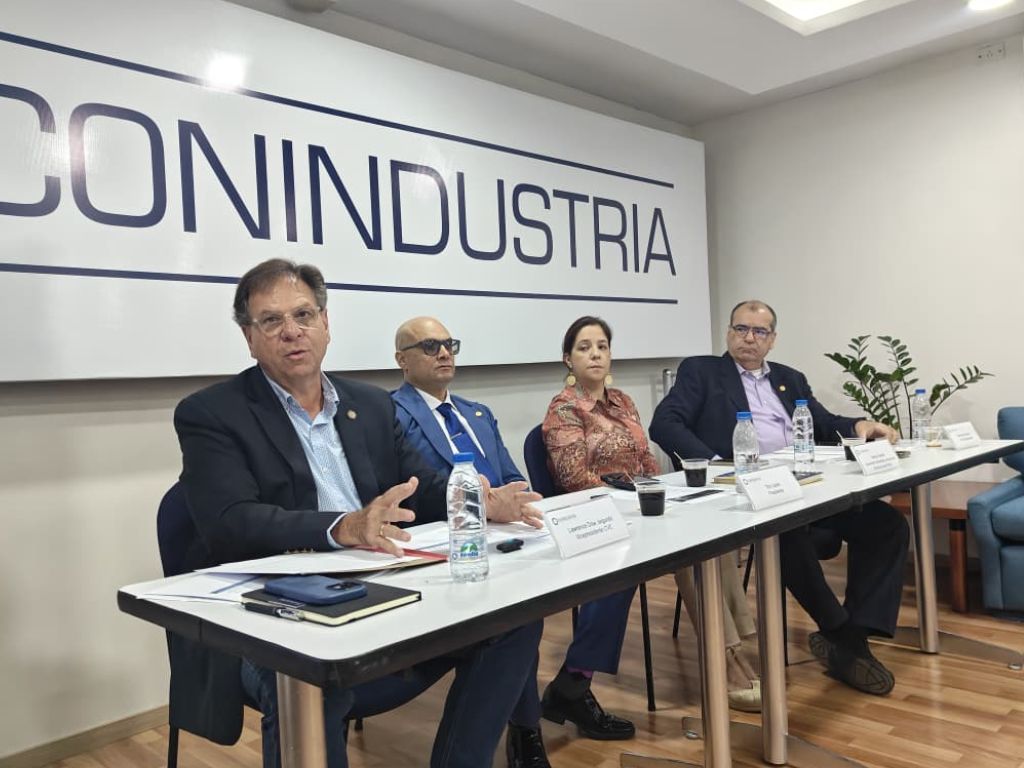
The Daily Journal – Nearly two months after the two major earthquakes that devastated parts of the country on June 24, the Venezuelan Confederation of Industrialists (Conindustria), the Venezuelan Chamber of Construction (CVC) and the United Nations Development Programme (UNDP) held a high-level meeting to define the operational and strategic phases of Venezuela’s Reconstruction Plan, during which business leaders demanded that Venezuelan companies serve as the backbone of the entire process.
The meeting brought together Tito López, president of Conindustria; Mahomed Hussein, first vice president of the industrial association; Lawrence Dow, second vice president of the CVC; and Tomiris Useche, Development Finance Coordinator at UNDP Venezuela, along with presidents of sectoral chambers and CVC executives.
During his remarks, Lawrence Dow (CVC) firmly stated that the plan not only includes domestic manufacturing but must make it a fundamental pillar of the reconstruction effort. Dow insisted that authorities should allocate resources for this phase under a “produce in Venezuela first” principle, giving absolute preference to local production to meet demand for supplies and materials.
“The resources used during this phase must follow a non-negotiable principle: giving priority and preference to domestic production, which should provide most of what we need to rebuild our country,” the businessman said.
To make this vision viable, Dow stressed the urgent need to establish tax and customs relief in the hardest-hit areas, as well as the pressing need to reform key legal instruments, such as the Mortgage Credit Law and the Law Against Real Estate Fraud, to create the “perfect environment to promote investment.”
He warned that without a legal framework suited to the magnitude of the tragedy, the country will not achieve recovery within an appropriate timeframe.
Given the impracticality of individually reforming more than 200 restrictive laws — a process that would take three decades under the procedures established in the Constitution — both sectors agreed to propose the immediate implementation of temporary regulations that would serve as a “bridge” between the current legal framework and the framework they seek to establish.
This legal mechanism would help unlock the economy by introducing tax and parafiscal incentives, simplifying administrative procedures and easing companies’ access to credit. It would also make it easier for citizens to purchase or rent homes in the short term under favorable conditions for both parties.
For his part, Conindustria President Tito López supported removing legal bottlenecks to accelerate industrial processes under the current circumstances. As an immediate step, both sectors agreed to establish joint working groups between the manufacturing and construction industries to prioritize efforts and align the construction sector’s needs with the capabilities of manufacturing industries — including chemicals, plastics, metallurgy, mining, glass and ceramics, among others — to ensure their economic viability.
Regarding international support, Tomiris Useche explained that UNDP continues to carry out extensive work focused on early recovery, to link these efforts to the country’s sustainable development while strictly following the protocols that multilateral organizations require.
Along the same lines, Mahomed Hussein, first vice president of Conindustria, expressed a clear and firm institutional position on the imperative need for the country’s “reinstitutionalization,” which he described as a sine qua non condition for overcoming the multiple obstacles that continue to hinder sustained growth in the industrial sector.
The institutions unanimously committed to establishing a permanent technical communication channel. The joint working groups will serve as a key platform to coordinate projects, safely channel the arrival of potential investors and ensure that Venezuela’s resurgence has an indisputable driving force: its national industry.