The Daily Journal.- U.S. President Donald Trump said Sunday that Washington could maintain its presence in Iran and benefit from the country’s oil resources, as it did in Venezuela.
“Eventually, we’ll get out (of Iran), unless we decide to stay and keep the oil, like in Venezuela. You don’t hear about Venezuela anymore, do you? We’re getting thousands and thousands and thousands of billions of dollars. We paid for the war many times over,” Trump told reporters during his visit to Ireland.
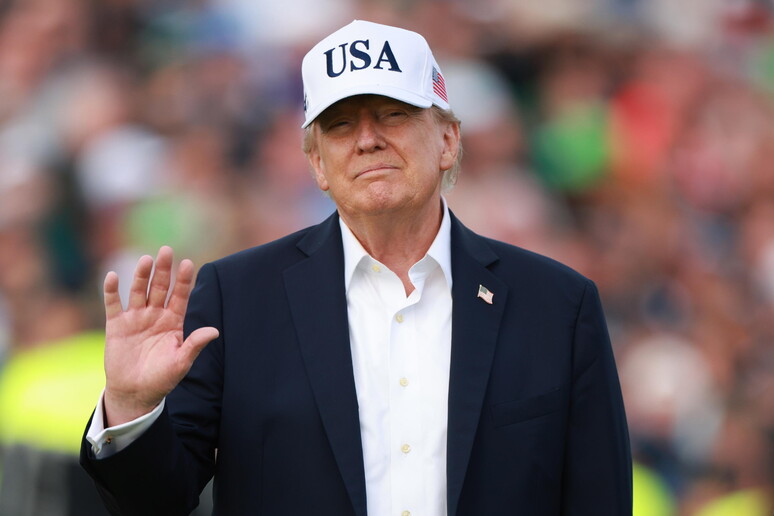
Trump made the remarks during the Irish Open tournament at his golf course in Doonbeg, Ireland, amid heightened tensions in the Middle East and just weeks before the U.S. midterm elections scheduled for Nov. 3.
Trump’s “predictions”
The U.S. president spoke explicitly about the future of the war with Iran and the options his administration is considering.
“Look, it could end before the midterm elections, but it will end right after them,” Trump said.
“I’ll tell you one thing: Iran desperately wants to make a deal. They call all the time. They want a deal. They have to make the right deal. I’m not going to accept a deal that isn’t good,” the president added.
However, his next statement set off alarm bells across international markets and foreign ministries worldwide: “Eventually, we’ll leave, unless we decide to stay and keep the oil, like in Venezuela.”
The comparison was no coincidence. Trump explicitly linked the conflict with Iran to the model his administration applied in Venezuela, where Washington announced a historic agreement in late August to take majority control of more than 65 billion barrels of Venezuelan crude oil.
Venezuelan precedent: one-fifth of the world’s largest oil reserves
The comparison with Venezuela goes beyond rhetoric. The agreement Trump announced on Aug. 29 gives the United States majority control over approximately 21.5% of Venezuela’s proven oil reserves, which the U.S. Energy Information Administration (EIA) estimates at roughly 303 billion barrels.
The agreement calls for developing 17 oil fields containing a total of 65 billion barrels and targets production of more than 1.3 million barrels per day, with private investment expected to exceed $100 billion.
For its part, the Venezuelan government said it retains “control and ownership” of its oil. However, the agreement runs for 25 years, and Trump hailed it as an unprecedented strategic achievement for Washington.
Iran: the new oil target
If Washington replicated the Venezuelan model in Iran, the implications would be enormous. Iran holds the world’s fourth-largest proven oil reserves, with approximately 208.6 billion barrels, according to OPEC data. Such a move by Washington would represent an unprecedented escalation in a conflict that has already lasted six months.
Trump, however, offered no details on how potential U.S. control over Iranian crude oil would work or whether it would involve a prolonged military presence or a partnership with private companies similar to the Venezuelan model.
The Zelensky factor and the diesel crisis
During the same appearance, Trump revealed that his administration has asked Ukrainian President Volodymyr Zelensky to stop attacking diesel refineries in Russia to prevent disruptions to the global fuel supply.
“Mr. Zelensky has to do one thing: stop attacking the diesel facilities in Russia. Attack other targets, but not the diesel refineries, because he’s causing a shortage of this fuel,” Trump said from Ireland.
Diesel prices in the United States surpassed $6 per gallon on Friday, reaching a record high. Prices have risen more than 55% since the start of the war with Iran, exceeding the 40% increase in gasoline prices.
“This isn’t because of the Middle East. It’s because of what’s happening between Russia and Ukraine. That’s why we’re talking to Mr. Zelensky about it. There are plenty of other targets. Don’t attack the diesel facilities, because that causes damage; it’s hurting the world,” Trump said.
An uncomfortable political timeline
Trump’s remarks come less than two months before the midterm elections, which will determine whether his Republican Party retains control of Congress. The president has repeatedly maintained that the war with Iran will end “immediately after” the elections, raising suspicions among analysts and political opponents who accuse him of managing the conflict’s timeline for electoral purposes.
According to media reports, some White House advisers have warned that the conflict could continue until 2029, a timeline far removed from the administration’s official narrative of an imminent end to the war.
International reactions
Trump’s suggestion that the United States could “keep Iran’s oil” has already begun to draw reactions. European diplomatic sources consulted by this outlet expressed “deep concern” over what they view as a doctrine aimed at appropriating sovereign energy resources. Meanwhile, Russia and China have yet to issue official statements on the matter.
Domestically, such a move could face significant legal and diplomatic obstacles, particularly if it involves a prolonged U.S. military presence on Iranian territory without an international legal framework to support it.
What comes next
Trump offered no detailed plan for Iran, but his statement leaves open a possibility that seemed unthinkable just weeks ago: the United States could not only intervene in the conflict but also remain there to secure control over the country’s energy resources.
With the Venezuelan precedent on the table and the electoral clock ticking, the world is watching to see whether the U.S. president turns his threat into a new state policy or whether it represents another bargaining chip in his distinctive strategy toward Tehran. The Islamic Republic has already responded forcefully: “Iran is not Venezuela.”