— Oil investments carry risks, just like any other investment. However, when a field has produced oil continuously for more than a century and accumulated nearly 950 million barrels of historical production, the past becomes more than history: it becomes a powerful tool for assessing the economic viability of future operations.
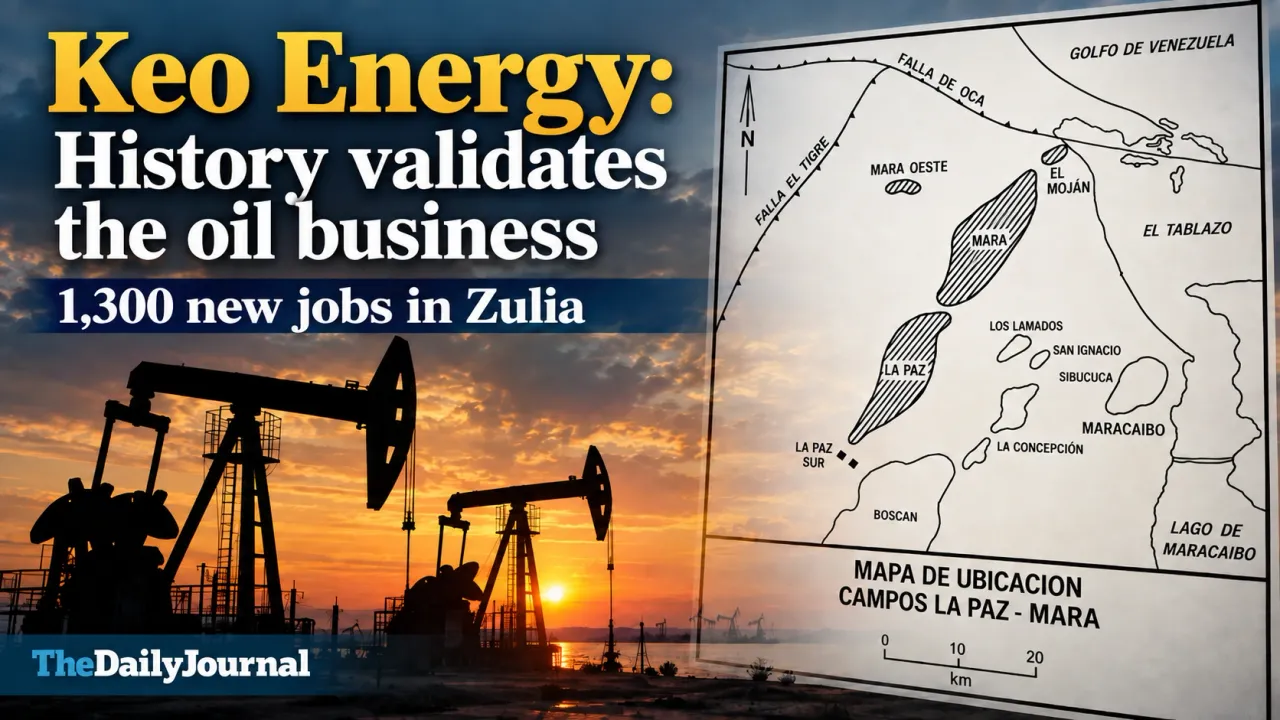
That is one of the main assets KEO Energy is gaining through its agreement with PetroUrdaneta, a mixed-ownership company majority-owned by Petróleos de Venezuela that operates the La Paz, Mara Oeste, Mara Este, and El Moján fields in the Maracaibo Basin. Under the comprehensive agreement signed with the state-owned oil company, KEO has assumed technical and operational responsibilities and will provide financing to restart production.
Although KEO is still relatively unknown in Venezuela, its parent company has international experience in offshore and onshore oil operations. In Brazil, it completed the acquisition of assets in Papa Terra and Peroá in May 2023. As of the end of 2022, these assets held combined reserves of 18.8 million barrels. During the third quarter of 2023, the assets produced 2,036 barrels per day.
In Oman, the company participated in Block 70, where it fulfilled its first-phase commitments, conducted a drilling campaign, and began production testing. Its experience also extended to the United States, where it maintained conventional oil production in the Illinois Basin from 60 wells under a low-cost, low-risk operating model.
But the assets’ history in Zulia provides an extraordinary point of reference.
The La Paz, Mara, and El Moján fields, west of Maracaibo, sit along one of the basin’s most important structural alignments. Exploratory well P-62 reached the Cretaceous limestone formations in 1944 and revealed La Paz’s true potential by encountering a highly productive reservoir, more than two decades after the field’s 1922 discovery.
Later, well P-84 reached a production rate of 30,000 barrels per day. The reservoir’s intense natural fracturing facilitated hydrocarbon flow and allowed production to extend into deeper formations. In 1953, P-B6 produced 3,000 barrels per day of 33° API crude from the basement rock.
La Paz’s historical scale is equally significant. PetroUrdaneta has estimated approximately 4.6 billion barrels of oil originally in place and roughly 950 million barrels of cumulative historical production. Its emblematic wells include P-62, P-84, P-86, P-114, and P-201.
P-84 holds a special place. Sources at Petróleos de Venezuela credit the well with nearly 64 million barrels of cumulative production, a figure that illustrates the field’s exceptional productivity over the decades.
Shell developed these assets for about half a century. Production began in the early 1920s through companies belonging to the Royal Dutch/Shell Group, including Venezuelan Oil Concessions and Caribbean Petroleum. Shell developed major Cretaceous reservoirs in La Paz and discovered the Mara field in 1945. In 1953, it discovered a significant accumulation of light oil in the igneous and metamorphic basement rock there.
That same year, Shell consolidated operations under the Shell brand in Venezuela. The company remained involved with these assets until the nationalization of the oil industry in 1975–1976, when the concession system ended.
All this history does not eliminate the geological, financial, or operational risks of a new investment. But it provides something no financial model can generate: decades of physical evidence of the reservoirs’ existence, productivity, and behavior.
That is why KEO Energy is not starting from scratch. Its investment is based on fields that have produced oil for generations.
Associated gas, an integral component of KEO Energy’s business at PetroUrdaneta, adds significant strategic value because its fields are close to Colombia and existing gas infrastructure. This could eventually facilitate exporting Venezuelan gas to the neighboring country, where demand for new supply sources is growing.
Now another test begins: determining how much of that historical potential can be recovered through capital investment, technology, well rehabilitation, and operational efficiency.
The impact will also extend beyond the barrels. The immediate expansion of operations includes creating 1,300 new jobs in Zulia, making the reactivation of PetroUrdaneta not only an oil investment but also a new engine of economic activity.