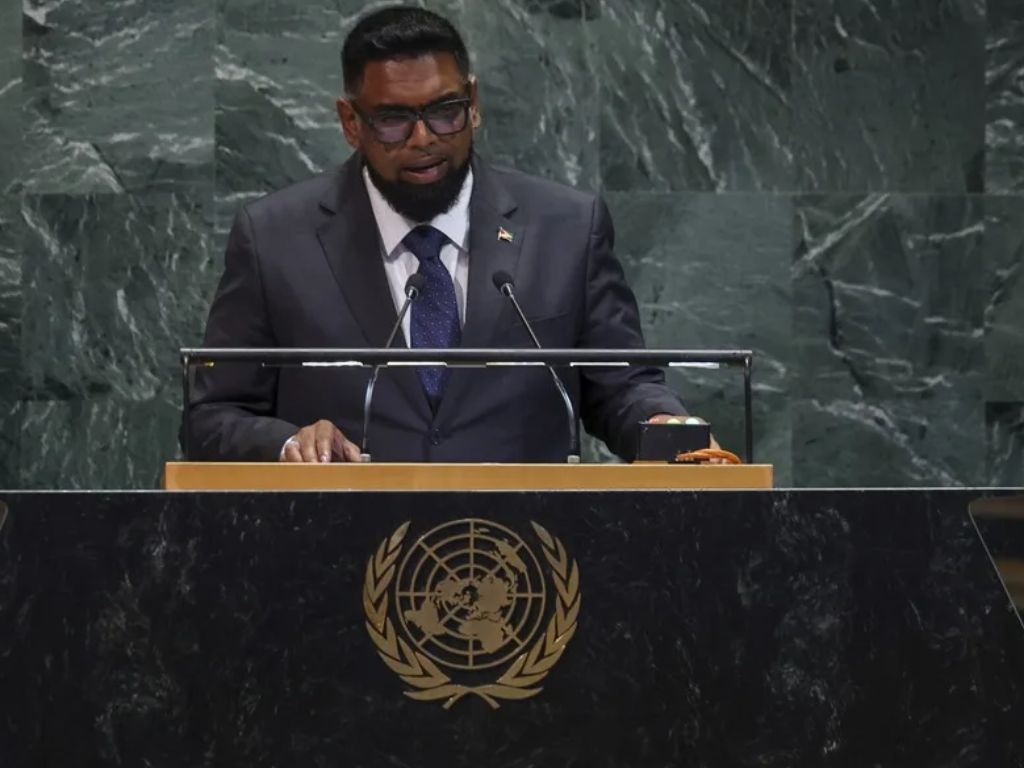
The Daily Journal.- Guyanese President Irfaan Ali urged Venezuela on Thursday to comply with the International Court of Justice’s (ICJ) forthcoming ruling on the Essequibo territorial dispute, in accordance with its obligations under the United Nations Charter.
During his address to the UN General Assembly, Ali expressed hope for a new chapter in relations between the neighboring countries that would benefit both peoples, promote national development, and strengthen regional stability.
His remarks followed statements by Venezuela’s acting President Delcy Rodríguez, who defended Venezuela’s “historic rights” over Essequibo before the same body and argued that bilateral negotiations produce more lasting agreements than external institutions.
Guyana maintains that proceedings before the ICJ offer the only legitimate path to resolving the dispute over a region spanning nearly 160,000 square kilometers and rich in minerals and oil. Venezuela, meanwhile, has historically challenged the court’s authority.
Last May, Venezuela stated that direct negotiations without third-party intervention would resolve the dispute with Guyana, as the ICJ held hearings on the matter.
Ali recalled that Guyana turned to the ICJ after decades of efforts to settle the dispute bilaterally, including through a joint commission and the UN Secretary-General’s good offices. According to the Guyanese president, his country participated in the court proceedings and encouraged Venezuela to do the same.
Ali also argued that the 1899 Paris Arbitral Award established a “complete, perfect and final” settlement of the border, while Venezuela maintains that the 1966 Geneva Agreement should serve as the basis for resolving the dispute.
The Guyanese president added that his country has pursued a peaceful resolution despite what he described as repeated provocations and acts of aggression over an extended period.
The territorial dispute over Essequibo dates back to the 1899 Paris Arbitral Award, which granted sovereignty over the territory to what was then British Guiana. Caracas declared the award null and void in 1962.
In 2018, Guyana filed an application with the ICJ seeking a declaration confirming the award’s legal validity and binding effect, as well as the definitive nature of the boundary it established.