Audio: https://clyp.it/smn5bwvr
Dr. Juan Barreto. — Interim president Delsy Rodríguez revives a historic claim and clashes with Guyana’s president, Irfaan Ali. How do dinosaurs enter this story? They rise from the dark depths underground, where pressure and heat cook the oily substance that powers the world, while other dark rooms simmer their own slow plots. Now that substance may reshape global geopolitics.
Many quote Woody Allen in Manhattan: “Life happens while you make other plans.” The same holds for today’s geopolitical turns. Black swans appear on the map. I claim no special expertise and, as a friend jokes, I hold a black belt in pessimism, so I doubt that what comes next will favor Venezuelans. Yet a perverse effect may still deliver gains. Let’s connect the pieces.
Exxon and Chevron clash with Guyana’s government. Guyana argues that Exxon’s contracts in the Stabroek block have expired and are no longer valid. President Ali demands compensation and royalties that the companies refuse to pay. Guyana now threatens a full audit of revenues and profits, while the companies reject those demands.
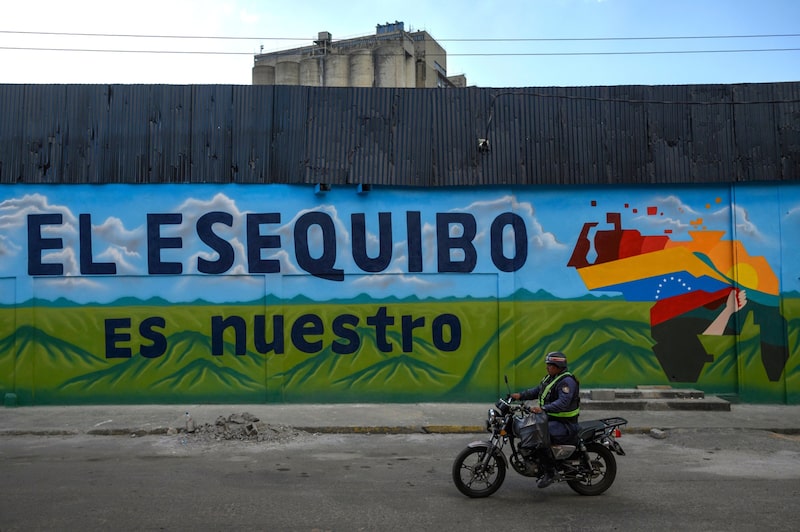
Consider this: what if the International Court of Justice accepts Venezuela’s claims over its territory and strategic maritime continental shelf waters, which cover two-thirds of what Guyana now treats as its territory? Venezuela has pressed this claim for years. New reports in the international press point to renewed momentum and a path to resolution. Starting May 4, the Court will gather Venezuela’s claims and hear both sides. Venezuela does not recognize the Court, yet its ruling binds the parties. Observers expect a decision in early 2027.
In plain terms, that ruling ends the case. It imposes a legal decision that all parties must accept; it does not offer an opinion.
The ruling will stand as final. Will Washington’s policy and the oil majors shape it? Some analysts argue that the United States holds a strong influence over the Court.
Winds shift across the Caribbean. Rodríguez travels among the islands as the U.S. Navy shows presence and local governments realign; Guyana may find itself increasingly isolated.
Will the midterm elections in the north decide this territory’s fate? Could Trump “lose while winning” and use Venezuela’s claim as a bargaining chip with Democrats and dissident Republicans tied to oil lobbies? Could the power of multinationals grease Venezuela’s long-stalled claim and deliver a double outcome—avoid impeachment for Trump while tipping the scales of justice toward Venezuela?
What serves the oil companies better: compliance with Venezuelan law and jurisdiction or deference to Guyana’s sovereign claims? Which sovereignty offers the better deal? The Court’s outcome will shape not only a territorial dispute but also the global economy. A close U.S. partner could gain vast mineral and oil wealth by adding a large territory and altering the game. The shock could rival that of the meteor that wiped out the dinosaurs, after which Earth harnessed the energy of the aftermath. The business would then rest under Venezuelan law with friendly U.S. protection.
New hydrocarbons and mining laws now favor foreign investment, according to experts. Trump welcomes that shift and supports Rodríguez’s administration. Dawn will tell. In Venezuela, the sun rises over the Essequibo.
Postscript: Could this bold move mark the start of a campaign to annex Venezuela as the 51st state?