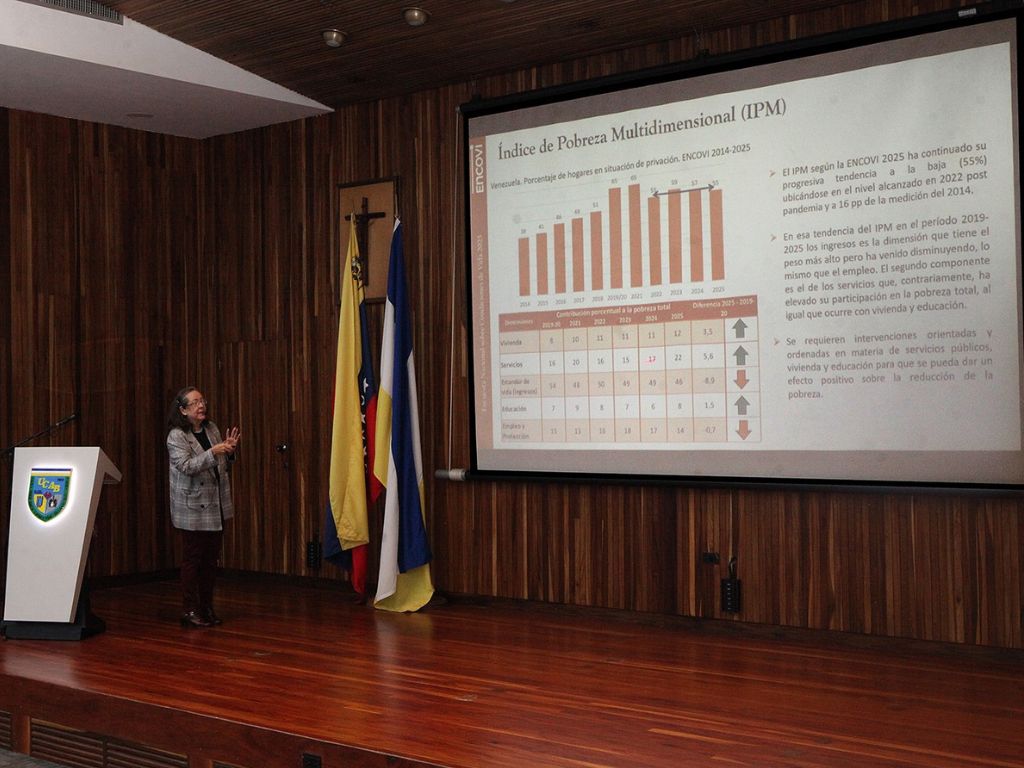
The Daily Journal. – Anitza Freitez, coordinator of the National Survey of Living Conditions (ENCOVI) and director of the Institute for Economic and Social Research at the Andrés Bello Catholic University (IIES-UCAB), presented the results of the 2025 survey this Thursday. During her presentation, the researcher highlighted a sustained downward trend in monetary poverty since 2021, when generalized impoverishment peaked at nearly 90%. According to the latest data, income-based poverty now stands at 68% of households, while extreme poverty has fallen to 32%. Freitez attributed this improvement to the dismantling of controls, income recovery, and an economic growth rate that has ceased to be negative.
However, Freitez warned that attention should not focus solely on short-term income, but also on multidimensional poverty, which evaluates 13 indicators of deprivation in areas such as housing, education, and public services. This measurement shows a troubling stagnation: after dropping from a peak of 65% during the pandemic, multidimensional poverty has fluctuated between 55% and 57% from 2022 through 2025. A key finding of the survey is that income has become less important as a determinant of poverty, while the deterioration of public services and housing conditions has become increasingly significant in limiting household well-being.
Inequality and the Limits of Social Policy
Regarding wealth distribution, ENCOVI reveals an improvement in the Gini coefficient, placing Venezuela at levels similar to those of 2016, with inequality less severe than in Brazil or Colombia, though still far from standards such as Uruguay’s. Freitez explained that between 2023 and 2025, average income doubled among the poorest sectors (deciles 1 through 5). However, the social policy based on government bonuses appears to have reached its limit: the average value of these transfers dropped from $43 in 2024 to $37.6 in 2025, and targeting efficiency has declined, as the percentage of extremely poor households receiving bonuses fell from 85% to 69%.
Regarding the CLAP food program, the researcher noted that the food boxes have lost importance both in the number of beneficiaries and in delivery regularity. Monthly deliveries have declined, with distributions now occurring every two or three months.
The Crisis of Public Services
The report devotes a critical section to the collapse of basic services, stating that access to potable water and electricity is now one of the greatest obstacles to human dignity. Although connection to the public water system showed a slight recovery after the pandemic, Freitez reported that only 29% of households receive water daily, and of that group, only 19% enjoy continuous 24-hour service. This deficiency forces most of the population to rely on water storage systems that may compromise public health.
The electricity situation is described in the report as an institutional “drama.” Although Venezuela has had an almost universal public electrical grid for decades, service quality is extremely poor. According to ENCOVI data, only 10% of households report never experiencing power outages, a figure that has remained stagnant since 2019. The rest of the population faces daily blackouts lasting several hours and constant voltage fluctuations, affecting not only daily life but also household appliances and equipment used by Venezuelan families.