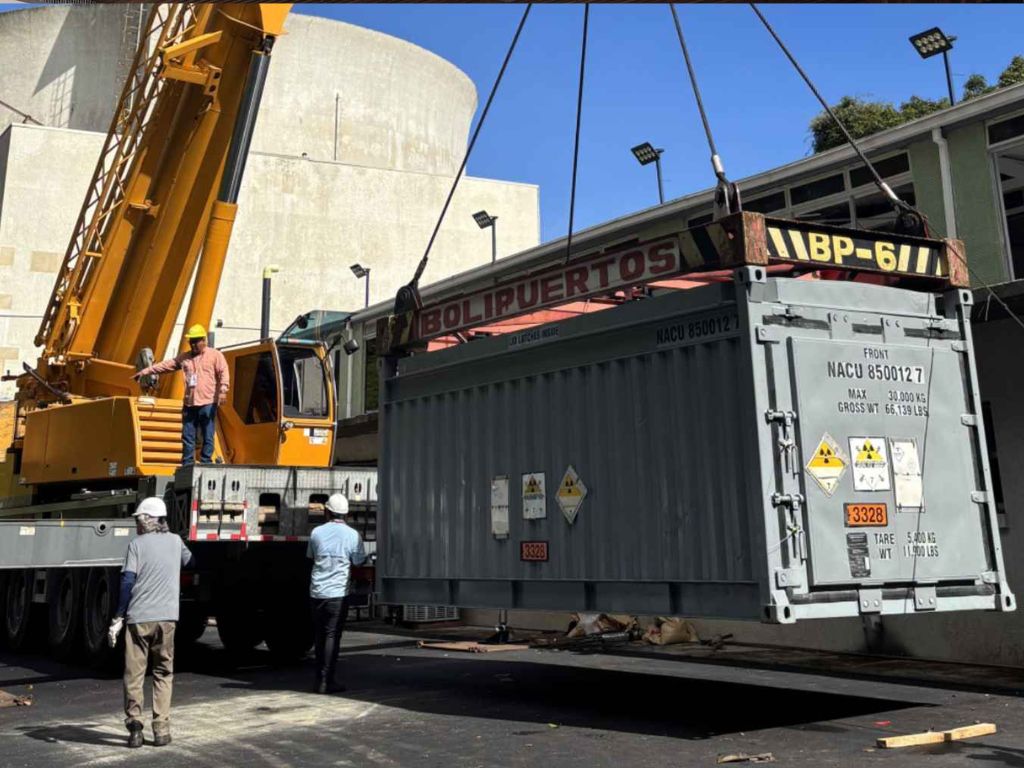
The Daily Journal.- The United States Embassy in Caracas announced this Friday the successful removal of all enriched uranium that remained in a research reactor in Venezuela.
What would traditionally have taken years of negotiations and logistics was completed in just a few months. According to Brandon Williams, administrator of the U.S. Department of Energy’s National Nuclear Security Administration (NNSA), this achievement is tangible proof of the country’s new phase: “The safe removal of all enriched uranium from Venezuela sends another signal to the world of a restored and renewed Venezuela,” Williams stated.
According to a press release, following Energy Secretary Chris Wright’s visit to Caracas last February, teams of experts from the NNSA, the State Department, Venezuelan authorities, and specialists from the United Kingdom worked against the clock to carry out the extraction.
The operation focused on the RV-1 reactor, located at the Venezuelan Institute for Scientific Research (IVIC). Although the reactor ceased operations in 1991, it still stored 13.5 kilograms of uranium enriched above the critical 20% threshold.
The enriched uranium is already on U.S. soil, where the Department of Energy’s Office of Environmental Management has assumed custody. Technicians will process the material at the H-Canyon chemical separations facility to obtain high-assay low-enriched uranium ( HALEU).
Caracas Invokes International Commitment
On Thursday, the Venezuelan government, through a statement from the Ministry of Popular Power for Science and Technology, framed the operation as part of its policy of “strict compliance with international treaties.”
The official statement emphasized that the removal was carried out in full transparency with the International Atomic Energy Agency (IAEA) and IVIC personnel. “This action reaffirms our unwavering commitment to peace and international security, ensuring that sensitive materials are managed under the highest non-proliferation standards,” the statement reads.
Likewise, Venezuelan authorities indicated that the removal of uranium from the RV-1 reactor — whose scientific activity ended in 1991 — is a strategic step toward the country’s technological modernization. “With the successful removal of this surplus material, Venezuela not only eliminates potential risks, but also opens the door to a new stage of sovereign scientific cooperation that will promote the development of our nation in this new cycle,” the ministry concluded.