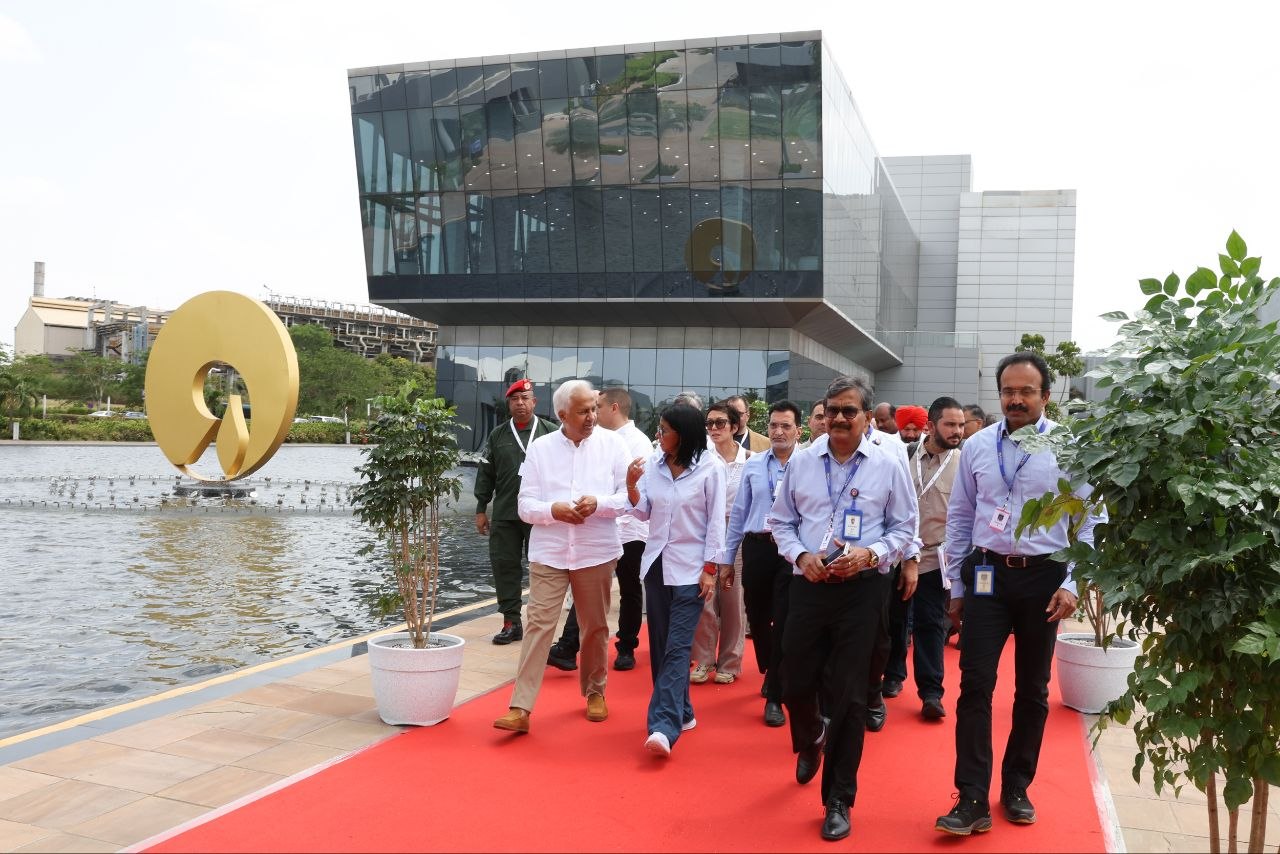
The Daily Journal — During her official visit to India, Venezuela’s Acting President Delcy Rodríguez toured the facilities of the Jamnagar Refinery on Friday for a technical inspection after completing a series of high-level political meetings in the Indian capital.
Rodríguez’s visit to the world’s largest refining complex forms part of the Venezuelan government’s strategy to strengthen a global energy agenda. Through this effort, Caracas seeks to attract new investment flows and secure a stronger position in international energy markets.
Upon arriving at the industrial complex owned by Mukesh Ambani, whom Forbes ranks as Asia’s richest man, Rodríguez met with senior executives from Reliance Industries Limited. Among the officials who welcomed her were Debangsu Ray, Cluster President and Director of Manufacturing at Jamnagar, and M.B. Kishore, President of the refinery’s Special Economic Zone.
Reliance’s Role in Venezuela’s Oil Sector
The renewed relationship with Reliance Industries follows a major legal development earlier this year. In February, the U.S. Department of the Treasury granted a general license to the Indian corporation, allowing the refining giant to resume direct purchases of Venezuelan crude without violating U.S. sanctions.
Reliance has long ranked among the most important buyers of Venezuela’s extra-heavy crude. In 2012, the company signed a long-term agreement to secure supplies of up to 400,000 barrels per day from Petróleos de Venezuela S.A. (PDVSA).
Jamnagar holds strategic importance because it ranks among the few refineries in the world with the technology and sophistication required to process Venezuela’s high-sulfur, high-viscosity crude grades efficiently. Industry reports describe Jamnagar as the world’s largest refining complex and highlight its ability to process heavy Venezuelan crude.
Commercial ties between Reliance and Venezuela weakened in 2019 after Washington tightened financial restrictions. At that time, the Indian company accounted for roughly a quarter of Venezuela’s crude exports. Although Reliance regained authorization to trade Venezuelan oil in 2024, shipments stopped again after that permit expired.
India Overtakes China as a Leading Destination for Venezuelan Crude
The impact of the new authorization from the Office of Foreign Assets Control (OFAC) and Reliance’s aggressive return to the Venezuelan market has already appeared in recent trade figures.
According to data reported by Reuters, India imported approximately 427,000 barrels per day of Venezuelan crude in May, the highest level recorded in recent months. Reliance Industries emerged as one of the principal buyers of those cargoes.
However, Reuters reported that the United States remained Venezuela’s largest export destination in May, receiving about 558,000 barrels per day, while India ranked second with 427,000 barrels per day.
With Reliance positioned among the largest purchasers of Venezuelan crude, India has significantly expanded its role in Venezuela’s export market and has surpassed China’s demand during the same period.