Roger J. Rivero, Industrial Engineer.
Audio: https://clyp.it/klcwekmn
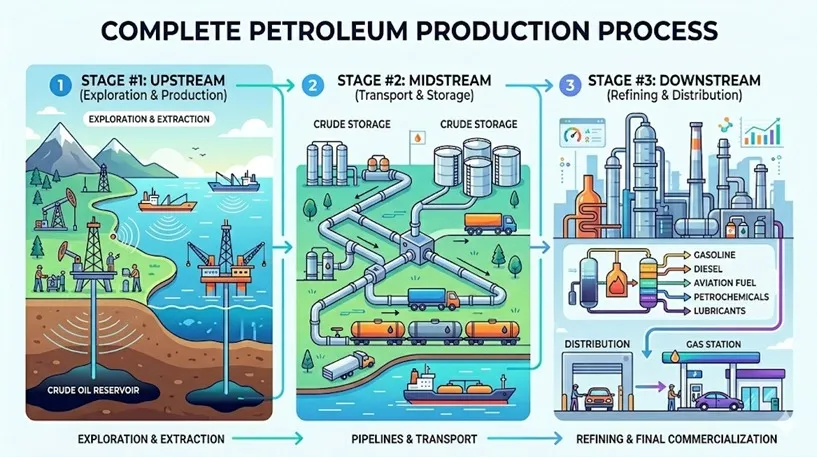
Let’s talk about the phases and processes of Oil Production, which we will break down below.
Now, let’s describe the stages, which are as follows:
1. Upstream (Exploration-Production)
2. Midstream (Transportation-Storage)
3. Downstream (Refining-Marketing)
1) Upstream (Field Exploration/Production)
The most human, the most criticized, and the most dangerous stage. In past decades, the death toll in this phase was significant; explorations in highly remote areas exposed operators to many natural hazards.
Phase A of this stage: In this phase, various processes, sub-processes, and equipment are used. Thanks to modern advancements, today’s equipment is more mobile, manageable, and high-performing for technicians and specialists than it was decades ago, when drilling and exploration were extremely hazardous tasks.
Some of the equipment used in this earliest stage includes Seismic methods, Gravimetric methods, and geochemical analyses, which are carried out by professionals in the fields of Geology and Geophysics.
Phase B of this stage: This phase involves the actual drilling process using the “Drilling Rig,” which has also seen massive advancements compared to decades ago. Back then, being on the “drill floor” was highly dangerous. This risk drove the current improvements we see today, featuring equipment controlled from the main cabin and cyber-base controls, making the drilling process—as well as being on the floor during pipe connections and additions—much safer.
Some of the equipment used in this drilling stage includes: Rotary drilling rig equipment, Hoisting system – Rotating system, cutting tools, Circulation system – MWD and LWD tools, which are operated by petroleum industry professionals, drilling engineers, petroleum engineers, and mud engineers, as well as wellsite geologists and geophysicists, along with OHSE, maintenance, and logistics personnel.
Phase C of this stage: This phase involves more extraction, distribution, and storage processes, making it highly focused on logistics. This is where pipelines for transporting crude oil, tank storage, pumping stations, and separation systems or equipment for removing unwanted residues are constructed. In short, it is the mecca of welding processes, where mechanical and civil engineers are always accompanied by OHSE and quality control personnel to oversee all operations.
Some of the equipment used in this extraction, production, and storage stage: The equipment in this phase consists of the Extraction System, Surface Separation System, and Storage Tanks, managed by specialized personnel in these areas, including production engineers, maintenance technicians, plant operators, and HSEQ (Health, Safety, Environment, and Quality) personnel.
2) Midstream (Transportation/Storage)
The most eye-catching phase to the general public. Between the pipelines running along roads, the specialized secure areas with tank farms of various storage capacities, and, in some cases, the ports equipped with distribution lines for loading tankers, this is the commercial and most visible side of oil production that the average person notices.
In this phase, the interacting equipment and components are the following:
Pipelines: These are the lines we see along highways or cutting through hillsides, leading to pumping stations to maintain flow and pressure.
Storage Terminals: These are large coastal or inland facilities properly equipped to receive, store, and redirect crude oil and its derivatives.
Oil Tankers: These are massive tanker ships (such as VLCCs or ULCCs) used for international maritime trade.
3) Downstream (Refining/Marketing)
The most technical, industrial, and economically profitable phase. The refining process and the subsequent marketing of petroleum derivatives, including Gas, generate significant revenue, with petrochemicals and plastics being highly profitable byproducts of oil separation and distillation.
,
oil separation and distillation
The processes that make up this Phase are:
Fractional Distillation Towers: These are large steel columns that separate crude oil.
Conversion Units: Furnaces, reactors, cracking units, reformers, and alkylation equipment that process heavy fractions to convert them into lighter, more valuable products, such as aviation gasoline (avgas).
And the specialized personnel in refining, petrochemical derivatives, and marketing.