The Daily Journal — A coalition of trade unions and human rights organizations has formally submitted an Individual Communication to the United Nations Human Rights Committee in Geneva, Switzerland. Through this legal action, the coalition accuses the Venezuelan state of systematically violating citizens’ rights to access justice and obtain an effective judicial remedy.
The international complaint comes after three years without any response to a constitutional protection action filed before Venezuela’s Supreme Tribunal of Justice (TSJ) in 2023. The petition sought enforcement of the constitutional right to a living wage.
The complaint bears the signatures of labor leaders Eduardo Sánchez (Workers’ Union of the Central University of Venezuela), Adelmo Becerra (Observatory for Dignity at Work), Marisol Guédez (Comunes Movement), and Antonio González Plessmann (Surgentes Collective).
The origin of the claim: Four years of wage freeze
The legal and institutional dispute dates back to July 25, 2023, when the petitioners—later joined by more than 50 workers from different regions of the country—filed a Constitutional Protection Action for Collective Rights and Interests before the Constitutional Chamber of the TSJ.
The petition sought to stop the National Executive’s failure to adjust the living minimum wage and to challenge the government’s bonus-based income policy, which undermines the proper calculation of severance payments, profit-sharing benefits, and vacation bonuses.
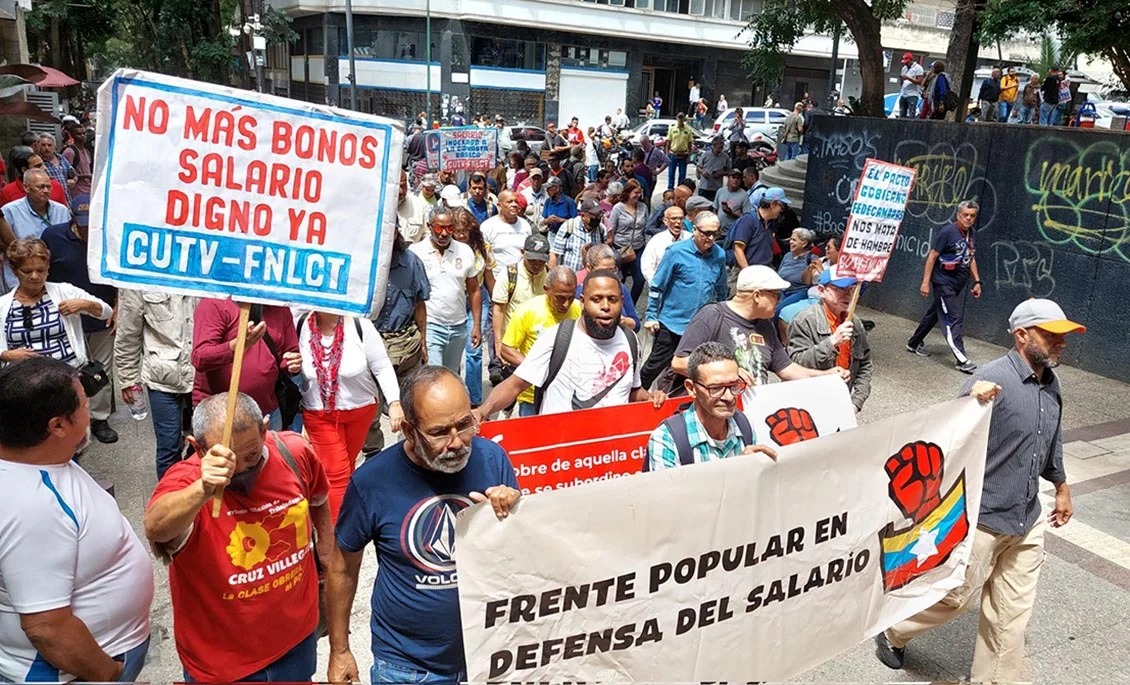
“In 2023, several of the grassroots organizations that now support this petition formed the Popular Front in Defense of Wages and filed a Constitutional Protection Action. Article 91 of the Constitution is clear. It states that ‘the living minimum wage shall be adjusted every year, taking the cost of the basic basket of goods as one of its benchmarks.’ However, the last minimum wage increase took place in March 2022, and today it amounts to less than one U.S. dollar per month. Since March 2022, the government has continuously violated Article 91 of the Constitution. That is why we turned to the TSJ in search of justice,” explained Marisol Guédez, spokesperson for the Human Rights Unit of Comunes.
Petitioners accuse the TSJ of imposing a “Blockade” and institutional silence
As the third anniversary of the constitutional petition approaches, the complainants warn that the country’s highest court has remained completely silent. The Constitutional Chamber has neither accepted nor rejected the case, has not scheduled hearings, and, according to the complaint, has actively prevented lawyers from accessing copies of the court file.
Antonio González Plessmann, co-director of the Surgentes Human Rights Collective, spoke bluntly about the court’s role in deepening the labor crisis:
“We went to the TSJ seeking protection from violations of the right to a sufficient wage, only to see our right to justice violated there as well. We have encountered a wall of silence, opacity, and complicity with the Executive Branch. We believe this reflects alignment with the neoliberal policies promoted by the country’s elites, policies that dismantle labor rights while granting privileges and incentives to capital,” the activist stated.
Four key demands before the United Nations
The international complaint relies on Articles 2.3 and 14.1 of the International Covenant on Civil and Political Rights (ICCPR), a binding treaty that Venezuela has observed since 1978.
Through this Individual Communication, the activists and labor organizations formally ask the U.N. Committee to declare the case admissible, recognizing that workers face a material impossibility of obtaining prompt justice within the domestic legal system because of the TSJ’s conduct.
They also ask the Committee to determine and certify that Venezuela violated the ICCPR by engaging in a prolonged and harmful denial of justice.
In addition, the coalition of trade unionists and human rights defenders seeks immediate reparations and urges the Venezuelan state to implement institutional reforms that prevent “procedural silence from serving as a mechanism of absolute deprivation of protection for citizens.”