Audio summary of the news article: https://clyp.it/l3hja4yp
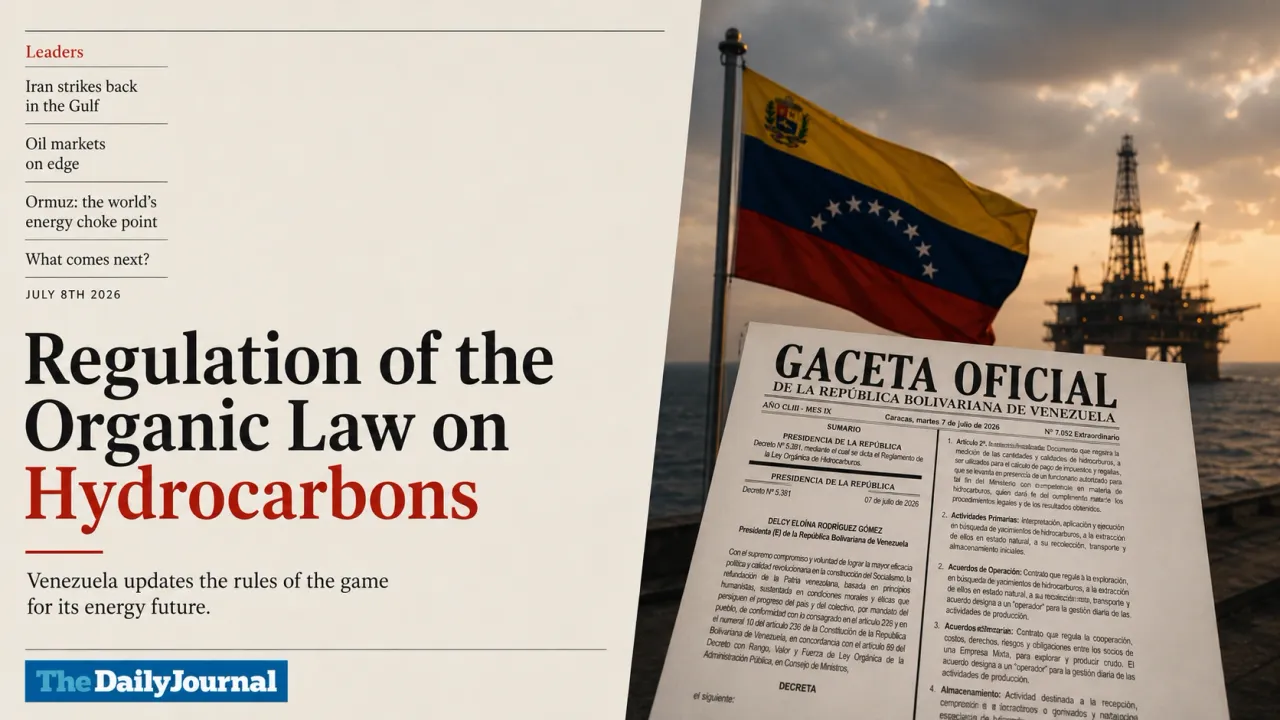
PDF of the Regulations of the Organic Hydrocarbons Law: https://drive.google.com/file/d/1j6NvstM1su_GMrxLxW82bveTjvVBdm1X/view?usp=sharing
Julio A. López, Editor-in-Chief. — Geology does not write checks, drill wells, or rebuild pipelines. Venezuela has oil and gas, including known oil and gas fields. The problem lies in converting that geological wealth into financeable projects, production, employment, taxes, and infrastructure.
The legal reform opened important spaces for private capital and broke with part of the previous statist model. However, the Regulations risk turning that opening into a labyrinth of plans, authorizations, reviews, controls, and administrative interventions.
Venezuela needs speed, but the new framework appears to respond with more layers of supervision. Each additional step may imply time, uncertainty, and costs. And in the oil sector, where an investment decision can commit hundreds or thousands of millions of dollars, bureaucracy also factors into the calculation of economic risk.
Added to that concern is a decisive variable: royalties.
The new framework provides for a royalty that can reach 30% on hydrocarbons extracted and not reinjected. Added to this are other tax obligations, including the Integrated Hydrocarbons Tax, which applies to up to 15% of monthly gross revenues.
During the Oil Opening of the 1990s, the country understood that not all projects could bear the same burden from the first barrel. Mechanisms existed that allowed royalty rates to be reduced to as low as 1% on certain projects and to increase progressively as their economic performance improved.
The logic was elementary: first, allow the project to be born, receive investment, increase production, and develop its capacity to contribute; afterward, increase the State’s fiscal participation as profitability grew. It was not giving away oil. It was recognizing a reality that politics sometimes forgets: 1% of a project that exists may be worth more than 30% of a project that never obtains financial approval.
Venezuela needs to recover production, rehabilitate mature fields, rebuild facilities, address liabilities, incorporate technology, and mobilize billions of dollars.
The new framework does contemplate possibilities for reducing the royalty. To obtain reductions, they appear especially suited to companies with enormous financial, technical, and legal capacity. If an operator must justify the project’s economics in detail, submit complex studies, undergo successive evaluations, and rely on administrative decisions to obtain a burden compatible with the investment, the reduction ceases to function as a competitive rule and begins to resemble a negotiated concession.
A large multinational can mobilize teams of lawyers, tax consultants, economists, reservoir engineers, and regulatory specialists. It can finance studies, sustain prolonged negotiations, and wait for administrative decisions. A mid-sized company, an independent operator, or a new investor may not be able to endure the same process.
The paradox would be serious: an industry formally open, but whose real access ends up reserved for those with sufficient size to make it through the labyrinth.
Not only are the large international oil companies needed; Venezuela needs mid-sized operators, independent companies, companies specialized in mature fields, private capital, technology providers, and new players capable of taking on projects that may not be priorities for the global giants.
For that reason, royalty reductions should be based on clear, objective, predictable, and accessible criteria for all. If a project requires extraordinary investments, offers low initial profitability, operates in a marginal field, or takes years to recover capital, the tax burden should be adjusted using transparent formulas. And when production, prices, or profitability increase, the State’s participation should also grow automatically.
That principle would make it possible to align interests. The investor would have visibility to calculate risks and returns. The State would capture greater rent when the project can pay it. And the country would reduce the discretion that always appears when an advantage depends more on an administrative negotiation than on a known rule.
The new Regulations can still demonstrate that they facilitate that objective. But if they combine high royalties with multiple reviews, administrative intrusions, and reduction mechanisms that, in practice, only the most powerful companies can manage, the opening runs the risk of existing more on paper than in the fields.
Venezuela does not have time to conflate control with complexity or sovereignty with burdens that drive away investment.