By Neirlay Andrade
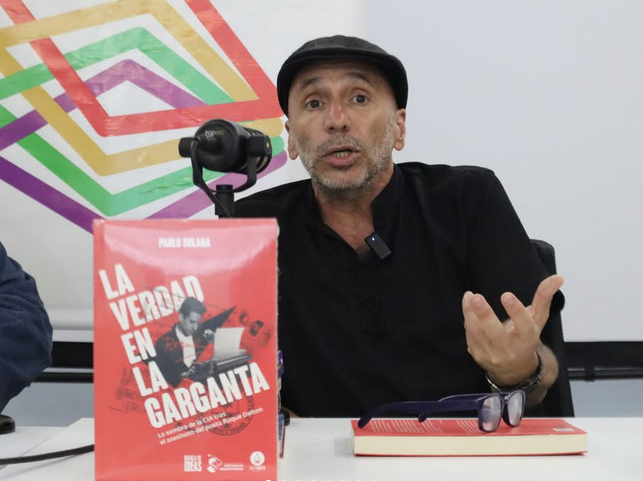
Argentine journalist Pablo Solana recently visited Caracas to present his book With the Truth in His Throat: The CIA’s Shadow Behind the Murder of Poet Roque Dalton. In this investigation, the writer’s life unfolds at the intersection of three forces: the internal struggles of the Salvadoran left, U.S. counterintelligence operations, and the ongoing battle over Dalton’s political and literary legacy.
During the book presentation—held at the Center for Socialist Democracy (CEDES)—Solana placed the case in territory that remains uncomfortable even for the revolutionary tradition itself: Dalton did not die in battle or at the hands of the enemy. Members of his own organization killed him.
“Roque Dalton was murdered on May 10, 1975. He did not die in combat or during a confrontation. An internal dynamic within the guerrilla movement led to his death,” the journalist recalled.
That statement shapes the entire narrative. There is no classic epic and no obvious external enemy. Instead, the story exposes a fracture within El Salvador’s own insurgent movement. Julio Cortázar described Dalton’s killing as a “monstrous death,” not only because of its brutality but also because no one could tell the story coherently for decades.
According to Solana’s reconstruction, the Revolutionary People’s Army (ERP) struggled with a profound ideological conflict. Dalton, one of the leading voices of 20th-century Latin American poetry, belonged to a faction that advocated closer ties between the guerrilla movement and the Salvadoran people, while another faction favored a more militaristic strategy. “That dispute ultimately led to the crime,” Solana argues.
The origin of the suspicion: Dalton’s 1964 arrest and escape
Solana identifies Dalton’s arrest and escape in 1964 as a crucial event in understanding the suspicions that later surrounded the poet and his alleged ties to U.S. intelligence.
Salvadoran police arrested Dalton with the intention of handing him over to CIA agents who had traveled to the country to recruit him as an operative. Dalton, however, escaped under circumstances that later fueled multiple interpretations, including within sectors of the Salvadoran left. According to the investigation, that episode created a zone of political ambiguity that persisted for five decades.
To address those long-standing suspicions, Solana carefully examined more than 70 declassified U.S. intelligence cables. The documents place the episode in a different context. According to the journalist, they show that the CIA closely monitored Dalton from an early stage and incorporated him into its broader counterinsurgency strategy in Central America.
Based on those files, Solana concludes that Dalton’s escape was genuine and that “the CIA regretted his escape.” The declassified papers also reaffirm that, after he fled, “Dalton remained a target to be eliminated.”
That finding offers a new way to understand the historical suspicion. The story of Dalton’s escape circulated not only within the Salvadoran left but also through U.S. intelligence circles, which, according to Solana, later “helped spread that version.” During Dalton’s detention, agents reportedly warned him: “No matter what you do, Dalton, your reputation will end in disgrace.”
A detective’s work
The declassified CIA documents—which became public decades later for reasons unrelated to Dalton’s execution—show that the agency monitored the poet systematically as part of its counterinsurgency strategy in Central America.
“They speak about the persecution and about the importance his figure held for U.S. intelligence,” Solana explained.
The investigation, he added, does not rely on a single transparent archive. Instead, it pieces together fragments, redactions, and silences. Reading the material became an almost archaeological exercise.
“You have to learn how to read declassified documents and figure out where the key might be hidden beneath the blacked-out passages.”
The documents portray a CIA that did more than observe events. The agency infiltrated organizations, gathered intelligence, analyzed internal conflicts, and, according to the book’s central hypothesis, indirectly shaped political scenarios.
Within this account, the Cold War ceases to be an abstract geopolitical contest. Instead, it emerges as a web of opaque interactions where the line between internal and external forces becomes increasingly blurred.
The battle over memory
Solana also reflected on what the Dalton case reveals today.
“The CIA meets with a president or a minister… but beneath that visible tip of the iceberg lie much dirtier, darker, and more dangerous operations,” he said. In that context, Dalton’s case was far from exceptional.
One of the most delicate aspects of the story involves its symbolic dimension. For Solana, the issue extends beyond the poet’s physical murder to the narrative later constructed around his life and death.
Here, the struggle shifts to the realm of memory—not only eliminating a political figure but also shaping how future generations interpret him.
The files also cast Dalton’s escape during the 1960s in a different light. According to Solana’s interpretation, suspicion within sectors of the Salvadoran left may have grown out of a deliberate intelligence strategy.
Solana further complicates the narrative by calling for a critical reassessment of the revolutionary left’s own internal dynamics.
“There were times when the CIA acted with open and brutal force… but it also stood behind attitudes that appeared suspicious within certain sectors of the revolutionary left.”
The Argentine writer broadens the discussion to include the region and the present. Dalton’s case, he argues, it is not merely a Salvadoran episode but an unresolved issue for Latin American leftist movements.
“It is difficult to scrutinize a chapter of history that the Salvadoran left still embraces,” he said, referring to the armed struggle.
Yet beyond the specific actors involved, he frames the issue within a broader international perspective.
“We are part of a continental left for which the Dalton case also remains unfinished business.”
Solana concluded by combining political recognition with the pursuit of historical truth.
“The mistakes made by the left were real, and we must acknowledge them. We must also clarify what belonged to the enemy’s actions. And we must honor Roque Dalton’s commitment, both as a poet and as a revolutionary.”