Audio: https://clyp.it/ne1oh5te
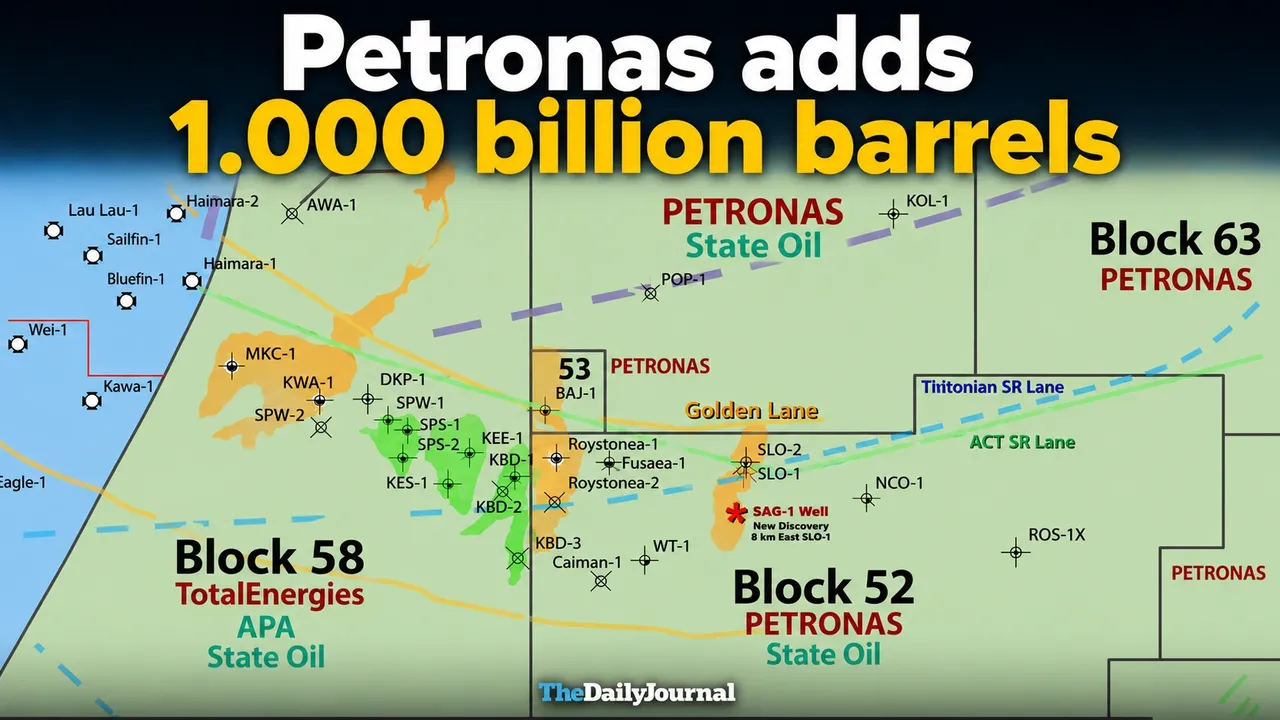
Julio A. López, Editor-in-Chief — Petronas, through its subsidiary Petronas Suriname E&P B.V., announced two new hydrocarbon discoveries and a successful appraisal well in Block 52, offshore Suriname, bringing its total number of successful wells in the country to eight and surpassing 1 billion barrels of oil equivalent in recoverable resources.
Three Wells, Three Results
The Caiman-1 exploration well, drilled in 90 meters of water to a total depth of 5,065 meters, encountered multiple oil-bearing Cretaceous sandstone intervals. A few kilometers away, the Swartzia Aspasia Complex-1 (SAC-1) well, located 8 kilometers east of the Sloanea-1 gas discovery and drilled in 610 meters of water to a depth of 4,560 meters, penetrated gas-bearing sandstone reservoirs. Formation testing (DST) confirmed strong deliverability and good reservoir quality.
The third well, Roystonea-2, an appraisal well drilled 7 kilometers north of the original Roystonea-1 discovery, confirmed the lateral extension of the oil-bearing reservoirs with solid productivity results.
All eight discoveries are located along the Upper Cretaceous Golden Lane trend. Petronas had already declared the Sloanea gas field commercial in November 2025, with a final investment decision (FID) expected before the end of this year.
A Shift in the Regional Narrative
The results are significant because they challenge the pessimism that surrounded Suriname at the beginning of the year. In January, exploration activity in the country appeared lackluster: ExxonMobil had exited Block 52, and Apache returned most of Block 53, reinforcing the perception that the Guyana-Suriname basin clearly favored Guyanese waters. That outlook now appears to be changing.
The Caiman-1 result is particularly revealing: the well targeted a higher structural position near West Tapir-1, drilled in 2008 by Noble and Repsol, which never reached the Cretaceous sequence. Petronas tested what previous operators were unable or unwilling to pursue — and found oil.
Ownership Structure and Expansion
Petronas holds an 80% interest in Block 52 after acquiring Exxon’s position in 2024; the remaining 20% is held by Paradise Oil Company, a subsidiary of state-owned Staatsolie.
The block covers more than 4,700 square kilometers, and the Malaysian company recently acquired Block 66, immediately to the north, as a strategic acreage position.
In total, Petronas currently holds interests in eight offshore blocks in Suriname: Blocks 9, 10, 48, 52, 53, 63, 64, and 66.
Geological Diversity Opens New Opportunities
What distinguishes this exploration success is the diversity of the discoveries: oil in shallow waters, gas with strong deliverability in deeper waters, and appraisal wells confirming that the discoveries extend beyond the initial mapping.
The results strengthen the case for multiple oil and gas developments in Block 52, potentially including an independent floating liquefied natural gas (FLNG) project, further establishing Suriname as one of the most dynamic exploration frontiers in the Guyana-Suriname basin.