Audio: https://clyp.it/sleaff2l
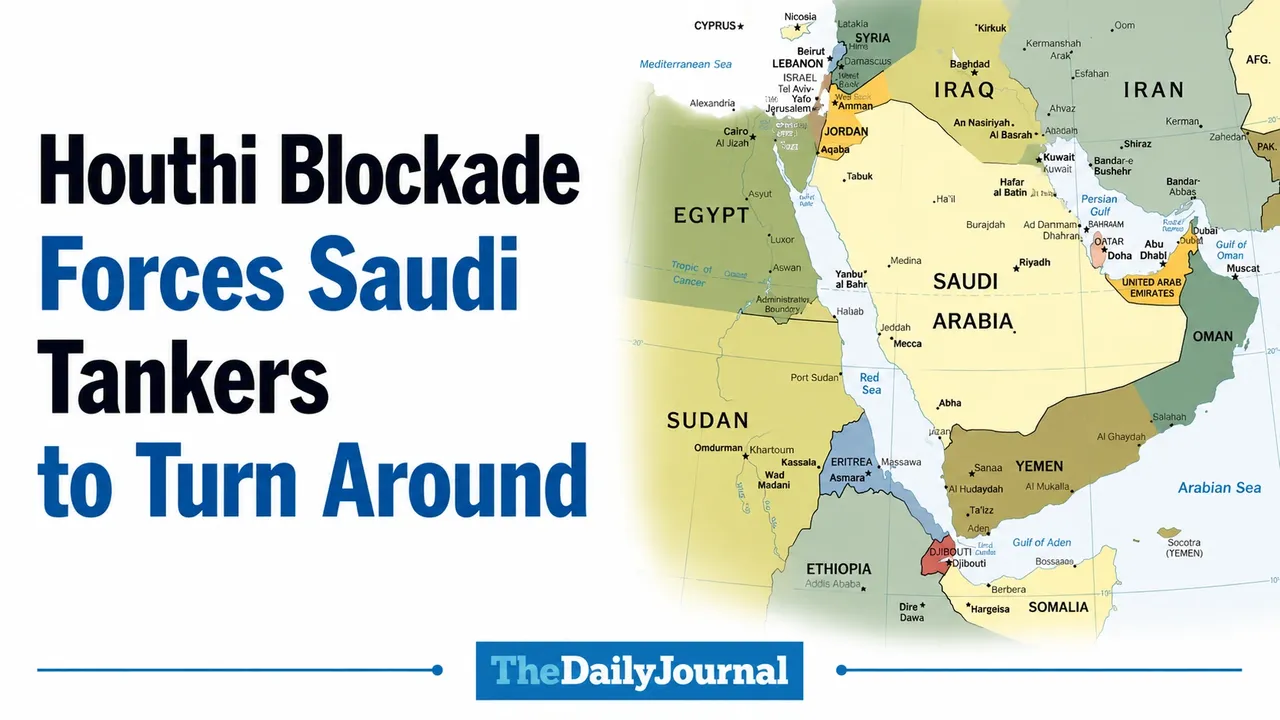
Julio A. López, Editor-in-Chief.— Two oil tankers carrying Saudi crude bound for China and India reversed course in the Red Sea on Tuesday after Yemen’s Houthis announced a naval blockade against Saudi Arabia on Monday, opening a third active front in the U.S.-Iran war and directly hitting the kingdom’s last remaining escape route for its oil after the Strait of Hormuz was effectively paralyzed.
From Yanbu to the Suez Canal: The Turn That Confirms the Threat
The two vessels, which had loaded Saudi crude at the Red Sea port of Yanbu, changed course toward the Suez Canal instead of continuing through Bab el-Mandeb toward the Indian Ocean. With the war keeping the Strait of Hormuz closed to traffic out of the Gulf, the Red Sea had become the main alternative route for millions of barrels of Saudi oil per day, transported by pipeline to Yanbu. The Houthis, who control northern and western Yemen, including the coast at the entrance to the Red Sea, also sent shipping companies a letter warning that they would attack any vessel loading or unloading Saudi oil.
President Donald Trump acknowledged that, so far, the Houthis have not formally closed Bab el-Mandeb — the strait known as the “Gate of Tears” — but warned: “It hasn’t happened so far. If something like that happens, we’ll take care of it.” Oil prices reacted immediately: crude rose more than 2% on Tuesday, with Brent trading above $91 a barrel and U.S. gasoline prices back above $4 a gallon.
War Enters Its Eleventh Consecutive Night
The Houthi announcement comes amid an escalation that the United States and Iran have failed to contain since the collapse, earlier this month, of a provisional ceasefire that had been in place for only a few weeks. U.S. Central Command (CENTCOM) confirmed that it had bombed targets across Iran overnight Tuesday, marking the eleventh consecutive night of strikes, while residents of Tehran reported explosions early Wednesday as Iranian air defenses were activated over the capital.
According to CENTCOM, attacks over the past week and a half have hit military command centers, maritime capabilities, missile and drone launch sites, and Iranian air defense systems.
An Iranian Health Ministry official said that 50 civilians had been killed and 500 wounded in recent U.S. attacks.
U.S. Defense Secretary Pete Hegseth told senators during a hearing that the war — which Congress has not authorized — has so far cost $37.5 billion, and requested an additional $70 billion in “supplemental” funding, in part to replenish depleted missile stockpiles. Trump also confirmed that 18 U.S. service members have been killed so far, including four in Iranian attacks on bases in Jordan and Iraq in recent days, in a war that has proven unpopular among Americans and others affected by rising energy costs worldwide.
Diplomatic Window: A 10-Day Ceasefire Proposal
Amid the escalation, a senior Iranian official said Monday that Tehran had received a proposal from mediators for a 10-day ceasefire, in an effort to salvage the provisional agreement signed in June, which had itself replaced another pact reached in April.
In a sign that diplomacy remains alive, Iranian Interior Minister Eskandar Momeni visited Pakistan — a country acting as a mediator — and urged Islamabad to continue its efforts. Trump, meanwhile, renewed his threats on Tuesday to attack Iranian nuclear facilities at Natanz “soon,” after having described them in June 2025 as “destroyed” following a U.S. bombing of the facility, which is located in a mountainous region. Iran then vowed to retaliate.
Transit through the region’s key energy chokepoints — Hormuz and Bab el-Mandeb/Suez Canal — is running at approximately one-third of 2023 levels this year, according to data cited by Reuters, underscoring a war that has already left thousands dead across the Gulf since it began on February 28 with U.S. and Israeli attacks on Iran.