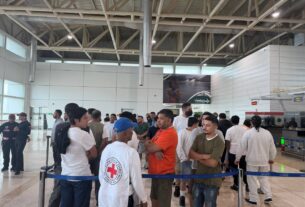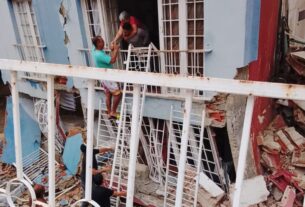
Homes built with zinc sheets and dirt floors, children living in houses marked with red tags, and communities affected by the earthquakes were among the realities encountered by volunteer inspectors coordinated by Sergio Silva, a professor at the Central University of Venezuela’s School of Civil Engineering, during an outreach mission carried out from July 24 to 26.
By Vanessa Davies
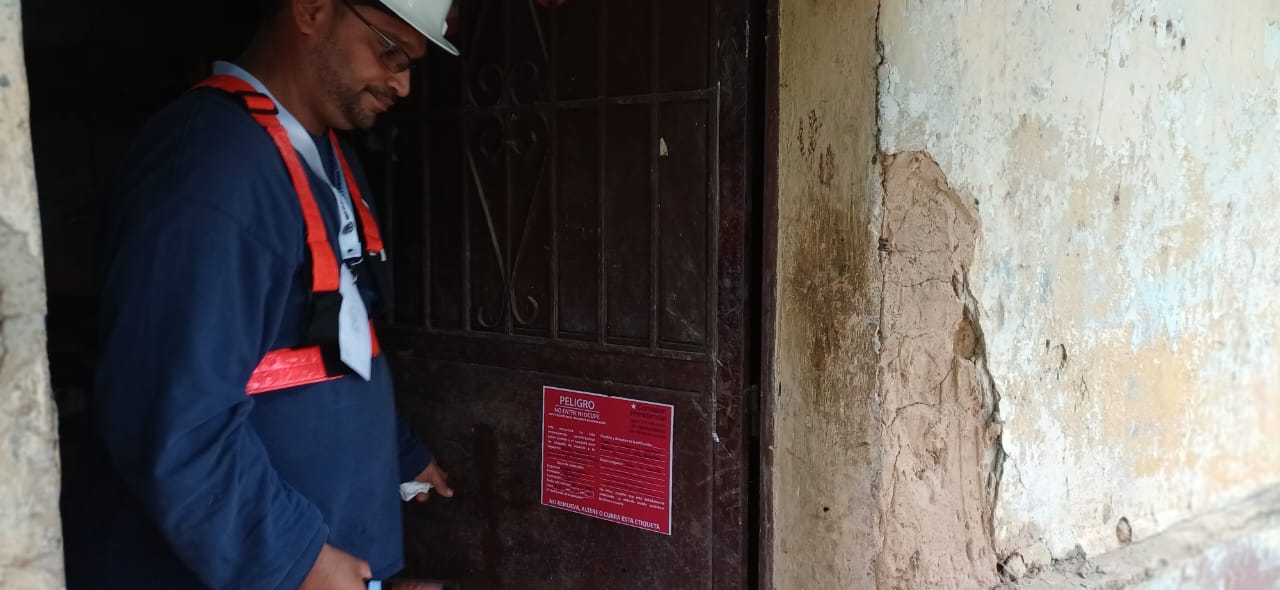
Hortensia’s home was already fragile before the San Juan earthquakes, but the tremors left it even more vulnerable. She and her husband, José Benítez, live in a rural area of Carayaca where they grow avocados and cultivate beans. Although Benítez told Gustavo Córdova, a firefighter at the Central University of Venezuela (UCV), that he already knew their bahareque home would receive the highest-risk classification, Córdova’s assessment still shook him. The firefighter, more accustomed to putting out fires, stood beside Hortensia as she cried, placing the red warning sticker on the metal door.
Their story reflects what volunteer inspectors found across much of Carayaca. Under the coordination of Sergio Silva, a professor at UCV’s School of Civil Engineering, the teams spread out through three areas of the parish between July 24 and 26. The university’s Office of the Rector supported the effort, while Professor Tibisay Serrada welcomed the volunteers to her inn, La Aldea, where the teams stayed during the mission.
Green for engineering, red for social conditions
Twenty-one structural inspection specialists and four social workers assessed 217 homes across three communes in just three days. Engineers classified 42% of the houses as green. Yet Nayrubi Ramírez, a professor at UCV’s School of Social Work, believes many of those same families deserve a red tag because of the severe hardships they endure. Inspectors assigned yellow tags to 32% of the homes, indicating moderate structural risk, while 26% received red tags.
For engineers, Silva explained, a red tag simply means “they need help. Help from the State.”
Yet many houses built with zinc sheets and dirt floors remained standing after the June 24 earthquakes, exposing another kind of vulnerability that also demands attention.
“We found overcrowded households that already existed before the earthquake, and we also found overcrowding afterward because many people from Catia La Mar and Caraballeda moved into this parish to shelter with relatives during the emergency,” Ramírez explained.
“Someone must restore their dignity”
Inspectors used hammers and picks to examine the homes that community leaders identified as the most severely affected. Women leading communal councils and communes accompanied the teams up and down the mountains, hoping to restore some of the peace that the earthquakes had taken from local families.
“My daughter suffered a breakdown after the earthquakes,” said Marbeli Briceño, who lives in the El Cohete sector along the Carayaca-Tarma road.
That fear has not disappeared. Every tremor, no matter how small, sends the family running once again.
After inspecting Rosaura Alemán’s house with the help of students Miguel Figueroa and Jesús Silva, inspector Pedro Durán spoke with complete honesty.
“The earthquakes did not damage your house, so that it will receive a green tag. But someone must restore your dignity.”
She answered quietly:
“I don’t want to leave this place.”
The modesty of her home does not defeat her. Instead, it gives her another reason to keep fighting.