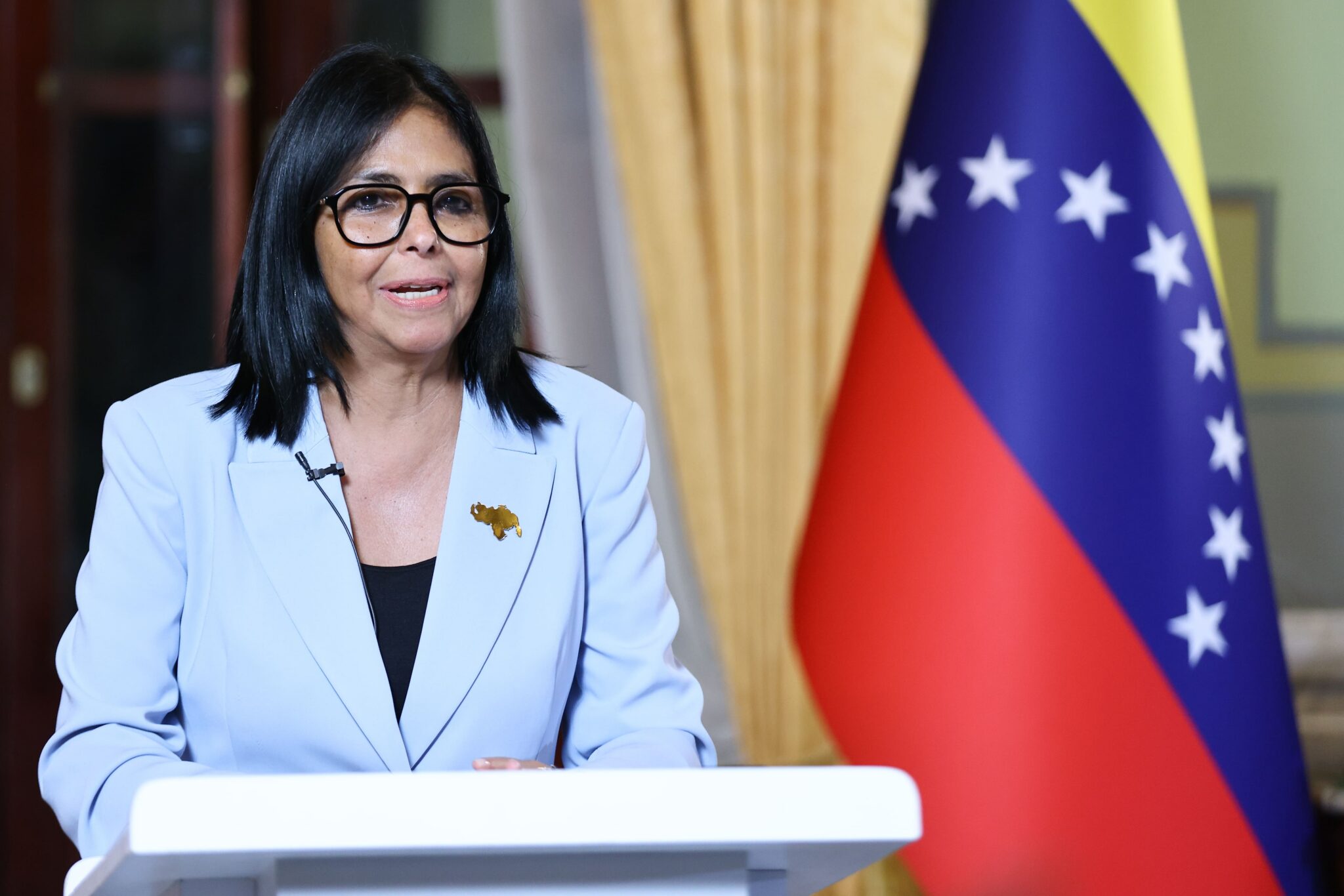
CARACAS — Venezuela’s acting president, Delcy Rodríguez, said Saturday night that the energy agreement with the United States calls for the development of 17 strategic oil fields and aims to reach production of more than 1.5 million barrels per day over its 25-year term.
In a statement shared on social media, Rodríguez provided new financial and operational details about the agreement announced Friday and said Venezuela will retain ownership of its natural resources. In contrast, the United States will provide capital and technology to restore oil industry assets.
A day earlier, U.S. President Donald Trump announced an energy agreement that he described as “the largest oil deal in world history.” U.S. companies will take control of fields containing more than 65 billion barrels of crude oil, equivalent to 21% of Venezuela’s total proven oil reserves.
“This 25-year binational project includes the development of 17 strategic fields with a production target of more than 1.5 million barrels per day,” she said.
The announcement provides a specific production target for the agreement for the first time. The Venezuelan government has presented the deal as a way to attract foreign investment and revive an oil industry that has struggled for years with financial restrictions, deteriorating infrastructure and U.S. sanctions.
Estimated revenue of $209.335 billion
Rodríguez estimated that the project could generate $209.335 billion in revenue for the Venezuelan State, based on an average oil price of $65 per barrel.
“Using a price of $65 per barrel as a reference—which could be higher or lower—our country’s revenues would reach a total of $209.335 billion for the Venezuelan State,” she said.
According to her calculations, “for every barrel produced and sold, nearly $19 goes directly to our country.”
The projections depend on fluctuations in international oil prices and on whether the fields included in the agreement meet their production targets.
Rodríguez argued that Venezuela needs investment, technology and infrastructure to turn its reserves into production and greater tax revenues.
“Having resources underground is not enough. We need investment, technology, infrastructure and productive capacity to turn that wealth into well-being for our people,” she said.
U.S. capital and Venezuelan oil
The official described the agreement as a cooperation framework under which Venezuela will contribute its reserves, infrastructure and operational expertise, while the United States will provide capital and technology.
“Venezuela contributes oil, its industry and the experience of its workers accumulated over more than 100 years. The United States contributes the capital and technology necessary to restore and develop those assets,” she said.
In return, Venezuela expects to obtain “production, jobs, infrastructure investment, greater revenues for the State [and] productive linkages for domestic industry.”
Rodríguez said the bilateral agreement forms part of a broader strategy to increase the country’s energy capacity, which also includes projects with international companies.
“Our goal goes further,” she said, citing agreements with companies such as Chevron, Repsol, ENI, Shell and BP.
According to the statement, the government seeks to expand oil production, increase gas exports and develop the petrochemical industry.
Eight new blocks in the Orinoco Belt
Rodríguez said the project also includes developing eight new, or greenfield, blocks in the Orinoco Oil Belt, under a fiscal framework that, according to her explanation, includes minimum royalties of 16% and a 34% income tax.
The official compared these terms with projects developed during Venezuela’s oil opening in the 1990s.
“The last major project to develop four greenfield blocks in the Orinoco Oil Belt came through the strategic associations during the oil opening 30 years ago, with 1% royalties and a 34% income tax,” she said.
The new agreement, she added, “includes the development of eight greenfield blocks in the Belt, with minimum royalties of 16% and a 34% income tax.”
Government defends ownership of resources
Rodríguez also addressed questions about the conditions under which foreign operators will participate in the fields included in the project.
“One thing must remain absolutely clear: Venezuela retains ownership and sovereignty over its resources while using capital, technology [and] operational capacity to support the recovery of a strategic industry,” she said.
Her statement sought to clarify the scope of the agreement after U.S. President Donald Trump announced that companies from his country would assume majority control over Venezuelan oil assets linked to the deal.
Rodríguez said the Venezuelan government will disclose information about investment levels, production and revenues generated by the projects.
“Venezuelans have the right to know how much companies invest, how much they produce, how much the State receives and what conditions apply to operators,” she said.
The acting president defended negotiations with Washington as part of a strategy to transform political differences between the two countries into economic cooperation.
“That is why we chose the path of diplomacy with the United States of America: to transform our differences into cooperation, and that cooperation into investment, production, well-being [and] concrete results for Venezuelans,” she said.