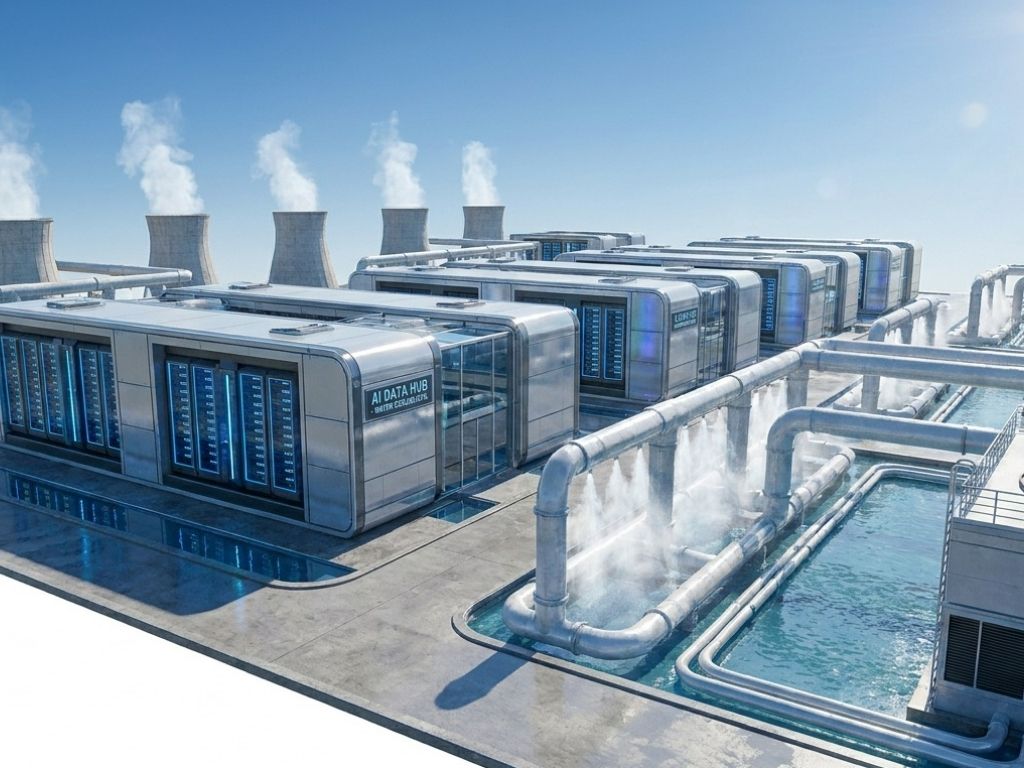
The Daily Journal – The global race for Artificial Intelligence (AI) supremacy has encountered its greatest obstacle not in algorithms, but in the Earth’s natural resources. Cloud computing and deep-learning models require massive physical infrastructure that consumes electricity and water at unprecedented rates.
With critical projections for the end of the decade, the technology industry now faces regulatory and social scrutiny over the sustainability of “digital progress.”
A growing water footprint: Figures since 2014
The transformation of data centers into hyperconnected mega-campuses has multiplied their environmental impact over the past decade. In key regions such as the United States, these facilities now consume three times as much water as they did nearly a decade ago, compared with figures from the 2014-2015 period, which provide a quantitative baseline from before the current artificial intelligence boom.
According to data analyzed by market intelligence firms, data centers worldwide consumed an estimated 2.97 trillion liters of water in 2026. This figure marks a direct increase from the 2.66 trillion liters consumed in 2025.
New high-powered AI servers (>700 watts) drive much of this consumption because they require evaporative cooling systems that rely on potable water. Environmentalists warn that climate change and industrial pollution across major watersheds have already placed potable water resources under severe pressure.
Projections for 2031: Growing pressure on global watersheds
Projections indicate that global consumption could reach 5.2 trillion liters by 2031, with a compound annual growth rate (CAGR) of 11.84% from 2026 to 2031. North America leads the market with a 38.55% share, while the Asia-Pacific region is growing at a 12.31% CAGR. China stands out in particular, as its consumption could triple to 3.05 billion cubic meters by 2031.
Potential environmental risks
- Water scarcity: High demand creates conflicts in water-stressed areas such as the southwestern United States, Europe and Singapore, and has prompted project suspensions in countries such as Chile.
- Energy-water dilemma: Water restrictions force operators to use dry cooling systems, which dramatically increase electricity consumption.
Technological mitigation strategies
To counter these challenges, advanced cooling solutions could grow at a 12.92% CAGR through 2031, while reclaimed water use is growing at 13.68% annually. However, if ambitious investments in generative AI continue at their current pace, all indications suggest that the industry could push potable water supplies beyond their current limits and further intensify existing scarcity risks.
Technology giants are also exploring another strategy: installing data centers in space, where temperatures in the Earth’s shadow can fall as low as -180°C (-292°F). This approach could dramatically reduce water consumption, but it requires massive investments starting at around $1 billion per megawatt (MW) of capacity—approximately 100 times the cost of an equivalent facility on Earth.
With information from Rystad Energy, Mordor Intelligence, and Xataka