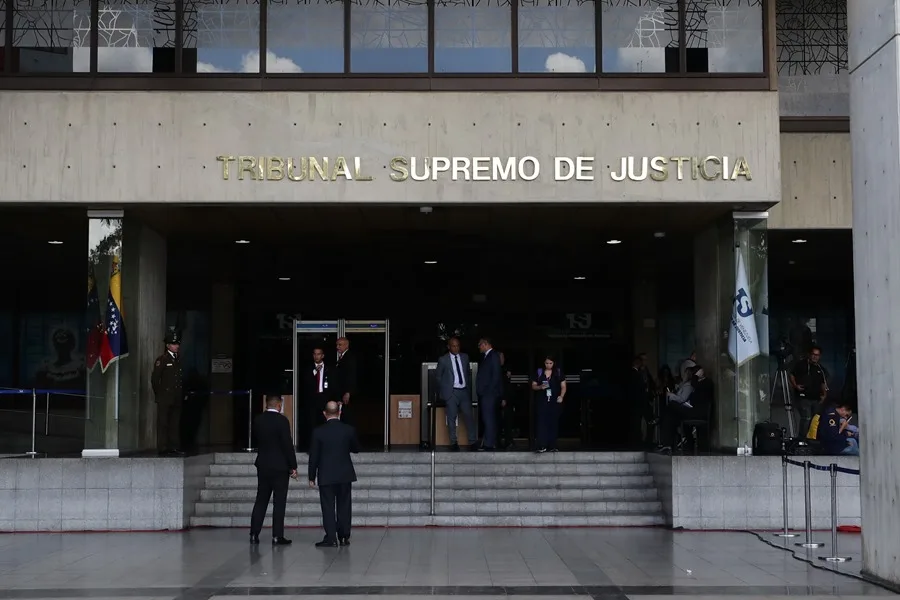
The Daily Journal.- The delegations representing the interim government and the National Assembly elected in 2015 announced last Friday the formation of a Council for the Review of Credentials and Requirements of candidates seeking seats on the Supreme Court of Justice (TSJ). The parties created the body under the agreements reached during the political dialogue process, and it will work alongside the Judicial Nominations Committee.
The parties agreed on the council’s composition at the close of the second round of talks as part of their commitments to strengthen Venezuela’s judicial institutions.
Seven jurists and academics with experience in the administration of justice, university teaching and legal research will serve on the council.
Among its members is Belén Ramírez Landaeta, a specialist in administrative law and former judge of the First Court for Administrative Disputes and the former Supreme Court of Justice. She currently serves as president of the Foundation for Administrative Law Studies (Funeda).
The council also includes María Bernardoni de Govea, who served as labor minister during Rafael Caldera’s second administration. An expert in labor law and social security, she has also pursued an academic career at the Central University of Venezuela, Andrés Bello Catholic University, and Monteávila University.
Another member is Deyanira Nieves Bastidas, a former justice of the TSJ’s Criminal Cassation Chamber and former director general of the Public Defender’s Office. She currently serves as rector of the Audiovisual University of Venezuela.
The council also includes Rogelio Pérez Perdomo, a lawyer and sociologist of law who formerly served as dean of the Faculty of Legal and Political Studies at Metropolitan University and as a visiting professor at Stanford University.
Bernardo Pulido Márquez, a lawyer specializing in constitutional law and human rights, will also serve on the council. He pursued graduate studies at Stanford and Notre Dame universities and has experience litigating cases before the Inter-American Human Rights System and United Nations mechanisms.
Among the members with ties to Venezuela’s judicial system is Silio César Sánchez Zerpa, a constitutional law specialist and former executive director of the TSJ’s Magistracy, as well as vice rector of the Bolivarian University of Venezuela.
Federico Sebastián Fuenmayor Gallo completes the council. A lawyer specializing in criminal and constitutional law, he became an alternate justice of the TSJ’s Constitutional Chamber in 2015. He participated in judicial decisions related to the institutional conflict between the country’s highest court and the opposition-controlled National Assembly.