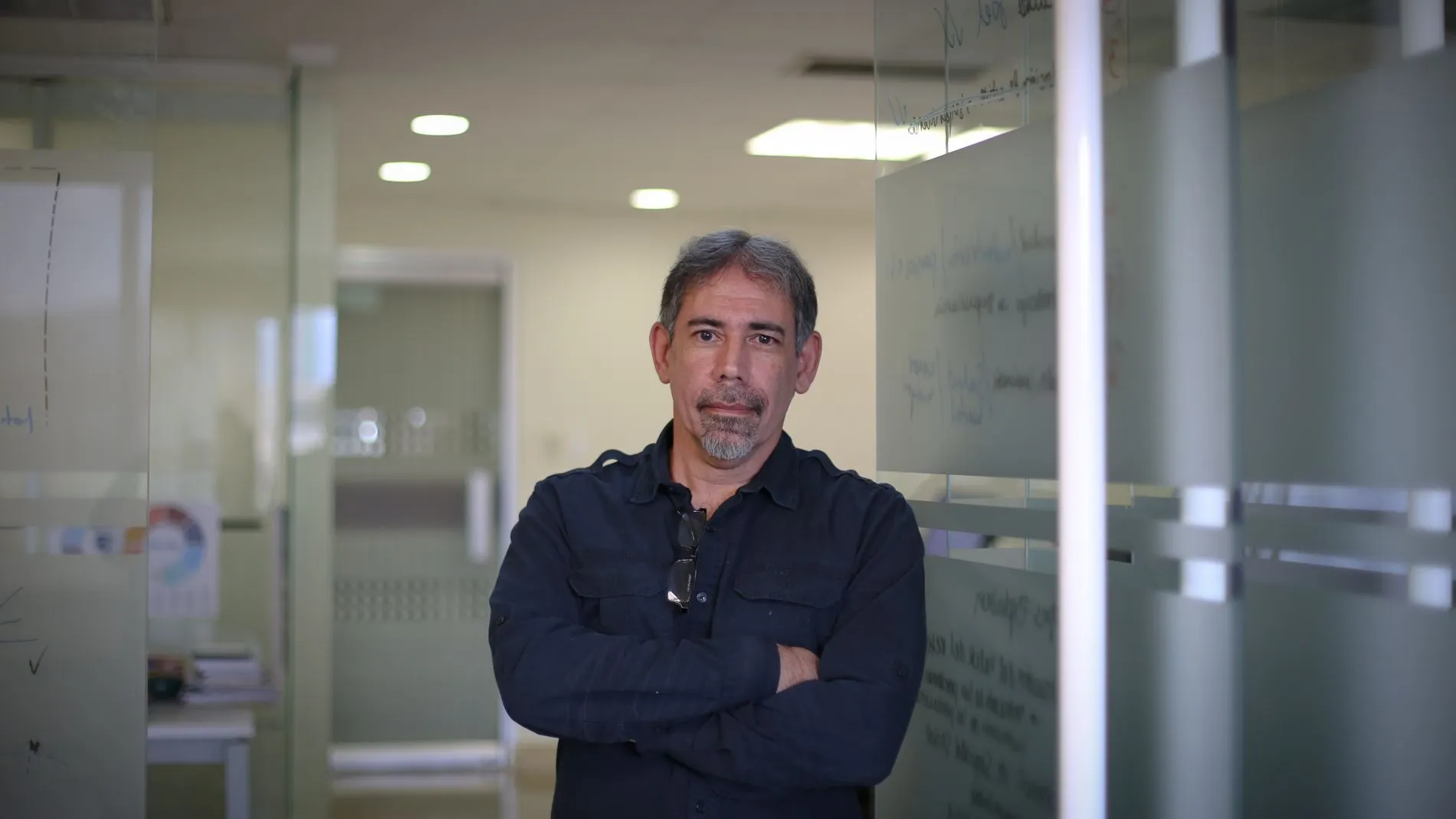
The economist warns that the process must begin with a forensic audit of liabilities. The scale and diversity of creditors will require a combination of traditional instruments and mechanisms linked to economic and fiscal performance.
Neirlay Andrade
Venezuela faces the challenge of restructuring an external debt whose size, composition, and creditor diversity make the process particularly complex. For economist Leonardo Vera, a tenured professor at the Central University of Venezuela (UCV), the country must not only determine how much it owes, but also establish how much it can pay and under what conditions it can modify its obligations without falling into default again.
During a conference at UCV’s Faculty of Economic and Social Sciences, organized by the Friedrich Ebert Foundation, Vera reviewed Venezuela’s borrowing process, the various estimates of its liabilities and the conditions that, in his view, should be met before presenting a proposal to creditors.
His assessment starts from one premise: Venezuela’s debt is not homogeneous. Beyond sovereign and Petróleos de Venezuela (PDVSA) bonds, there are bilateral obligations, debt owed to multilateral organizations, commitments to China and the Paris Club, arbitration awards, and claims from former partners of the state-owned oil company.
“A complex mosaic of creditors,” Vera summarized.
How we got here
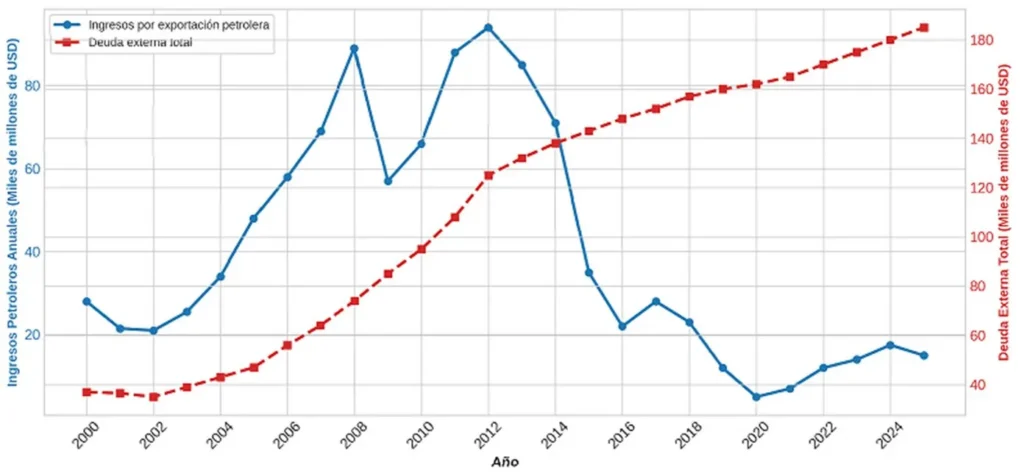
Venezuela’s debt began to grow more rapidly in 2002, coinciding with rising oil prices. For Vera, the relationship between the two reflects one of the main failures in managing the country’s external finances: Venezuela increased its borrowing precisely when its oil revenues were rising.
“Debt began to grow very vigorously starting in 2002, just as oil prices were rising. Which seems contradictory, because if oil prices are going up and you have more oil revenue, why would you borrow more?” the economist said.
According to Vera, the explanation lay in Venezuela’s declining perceived risk. With higher oil revenues, markets became more willing to finance the country and assumed that crude prices and revenues would remain high.
The problem was that borrowing continued even after the oil cycle began to change.
The composition of the liabilities also changed. While sovereign and PDVSA bond issuances predominated in the early years, other obligations later accumulated, including arbitration awards, bilateral debt, and commitments to multilateral organizations.
Pressure on external finances became particularly evident beginning in 2011, when principal and interest payments began to come due.
Vera explained that debt service came to absorb nearly half of total exports at a time when the country was allocating significant resources to meeting obligations to international creditors.
“We borrowed enormously at that time,” he said.
In his view, one consequence of failing to restructure the debt preemptively was the increased pressure on available foreign currency.
“The cost of this policy of failing to restructure preemptively and on time, and instead having to wait until the 2017 default, was tightening the screws even further on exchange controls because there was not enough foreign currency,” he said.
For Vera, the period that followed brought a prolonged economic collapse that he described as the “Great Venezuelan Depression.”
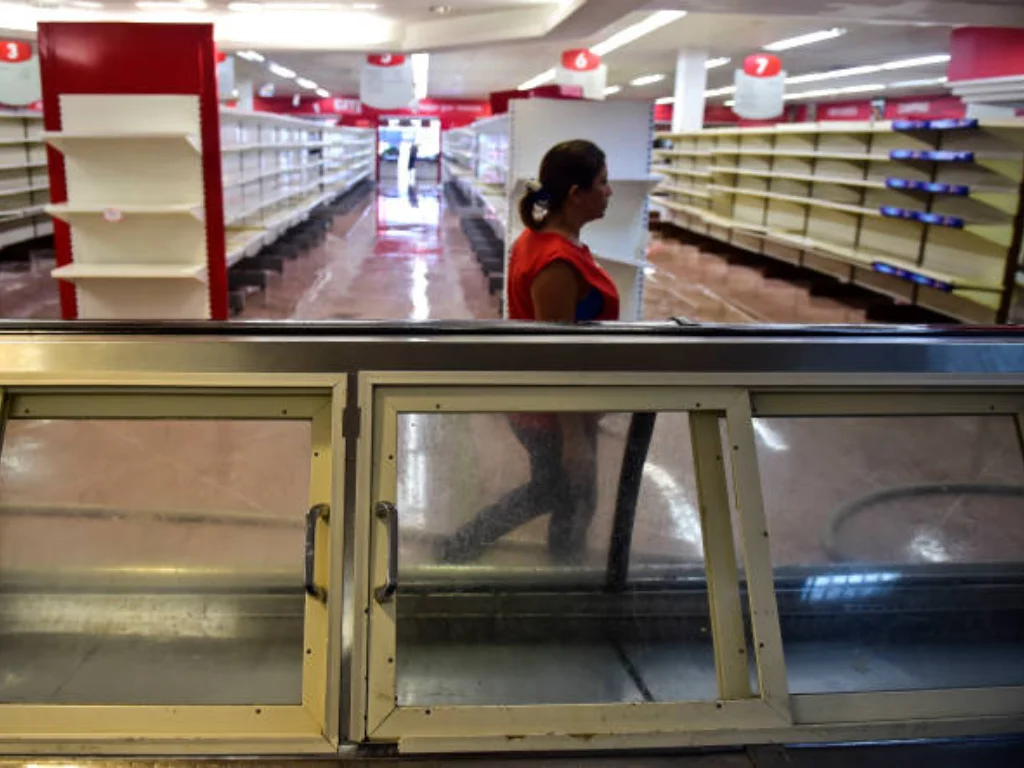
“The period when there weren’t even diapers for children at pharmacies, when there was no deodorant, no milk, no supplies for industry, and which led to the economic collapse that lasted seven and a half years in Venezuela,” he added.
The economist also recalled the contradiction during that period between announcing a restructuring — as Nicolás Maduro did — and continuing to make debt payments.
“No comment,” he joked.
How much is the debt?
Determining the size of the debt is one of the first problems any restructuring process must address.
Vera estimates Venezuela’s obligations at around $170 billion, which contrasts with the $240 billion estimate published by the Financial Times.
His calculation includes approximately $94 billion in financial debt owed by the Republic and PDVSA, including accrued interest.
To this, he adds debt owed to multilateral organizations, bilateral debt, commitments to the Paris Club and approximately $17 billion owed to China.
It also includes about $22 billion in arbitration awards.
The structure of the liabilities, however, continues to expand as new claims emerge.
“Every time you lift the rug at PDVSA, another partner with a debt turns up,” Vera said.
The economist cited Repsol, with a $5.3 billion claim, and Eni, with approximately $3 billion.
He also recalled that Indian companies recently demanded $1 billion from Delcy Rodríguez during the acting president’s visit to the Asian country.
The diversity of these obligations makes it difficult to establish a single figure and raises another problem: each group of creditors may have different rights, priorities, and conditions.
For that reason, the economist believes Venezuela must first precisely define the universe of obligations to be renegotiated.
Questions surrounding the restructuring process
The acting government announced the start of the restructuring process on May 13 and subsequently appointed Centerview Partners as its financial adviser. However, Vera believes numerous questions about the process remain unanswered.
Among the outstanding questions, he cited how much of the debt authorities have audited, the definitive amount of recognized liabilities, and whether they have conducted a debt sustainability analysis.
For Vera, the first step must be “a forensic audit of liabilities.”
Next, he proposes bringing together the different groups of creditors and reconciling the obligations through a comprehensive and transparent registry.
That registry should identify “the exact amount, the currency and the applicable law in each case.”
But restructuring cannot be limited to financial negotiations. The economist considers it essential for Venezuela to present a macroeconomic stabilization program.
“You don’t go into a debt restructuring in the midst of a macroeconomic stability process like the one Venezuela has today,” he said.
The country must establish its economic program and accompany it with a sovereign risk and debt sustainability framework.
Such an exercise would make it possible to determine the country’s actual repayment capacity and define what type of relief Venezuela needs.
Vera also points to the need to adapt the legal framework and obtain the necessary licenses to ensure that the process has validity across the different jurisdictions.
Creditors and courts, he explained, need to know who has the legal authority to commit the Venezuelan state to a new obligation.
“This is no trivial matter,” he warned, because a future government could challenge the authority of those who carried out a particular debt swap.
Once these issues have been resolved, the process should establish official communication channels and working groups with the different groups of creditors.
The role of the IMF
For the professor, the International Monetary Fund (IMF) plays a central role in any eventual restructuring.
He explained that its importance goes beyond financing. The organization can provide estimates of essential variables needed to determine Venezuela’s repayment capacity.
“In essence, the IMF is key because, from a technical standpoint, it is in a position to provide credible estimates of economic growth, the primary fiscal balance and the capacity to generate foreign currency,” he said.
These variables make it possible to determine how many resources the country needs to meet both its obligations and basic needs.
Vera explained that the sustainability analysis outcome would determine the type of restructuring.
If the debt is considered sustainable, although not with a sufficiently high probability, the process could focus on easing cash-flow pressures through longer maturities.
But if the conclusion is that the debt is unsustainable, a reduction in the principal owed would become necessary.
“If the determination is that the debt qualifies as unsustainable, which is the case, the IMF requires a haircut, a reduction in principal,” he said.
A reduction in interest could also be considered, particularly on accrued interest.

Delcy Rodríguez met with IMF Managing Director Kristalina Georgieva in New York on the sidelines of the 81st United Nations General Assembly.
In this scenario, Vera believes the IMF can serve as a reference point for both sides.
The economist considers the organization’s absence at this stage a warning sign for the process.
“It is a warning that the process is not being handled properly or that the process may have a chance of failing,” he said.
Vera also warns about the risk of repeating restructuring processes that subsequently require further renegotiation.
He cited Argentina as an example, describing it as a case of “serial restructuring.”
“That is why it is not just about restructuring; it is about restructuring well,” he said.
Instruments for a complex restructuring
Once the amount of debt and the country’s repayment capacity have been determined, the process should lead to a debt exchange.
According to Vera, the goal is to reduce the present value of the debt to make it sustainable for the debtor while simultaneously creating sufficient incentives for creditors to participate.
“The key in the exchange is to reduce the present value of the debt for the debtor, to make it sustainable, but that also benefits the creditor, because what the creditor wants is for those new bonds not to fall into default.”
The challenge lies in achieving sufficiently broad creditor participation and preventing groups that reject the agreement from subsequently pursuing legal action.
For this reason, Vera believes the scale and diversity of Venezuela’s case may require a menu of instruments.
“The exchange, in Venezuela’s case, which is a complex and very large restructuring, may require a menu of instruments combining traditional instruments with more creative instruments that exist today.”
Traditional instruments
Conventional tools include discount bonds, which directly reduce the debt’s value.
These instruments allow the nominal value of the obligations to be reduced while maintaining an interest rate that may remain attractive to creditors.
But Venezuela’s restructuring could incorporate additional clauses that would allow payments to adjust to the economy’s performance. Vera mentions oil-revenue-linked securities as one alternative, given the importance of hydrocarbons in generating foreign currency.
He also proposes instruments that would allow payments to pause temporarily in response to certain extraordinary events, such as a catastrophe, and automatically reschedule them.
Warrants versus symmetric bonds
Among the alternatives most frequently discussed in current debates are instruments linked to economic performance.
Vera mentions warrants, which Argentina and Greece have used in restructuring processes.
The logic is that creditors receive additional payments when the economy exceeds certain growth thresholds.
But the economist questions that design because the mechanism benefits creditors when the economy improves without necessarily providing equivalent relief when economic performance worsens.
“That is why every time financial investors come to Venezuela or talk abroad and say that warrants could be the solution for Venezuela, I say: red alert.”
He proposes using symmetric bonds, allowing payments to increase when oil revenues exceed certain levels and decrease when revenues fall below a benchmark.
“When things are going well, and oil revenues exceed the estimate the International Monetary Fund made for next year, I pay you more. When oil revenues fall below a threshold, I pay less.”
More options
Another alternative involves sustainability-linked bonds, whose payments can be tied to environmental, social and governance performance.
Vera also proposes debt-for-equity or debt-for-assets swaps.
These mechanisms could provide minority stakes in certain state assets, oil joint ventures, logistics infrastructure or secondary exploitation rights in exchange for extinguishing legal claims.
The instrument could prove particularly relevant for creditors holding arbitration awards.
“Depending on the cluster of creditors, I have a solution that can work for both sides,” he explained.
The economist also cited Sri Lanka as an example of a restructuring that incorporated instruments linked to economic performance and fiscal governance.
One of them ties payments to GDP performance: if the economy improves, the bond pays more; if it deteriorates, it pays less.
The second links automatic interest-rate reductions to compliance with specific fiscal management targets.
“These are innovations that are already on the market; they are not inventions,” Vera said.