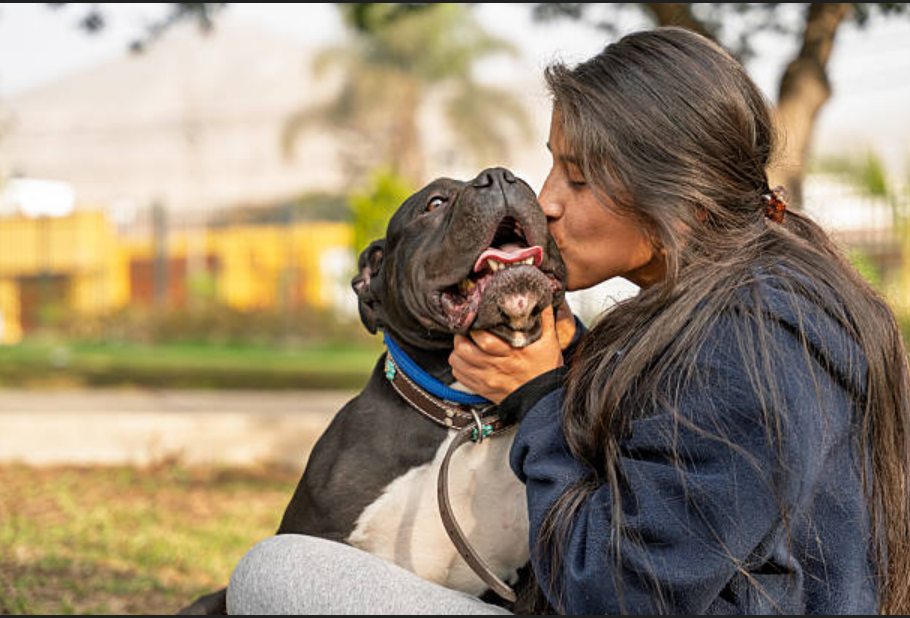
Pit bull-related incidents attract media attention, but that does not make them more common, says veterinarian Otto Alvarado. The specialist insists that pit bulls are not aggressive dogs and calls for raising them with love and commitment.
Vanessa Davies
Murderers, some say. They should be banned, others insist. They should disappear from the face of the Earth. They are little angels. They are not to blame for anything.
Violence, a bad reputation, and injustice seem to coexist in the birth certificate of the pit bull. Violence, because—as veterinarian Otto Alvarado reminds us—people originally bred them to confront bulls by crossing bulldogs and terriers. A bad reputation, because any event involving a pit bull quickly turns into viral news. And injustice, because people have used, accused, and condemned these dogs for an aggression they supposedly possess but, in reality, do not. Everything depends on the hand that guides them.
Ana Francisca’s hand proved especially gentle with Danko, her pit bull, who slept in a bed and ate from her hand. She recalls how he wagged his tail when he heard familiar voices, welcomed petting, and licked people’s hands. Never, she stresses, did any regrettable incident occur.
Eighty percent versus twenty percent
Last May, according to media reports, a man died in La Guaira after his pit bull bit him. Public reports indicated that the animal allegedly tried to approach a student and, when its owner attempted to control it, allegedly attacked him.
Do pit bulls frequently star in attacks?
Alvarado argues that the media reports these incidents more often than others, but that does not make them the most common. In fact, the veterinarian says he has suffered more from the bad temper of a poodle or a Siberian husky than from a pit bull.
“Why don’t we publicize poodle accidents? Let’s go to veterinary clinics and ask which dog has bitten veterinarians the most. In more than 30 years of practice, a Siberian husky has bitten me twice.”
According to Alvarado, genetics account for 20 percent of a pit bull’s behavior. In comparison, the environment contributes the remaining 80 percent—the conditions under which the dog grows up, the treatment it receives, and the affection it experiences.
“If you raise it calmly, around children, with affection, and teach it impulse control,” he says, “there is no problem.”
The opposite happens when people encourage hostility and constantly repeat commands such as “attack, attack.”
“The dog is not aggressive. Nature did not make it that way. What it has is a prey drive or pursuit instinct, and that develops when human beings encourage it.”
For example, if someone plays tug-of-war with a towel and lets the dog take it away, the dog feels victorious.
“It is not hatred or aggression. It is a pursuit instinct stimulated by movement,” he explains.
Other breeds possess similar instincts, and people do not consider them evil because of it.
“A beagle has it for hunting rabbits. A golden retriever has it for fetching a ball. A greyhound has it for chasing.”
The pit bull uses it to chase and capture whatever moves.
It is also an exceptionally strong animal.
Love is repaid with love
The Law for the Protection of Domestic and Captive Fauna, approved in 2010, restricts—but does not prohibit—the ownership of pit bulls in Venezuela.
Article 33 states:
“The ownership and possession of pit bull dogs is restricted. Consequently, anyone exercising such rights over these animals must comply with the following requirements: keep them permanently under controlled conditions, meet all corresponding sanitary requirements, and adopt the necessary safeguards to prevent the animals from escaping.”
In some circles, people interpreted this measure as a complete ban on owning pit bulls. In reality, no one prevents citizens from raising them.
Who usually owns pit bulls?
Men who seek them as a way to command respect or project authority. Sometimes they even use them for fights.
It is worth noting that the same law prohibits fights between domestic dogs in either public or private spaces (Article 16).
Yet those contests unfortunately continue, says the veterinarian.
“In irresponsible hands, the dog becomes a disaster. The problem is not the pit bull—it is the person handling the animal.”
Victims of abuse
As if that were not enough, many pit bull owners crop their dogs’ ears.
Alvarado criticizes these practices.
“Ear cropping and tail docking belong in the same category as removing a dog’s vocal cords so it will not make noise, or declawing a cat so it will not scratch furniture. All of these practices constitute animal abuse,” he warns.
“I seriously doubt that veterinarians who respect the profession engage in such practices.”
Many European countries prohibit canine devocalization because it removes one of the animal’s essential means of communication.
The European Convention for the Protection of Pet Animals, which entered into force in 2018, prohibits tail docking, ear cropping, severing vocal cords, and removing claws or teeth.
The convention also requires anesthesia for any procedure that causes pain.
In Venezuela, Article 27 of the Veterinary Code of Ethics states:
“A veterinarian must not inflict unnecessary pain or injury on an animal or use it for purposes other than those entrusted to it.”
People who use pit bulls in dogfighting, however, want cropped ears, and clearly some professionals perform the procedure.
“Someone once asked me whether I performed a ‘rose crop.’ I said, ‘What is a rose crop?’ Well, it is cut so low that it resembles a rosebud. During fights, the quickest way to seize another dog is by the ears. If there are no ears, there is nothing to grab.”
The veterinarian condemns the practice.
Some people want a pit bull only so they can turn it into a beast, and they will most likely end up with one because that is how they raised it.
Other families—like Ana Francisca’s—want a pit bull to love, spoil, and cherish.
Those families enjoy the companionship of an extraordinary friend.